
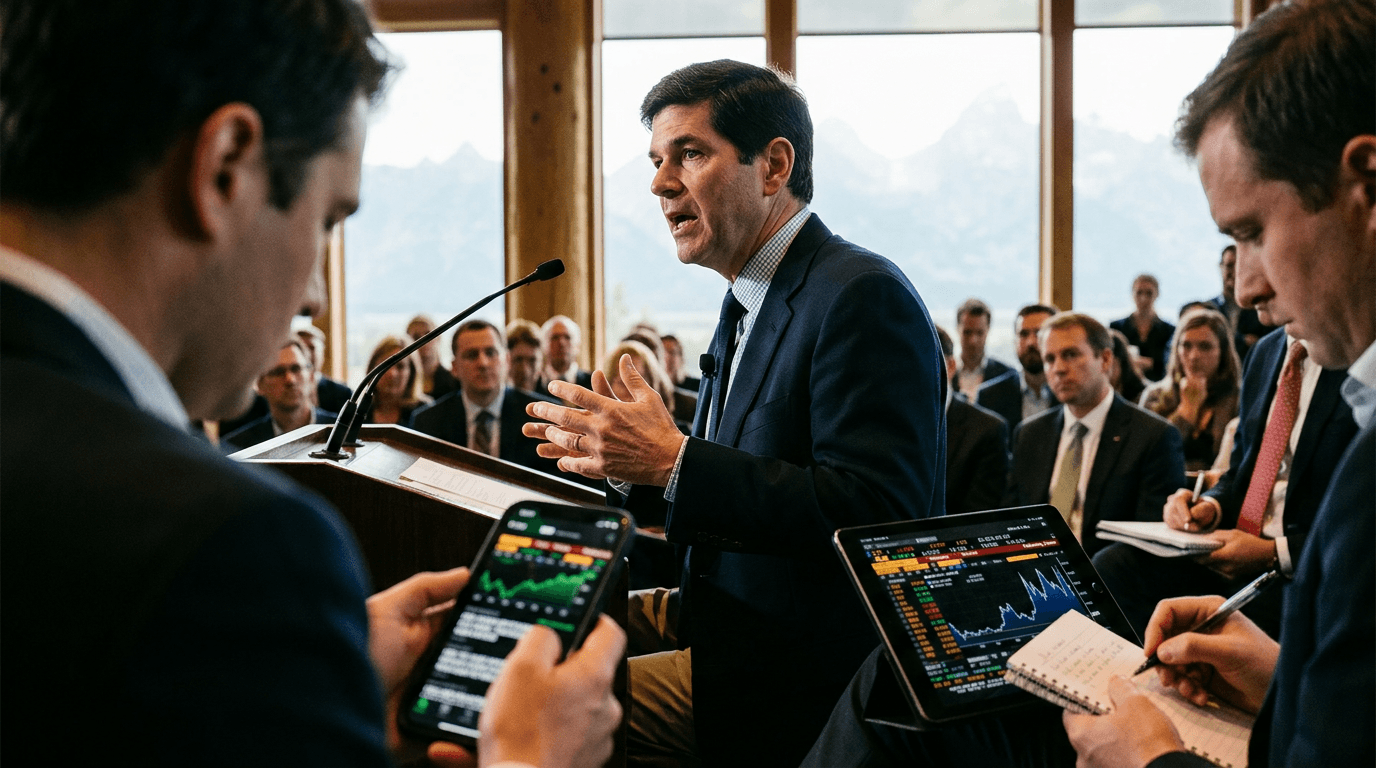
When a single speech can move an entire curve of interest rates, traders need to pay attention—not just in bonds, but across equity index futures, FX, and even crypto. Federal Reserve Chairman Kevin Warsh’s Jackson Hole remarks signaled that the Fed “may not be done” fighting inflation, and markets wasted no time repricing the path of U.S. policy rates.[1][5][7][8] Short-term Treasury yields jumped by more than 10 basis points, with the policy‑sensitive 2‑year note climbing toward the mid‑4% area in its largest single‑day Jackson Hole move in decades.[1][2][5][6][8] At the same time, futures markets sharply increased the implied probability of a near‑term rate hike, turning the event into a futures‑market story as much as a rates story.[1][2][9][15]
Jackson Hole Rhetoric And The Rates Curve
Warsh’s message in Jackson Hole was clear: recent inflation readings have improved at the margin, but not enough to convince the Fed that underlying trends have meaningfully cooled.[5][11] He emphasized that the central bank still has “work to do” to bring inflation back to target, a phrase markets read as hawkish relative to the prior, more cautious tone.[5][6][7][8] That change in rhetoric helped trigger a classic “bear flattening” of the Treasury curve—short‑dated yields rose sharply, while longer‑dated yields moved up more modestly.[2][4][6][7]
Policy‑sensitive maturities led the move. The 2‑year Treasury yield jumped around 11–12 basis points to roughly 4.34–4.36%, marking one of its biggest single‑day rises this year and the strongest post‑Jackson Hole reaction by that tenor since the mid‑1990s.[1][2][5][6][7] One‑year yields also pushed higher by more than 10 basis points, reinforcing the view that the market is bringing forward expectations for tighter policy.[5] Further out the curve, the 10‑year yield rose by around 5 basis points to the low‑4.7% range, while moves in the 30‑year were much smaller and even briefly reversed as investors grew more confident about long‑term inflation control.[2][4][6]
For traders, the shape of this move matters. A bear‑flattener tells you the market is repricing the near‑term stance of policy more aggressively than the long‑run equilibrium, a pattern typical when central bank rhetoric shifts hawkish but longer‑run inflation expectations remain anchored.[4][6][7] In practice, that creates opportunities and risks in trades that straddle maturities—such as spread trades between 2‑year and 10‑year futures—or strategies that rely on curve shape, not just outright yield levels.
Futures Markets Reprice The Fed Path
The more nuanced story is in rate‑futures pricing, where Jackson Hole became a catalyst for a rapid reassessment of the Fed’s next moves. Fed funds and Treasury futures now imply that the odds of a rate hike at the next FOMC meeting have jumped from roughly one‑third to well above one‑half, with several market gauges showing probabilities in the 56–60% range after the speech versus roughly 35–40% before.[1][2][9][15] Traders have also lifted the perceived likelihood of an additional move later in the year, with December hike odds pushing toward 80% on some futures‑based measures.[15]
This repricing illustrates how central‑bank communication functions as a live input into futures valuations. During Jackson Hole in 2025, when Jerome Powell’s tone pointed toward eventual rate cuts, futures markets quickly ramped up the implied probability of a quarter‑point cut to around 80–90%, while intermediate Treasury yields fell.[10][13] In 2026, by contrast, Warsh’s more forceful language on inflation has pushed probabilities in the opposite direction, lifting the entire expected policy path, at least over the next few meetings.[1][2][8][9]
For SimFi traders, this is a textbook example of how expectations—not actual decisions—drive P&L in rate futures. Implied probabilities embedded in options and Fed funds futures move continuously as rhetoric shifts, and the largest percentage changes often happen around key speeches, not just formal policy announcements.[1][2][9] Building scenarios around different rhetorical outcomes (dovish, balanced, hawkish) and stress‑testing portfolios against jumps in implied hike probabilities can turn a potentially destabilizing event into a calculated trading opportunity.
Cross-asset Ripple Effect: Equities, Fx, And Crypto
While the rates market reacted immediately, risk assets showed a more mixed, but still meaningful, response. Equity indexes and futures were choppy around the speech: in some reports, stocks initially dipped as yields rose, while later sessions saw major indexes hold steady or even edge higher as investors digested the message.[1][3][12] Index futures were similarly caught between stronger discount‑rate headwinds and a narrative that the Fed is serious about containing inflation, which can be supportive for cyclicals over the medium term.[1][3][12][14]
Higher near‑term rate expectations typically support the U.S. dollar and weigh on assets priced on long‑duration growth and liquidity, including high‑multiple tech stocks and speculative crypto tokens. Even when FX and crypto do not move immediately tick‑for‑tick with the rates market, changes in the discount rate filter through valuations via higher required returns and tighter financial conditions. For futures traders, that means you should treat Jackson Hole and similar events as cross‑asset risk days, not just bond market events.
On a SimFi platform, this is precisely the type of environment where cross‑market strategy testing adds value. Traders can simulate scenarios in which the 2‑year yield spikes another 10–20 basis points, then map the implied moves in equity index futures, major FX pairs, and crypto index products under different volatility and correlation assumptions. That gives a more holistic view of how a single rhetorical pivot can reshape risk‑reward across an entire multi‑asset portfolio.
Practical Takeaways For Simulated Futures Traders
First, treat central‑bank speeches like Jackson Hole as scheduled volatility events. Build “rhetoric ladders” in your scenarios: one path where the chair signals patience, one where they lean hawkish, and one where they surprise either way. Assign plausible probability shifts for rate hikes in each case, using recent moves (for example, hikes odds jumping from around 35–40% to near 60%) as a benchmark for what is realistic.[1][2][9][15]
Second, focus on curve trades, not just directional bets. The latest reaction was a bear‑flattener, with front‑end yields up sharply and longer maturities less affected, which favored positions that were long steepeners going into the event and punished those that were positioned for near‑term cuts.[2][4][6][7] In simulation, test how your strategies perform under both bear‑flattening and bull‑steepening scenarios, referencing historical Jackson Hole episodes as templates.[4][6][10][13]
Third, build cross‑asset stress scenarios around discount‑rate shocks. Estimate how a 10–15 basis point jump in short‑term yields would affect your equity, FX, and crypto exposures, then translate that into futures P&L ranges using historical beta relationships. Use the mixed but notable reactions in index futures and spot equities as a reminder that price action can be directionally consistent with rates but uneven in magnitude across sectors.[1][3][12][14]
Finally, emphasize risk management over short‑term prediction. Jackson Hole showed that rhetoric can push probabilities and yields sharply, but the market still retains a “healthy dose of skepticism” about how far and fast the Fed will actually move.[8][9][12] In simulation, this uncertainty is an advantage: you can explore multiple policy paths without capital at risk, refine your playbook for live trading, and define clear rules for scaling exposure around high‑impact communication events.
Conclusion: Turning Rhetoric Into Readiness
Jackson Hole 2026 reinforced a critical lesson for modern traders: in a world where central‑bank communication is instantaneously reflected in futures markets, preparedness matters more than prediction. Warsh’s hawkish tone lifted short‑term yields, flattened the curve, and pushed hike odds higher, rippling through rate futures and influencing equity, FX, and crypto valuations via higher discount‑rate expectations.[1][2][4][5][6][7][8][9][12][15] For both discretionary and systematic traders, the goal is not to guess every word of the next speech, but to build robust, scenario‑tested strategies that can absorb and exploit rapid repricing. SimFi platforms provide the ideal environment to practice that discipline—turning central‑bank rhetoric from a source of anxiety into a catalyst for informed, opportunity‑driven trading.