
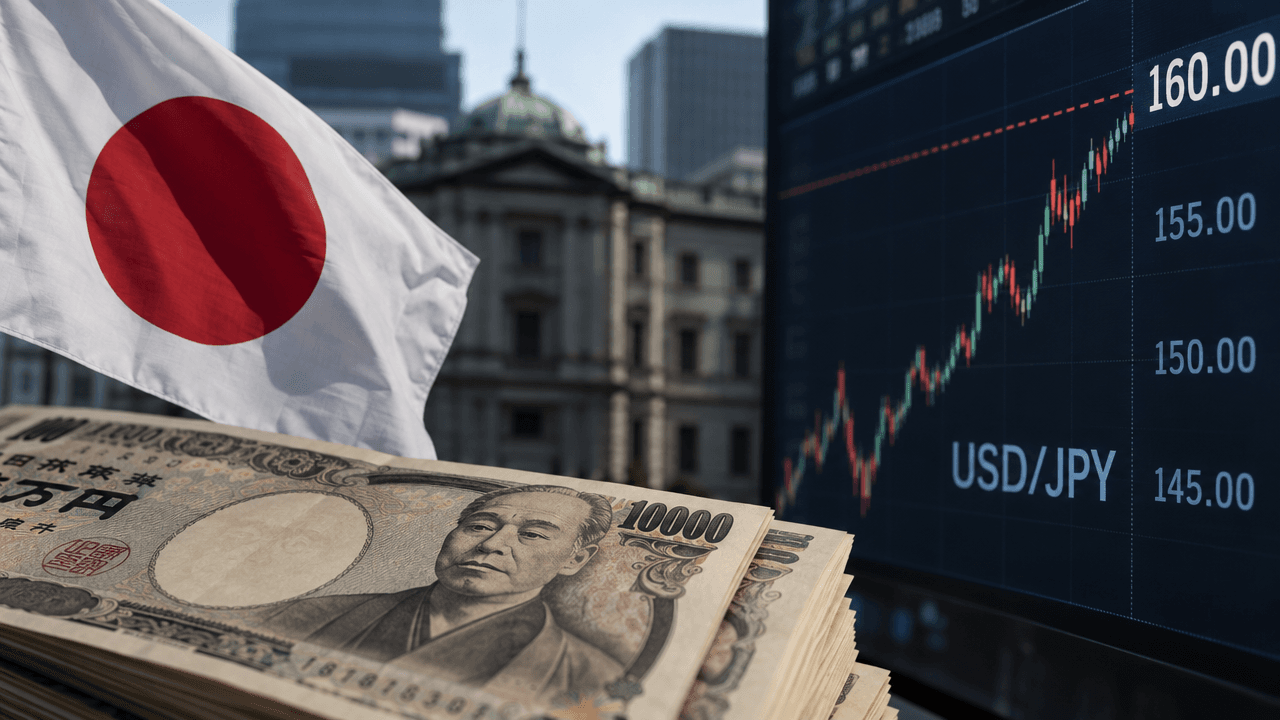
The yen’s slide toward 160 per dollar has put Japan’s currency policy back at the center of global markets. USD/JPY briefly moved above the psychologically important 160 level, prompting Japanese officials to intensify warnings about rapid, one-sided foreign-exchange movements. Finance Minister Satsuki Katayama said authorities would respond appropriately to excessive volatility and continue working closely with the U.S. Treasury. [5]
The message is clear: Japan may tolerate gradual currency adjustment, but an abrupt decline in the yen could trigger a stronger policy response. For traders, the approach toward 160 is no longer simply a technical event. It is also a test of official credibility, market positioning, and intervention risk.
Why 160 Matters To The Market
USD/JPY measures how many yen are needed to purchase one U.S. dollar. When the pair rises, the dollar strengthens against the yen and Japan’s currency weakens.
The 160 area has become important because it is associated with previous episodes of official concern and yen-buying intervention. Japan’s top currency diplomat, Atsushi Mimura, recently warned that it was “too early to forget” the intervention conducted during the summer, while describing recent moves as excessively rapid. [4]
That history changes the market’s behavior around the level. A trader buying USD/JPY near 160 is not only betting on continued dollar strength. They are also accepting the possibility that Japanese authorities could act suddenly, causing the pair to fall sharply.
This does not mean 160 is an automatic intervention trigger. Officials generally emphasize the speed and disorderliness of moves rather than defending a specific exchange-rate number. Nevertheless, the level has become a widely watched zone where risk management becomes particularly important.
What Japan Is Warning About
Japanese officials have focused on the character of the move rather than simply the yen’s absolute value. Katayama described recent foreign-exchange activity as “one-sided and rapid,” language that signals concern about speculative momentum and disorderly market conditions. [1]
That distinction matters. Exchange rates move for many legitimate reasons, including interest-rate expectations, economic growth, trade flows, and changes in investor risk appetite. Governments do not typically intervene merely because a currency reaches a particular price.
However, a fast move driven by concentrated speculation can create broader problems. A weaker yen raises the cost of imported energy, food, and raw materials. It can also increase inflation pressure for Japanese households and businesses. At the same time, exporters may benefit from a weaker currency, creating a complicated policy trade-off for Tokyo.
The warnings therefore serve two purposes. They communicate concern to the market, and they give officials an opportunity to slow speculative positioning before actual intervention becomes necessary.
WHY U.S. COORDINATION IS IMPORTANT
Japan’s finance minister said Tokyo would remain in close contact with the U.S. Treasury. Reports also indicated that U.S. and Japanese officials had aligned on the broader principle of addressing disorderly currency movements. [7]
This is significant because unilateral intervention is more difficult when the other major currency issuer does not support the policy. The United States has historically been sensitive to language that appears to target exchange rates for trade advantage. A shared focus on excessive volatility and one-sided moves creates more political space for cooperation.
Coordination does not guarantee that Washington would participate in yen-buying intervention. It does, however, make official warnings more credible and increases the potential market impact of future statements, diplomatic discussions, or coordinated action.
For traders, the key implication is that intervention risk can rise even without a formal policy announcement. Verbal intervention alone may be enough to encourage profit-taking among long-dollar positions and discourage fresh purchases near extreme levels.
HOW TRADERS CAN APPROACH USD/JPY
The first priority is to distinguish trend analysis from event risk. The broader USD/JPY trend may still be supported by differences between U.S. and Japanese interest rates, expectations for central-bank policy, and demand for dollar assets. But a strong trend does not eliminate the possibility of a rapid countertrend move.
Position sizing is especially important near intervention-sensitive levels. Traders who would normally use a standard position may need to reduce exposure when a sudden policy response could produce a large move within minutes.
Stop-loss placement also requires care. A stop that is too tight may be triggered by ordinary volatility, while a stop that is too wide can create unacceptable losses during an intervention event. Traders should define the maximum acceptable risk before entering rather than reacting after the market begins to move.
It is also useful to monitor price action after official comments. If USD/JPY continues rising despite repeated warnings, markets may be testing Tokyo’s willingness to act. If the pair retreats quickly, the warnings may already be influencing positioning.
Simulated Finance traders can use this event to practice scenario planning without risking live capital. One scenario might involve a gradual move above 160 with no intervention. Another could model a sudden yen rally after an official announcement. A third could examine a temporary pullback followed by renewed dollar strength. Comparing these outcomes helps traders understand whether their strategy depends on uninterrupted momentum.
The Bigger Market Lesson
Japan’s warnings demonstrate why macroeconomic trading cannot rely on charts alone. A technical breakout may look convincing, but policy communication can change the risk profile of a trade instantly.
The most important takeaway is not that USD/JPY must reverse at 160. It is that the probability of abrupt volatility increases as the pair approaches a level associated with previous official action. Japan’s government has signaled that it is watching the pace and direction of the yen’s decline, while keeping communication channels open with the United States.
For traders, discipline matters more than prediction. Track the level, monitor official language, respect the possibility of intervention, and avoid allowing a single directional view to become an oversized risk. In a market where policy headlines can move currencies as quickly as economic data, preparation is often the most valuable edge.