
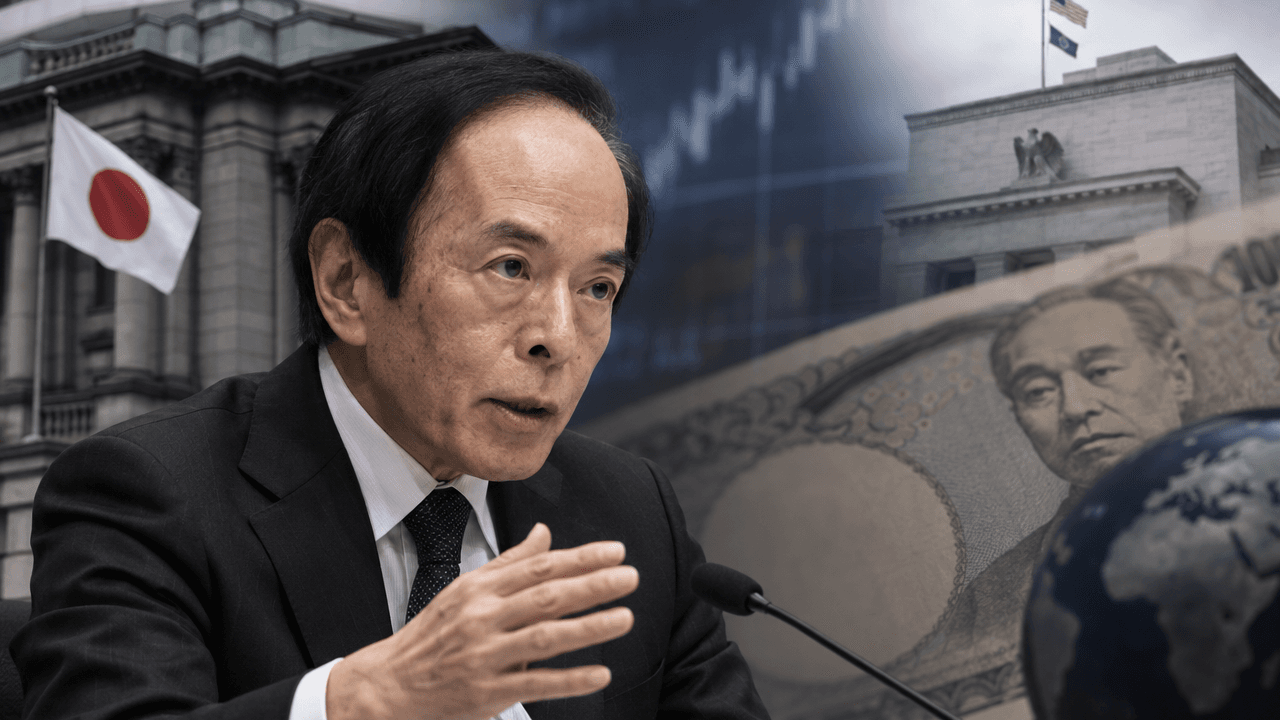
The Japanese yen is entering a new phase as markets increasingly anticipate that the Bank of Japan will continue raising interest rates. Governor Kazuo Ueda has reiterated that the central bank remains prepared to adjust monetary policy as economic activity, prices and financial conditions evolve. His comments have strengthened expectations for a possible rate increase at the BOJ’s December 17–18 meeting, giving the yen a more policy-sensitive outlook. [4]
WHY THE BOJ’S MESSAGE MATTERS
For years, the yen was associated with ultra-low interest rates and a persistent carry-trade strategy. Investors borrowed yen cheaply and shifted funds into higher-yielding currencies and assets elsewhere. That dynamic weakened the yen, particularly when interest-rate differentials between Japan and the United States widened.
The policy environment is now changing. Ueda has said that financial conditions remain accommodative despite earlier rate increases, suggesting that the BOJ does not view current policy as restrictive. He also indicated that the central bank intends to continue raising its policy rate when economic and inflation conditions justify further action. [2]
That language is important because it signals that the BOJ’s tightening cycle may not be limited to a single adjustment. Markets are no longer focused only on whether the central bank will hike. They are also considering how quickly rates could rise and where the eventual policy rate might settle.
Investors should distinguish between an immediate rate decision and the broader policy direction. Even if the BOJ delays a December move, continued guidance toward normalization could still support the yen over time.
December Rate Hike Expectations Rise
Market expectations have shifted noticeably toward another increase before the end of the year. A Reuters survey found that 61 of 71 economists, or 86%, expected the BOJ to raise its overnight call rate by 25 basis points to 1.50% at the December meeting. Nearly 60% also anticipated another increase to 1.75% by the end of March. [12]
A move to 1.50% would represent the BOJ’s third rate increase of the year, a meaningful development for a country that spent decades operating with exceptionally low or negative rates. It would also reinforce the view that Japanese policymakers are becoming more comfortable with gradual monetary normalization.
The case for tightening rests partly on inflation. Ueda has warned that weakness in the yen can raise the cost of a wide range of imported goods, increasing the risk that inflation could overshoot the BOJ’s 2% target. At the same time, he has described consumption as resilient and underlying inflation as broadly aligned with the central bank’s objective. [2][11]
This combination gives policymakers room to act. If inflation is persistent and domestic demand remains sufficiently strong, delaying rate increases could allow price pressures to become more deeply embedded.
What Further Tightening Means For The Yen
Additional BOJ tightening could support the yen through several channels. Higher Japanese interest rates would improve the relative return available from yen-denominated assets. If Japanese government bond yields rise while overseas yields stabilize or fall, the incentive to finance investments with borrowed yen may weaken.
A less attractive carry trade can lead investors to buy back yen, particularly when risk appetite deteriorates. During periods of market stress, traders often reduce leveraged positions, which can amplify yen gains.
The yen may also benefit from changing expectations. Foreign-exchange markets respond not only to actual rate decisions but also to projected policy paths. If traders begin to believe that the BOJ will continue raising rates in 2027, the currency could strengthen before those increases occur.
However, the outlook is not one-directional. The yen remains near historically weak levels against the dollar, and the interest-rate gap with the United States continues to matter. Recent market commentary has noted that Federal Reserve policy can offset the impact of BOJ tightening, especially if U.S. rates remain elevated or rise further. [3]
For this reason, a December BOJ hike could produce only a modest yen rally if the Federal Reserve maintains a strongly hawkish stance.
Risks To The Bullish Yen View
The biggest risk to the yen outlook is that expectations may already reflect much of the anticipated BOJ tightening. When a policy move becomes widely expected, the currency can react more strongly to the central bank’s guidance than to the rate decision itself. A hike accompanied by cautious language could trigger profit-taking rather than a sustained rally.
Economic weakness is another risk. Japan’s policymakers must balance inflation control against household purchasing power, corporate investment and consumer demand. If rate increases begin to slow activity sharply, the BOJ could adopt a more gradual approach.
Global markets also remain crucial. Strong U.S. economic data, higher Treasury yields or renewed demand for risk assets could keep investors selling yen despite Japan’s tighter policy. In addition, Japanese authorities have shown concern about excessive currency weakness, creating the possibility of official intervention or stronger verbal warnings.
For traders, the key indicators to monitor include BOJ communication, Japan’s wage growth, services inflation, household spending, U.S.-Japan bond-yield differentials and USD/JPY price action around major policy events.
Practical Takeaways For Traders
The yen’s policy outlook has become more constructive, but traders should avoid treating a December hike as a guaranteed one-way bullish signal. Position sizing and timing matter because currency markets can reverse quickly when expectations are crowded.
A more disciplined approach is to track whether the BOJ confirms three developments: inflation remains near or above target, consumption holds up, and financial conditions remain sufficiently loose. Evidence supporting all three would strengthen the case for additional hikes.
Traders should also watch the market’s reaction to the BOJ rather than relying solely on the headline decision. A stronger yen response would indicate that investors see a credible tightening cycle. A muted or negative response could suggest that U.S. rate expectations and existing positioning remain more powerful forces.
Conclusion
The yen’s outlook is shifting because the BOJ is increasingly presenting further tightening as a normal part of policy management rather than an exceptional move. Governor Ueda’s readiness to continue raising rates, combined with persistent inflation concerns and a weak currency, has placed a potential December hike firmly at the center of market expectations. [8]
The most likely path is gradual yen support, not an automatic surge. Japan’s policy normalization is significant, but its impact will depend on inflation, domestic growth, Federal Reserve decisions and global risk appetite. For investors and traders, the central question is no longer whether the BOJ has abandoned ultra-loose policy. It is how far and how quickly the central bank is prepared to go.