
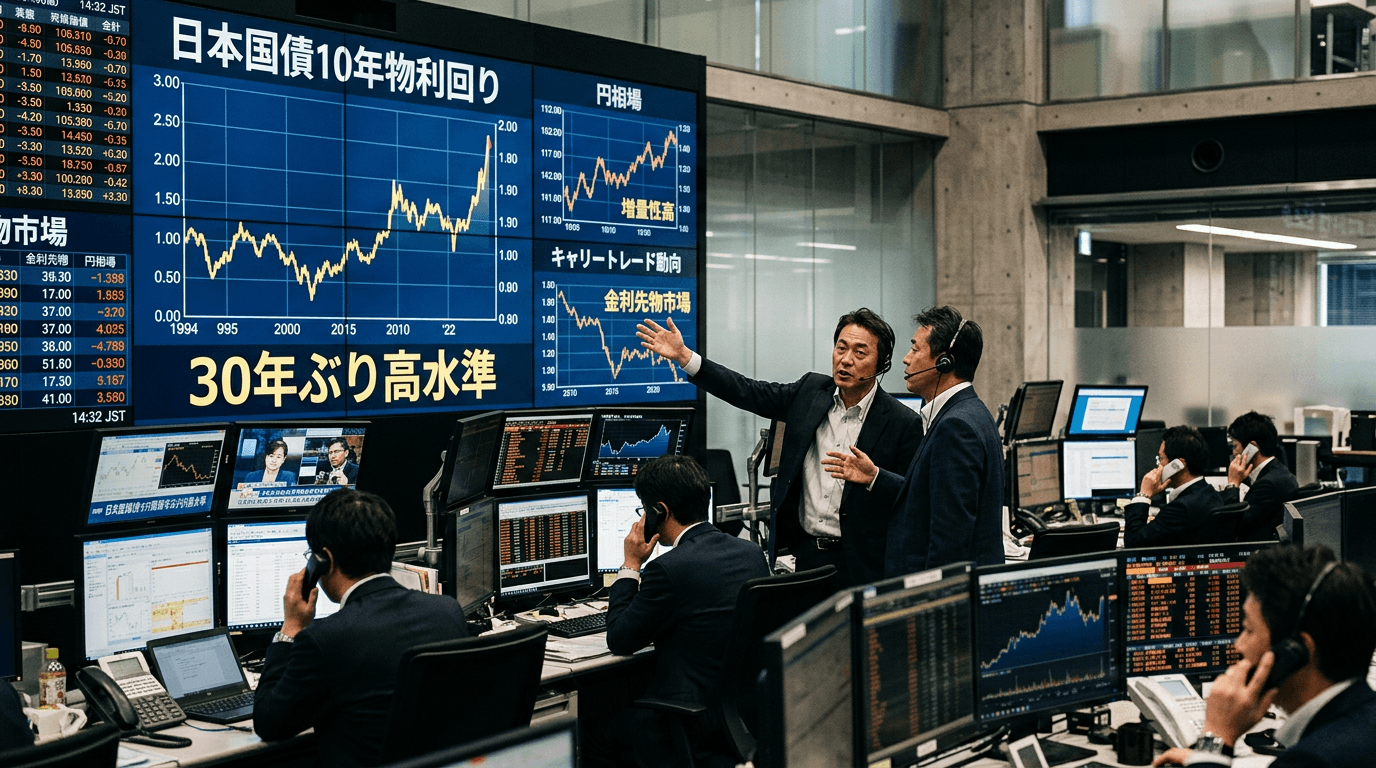
A 30‑year high in Japan’s benchmark 10‑year government bond yield is not just a local rates story – it is a regime shift that touches the yen, global carry trades, and rates futures pricing from Tokyo to New York. As yields break out of the range that defined Japan’s “low‑rate era,” traders now have to re‑think assumptions that have been baked into macro strategies for decades.[1][8]
JGB YIELDS BREAK A 30‑YEAR BARRIER
Japan’s benchmark 10‑year Japanese Government Bond (JGB) yield has climbed to around 2.88–2.90%, its highest level since September 1996.[1][7][8][10] This marks a decisive break from the sub‑1% yields that prevailed for much of the post‑2000 period and signals that Japan is firmly exiting the ultra‑low‑rate environment it was famous for.[4][8]
Yields move inversely to prices, so the move to multi‑decade highs reflects a sustained bout of selling in Japanese government debt.[1][7][9] The pressure is not confined to the 10‑year point of the curve: two‑year JGB yields, which are highly sensitive to Bank of Japan (BOJ) policy rates, have risen to about 1.44%, while five‑year yields have approached 2.0%.[1][3][7] Longer‑dated maturities have also repriced sharply, with 20‑year and 30‑year yields trading in the 3.5–4.0% region, levels that have lured foreign investors back into segments of the curve they largely ignored for years.[5][8][12]
For traders, the key takeaway is simple: Japan’s rates market is “back in play.” A market that was once effectively pinned by yield‑curve‑control and negative policy rates now offers meaningful yield, duration risk, and directional opportunities.[8]
WHAT’S DRIVING THE SURGE IN JAPANESE RATES?
Several overlapping forces are pushing JGB yields higher, and understanding them is critical for interpreting what comes next.
First, higher energy prices have rekindled inflation concerns in an import‑dependent economy.[1][2][7] Renewed oil price gains and fears of an energy‑driven inflation shock have strengthened expectations that the BOJ will need to keep normalizing policy rather than returning to negative rates or aggressive yield‑curve control.[2]
Second, Japan’s fiscal trajectory has become a key focus. Recent government policy blueprints have outlined large spending plans, raising questions about long‑term debt sustainability and putting additional upward pressure on yields.[1][7][9] Some analysts describe a “perfect storm” of fiscal worries and inflation uncertainty that has rattled bond investors and savers alike.[9]
Third, the domestic rate environment itself has changed. Japan’s base rate has risen above 1% for the first time since the mid‑1990s, reinforcing the perception that the BOJ is moving steadily away from its emergency‑level settings.[3] As short‑ and mid‑term yields move up, the entire curve is re‑pricing to reflect a more normal interest‑rate regime.
The practical takeaway for traders is that the move in JGBs is not a one‑off headline; it is rooted in structural shifts in inflation, fiscal policy, and central bank strategy. That makes it more durable – and more relevant – than a typical data‑driven spike.[1][2][8][9]
Impact On Yen Crosses And Carry Trades
The yen has long been the funding currency of choice for global carry trades, thanks to near‑zero rates and abundant liquidity. As Japanese yields rise, that calculus becomes more complicated.
Despite the climb in JGB yields, the yen has traded near multi‑decade lows against major currencies at various points, reflecting a mix of BOJ caution, global risk appetite, and the still‑wide rate differentials versus the US and Europe.[3][6] However, as Japan’s base rate and government bond yields move higher, the cost of funding in yen increases, compressing the carry available to investors borrowing in yen to buy higher‑yielding assets offshore.[2][3][5][8]
Yen crosses – such as USD/JPY, EUR/JPY, and AUD/JPY – have therefore become more sensitive to shifts in JGB yields and BOJ policy expectations. A sharper‑than‑expected rise in Japanese yields can trigger unwinds of leveraged carry positions, adding volatility to FX markets and creating feedback loops between rates and currencies.[2][6][8]
For traders, the key implications are:
- Funding in yen is no longer guaranteed to be “almost free.”
- Yen crosses will increasingly trade as a function of relative rate expectations, not just global risk sentiment.
- Carry strategies that ignore BOJ normalization risk are exposed to sudden drawdowns when yields spike.
In a SimFi environment, this makes yen‑based carry trades an ideal testing ground: participants can stress‑test strategies under different BOJ paths, JGB yield levels, and volatility regimes without capital at risk.
Ripple Effects In Rates Futures Markets
The move in the 10‑year JGB yield is also reshaping expectations embedded in rates futures tied to Japanese debt and global benchmarks. As investors price in higher long‑term Japanese yields and the possibility of further BOJ tightening, futures curves that reference JGBs adjust to reflect the new rate path.[1][2][4][8]
This repricing is not confined to Japan. Because Japanese investors are major holders of foreign bonds, shifts in domestic yields can influence demand for overseas government debt and, by extension, global rates futures. Higher JGB yields can reduce the incentive for Japanese institutions to buy US Treasuries or European sovereign bonds, altering cross‑border capital flows and marginal demand for those markets.[2][4][8][9]
From a trading perspective, that means:
- JGB futures are increasingly directional, with more volume and hedging activity around BOJ meetings and inflation data.
- Correlations between Japanese rates futures and major global contracts (such as US Treasury futures) can strengthen during periods of rapid repricing.
- Macro strategies that combine FX, rates futures, and credit spreads need to incorporate Japanese yield dynamics as a key driver rather than a background variable.
For SimFi users, this environment is an opportunity to build and test multi‑asset strategies that link yen crosses with JGB futures and global rates contracts under different yield scenarios.
How Traders Can Position In A New Japanese Rate Regime
With the 10‑year JGB yield at a 30‑year high, traders face a different Japan than the one they learned about over the past two decades. The question is how to translate this shift into practical positioning and risk management.
Several concrete approaches stand out
- Re‑evaluate yen funding: Revisit assumptions about the cost and stability of yen‑based leverage, particularly for carry and relative‑value strategies.
- Watch the curve, not just the headline: Moves in two‑year and five‑year JGBs can provide early signals about BOJ policy shifts that will later ripple into 10‑year and longer maturities.[1][3][7]
- Integrate BOJ scenarios: Build scenarios around different BOJ paths – from gradual normalization to more aggressive tightening – and map their impact on yen crosses, JGB futures, and global rates.
- Use simulation to explore regime changes: In a SimFi setting, traders can run historical and forward‑looking tests, overlaying the current yield shock onto past episodes of volatility to understand how strategies might behave in a world where Japanese rates are no longer anchored near zero.
Ultimately, the rise in Japan’s 10‑year yield is a reminder that even the most stable‑seeming macro assumptions can change. For years, “Japan = zero rates” was treated as a constant. Now, the country’s bond market is reasserting itself as a dynamic force that can move currencies, futures curves, and global capital flows.[1][2][8][9]
For traders and investors, the opportunity lies in engaging with this new regime early – building tools, strategies, and risk frameworks that treat Japanese yields as a live variable rather than a footnote. In a simulated environment, that preparation can be done safely; in live markets, it can be the difference between riding the regime shift and being run over by it.