
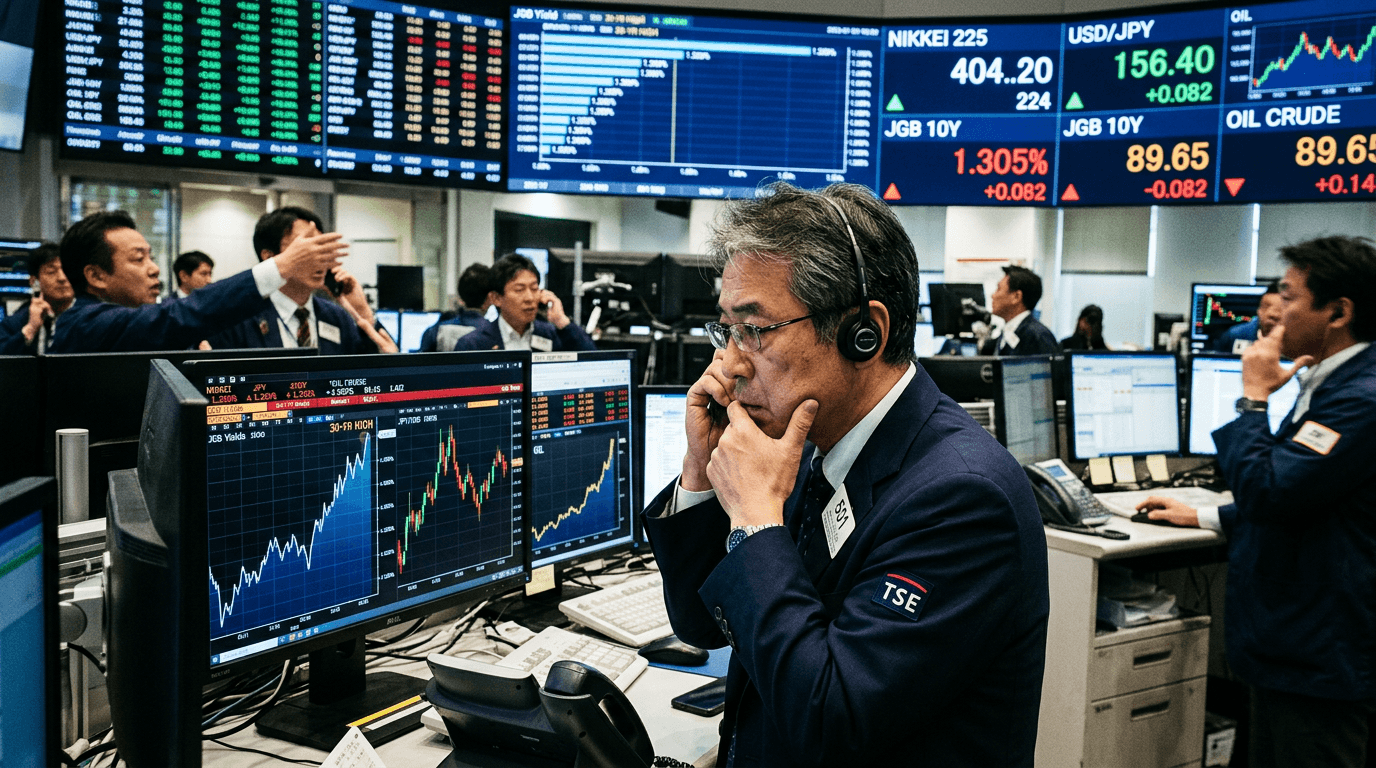
Japan’s benchmark 10‑year government bond yield has surged to its highest level in roughly three decades, a move that marks a dramatic break from Japan’s long era of near‑zero interest rates and is rippling across currencies, global bond markets, and carry‑trade strategies. For traders and investors, this is not just a local fixed‑income story; it is a structural shift in one of the world’s key funding markets.
WHY JAPAN’S 10‑YEAR YIELD MATTERS
For years, Japan’s government bond (JGB) market has been synonymous with ultra‑low yields, supported by aggressive Bank of Japan (BoJ) purchases and yield‑curve control. That regime is now fading. Earlier in 2026, the benchmark 10‑year JGB briefly touched around 2.125%, its highest level since 1999.[1][4] Some market observers now note that the 10‑year yield is around levels last seen in the late 1990s, effectively a 30‑year high.[1][7]
This move is not occurring in isolation. Yields across the Japanese curve have been repricing higher, with the 30‑year JGB yield climbing as far as 3.455%, a record high that underscores how investors expect further rate normalization from the BoJ.[4] The rise in long‑term yields reflects a shift from a heavily managed market to one where prices are more determined by private demand and perceptions of inflation and fiscal risk.[1]
Because Japanese capital is deeply integrated into global markets, a higher 10‑year JGB yield matters well beyond Tokyo. For decades, Japanese institutions have been major buyers of foreign bonds, seeking higher yields abroad while funding cheaply at home. As domestic yields push to multi‑decade highs, those cross‑border flows can slow or reverse, impacting everything from U.S. Treasuries and European sovereigns to emerging‑market debt.
Drivers: Oil, Inflation, And Boj Policy
At the core of this yield surge is a regime change in Japan’s inflation dynamics. After decades of battling deflation, Japan has now seen inflation holding above the BoJ’s 2% target for a prolonged period.[1] As a result, investors are demanding higher nominal yields to compensate for eroding real purchasing power, and the BoJ is steadily reducing its support.
According to recent analyses, the BoJ has been tightening its stance by scaling back regular bond purchases and allowing yields to move more freely, signaling a gradual exit from ultra‑loose policy.[1] The reduction in official demand for JGBs forces the market to find a new equilibrium, typically at higher yields when inflation is persistent.
Recent moves have likely been amplified by rising oil prices, which push up Japan’s import bill and feed into broader price pressures in an energy‑dependent economy. This link between oil and inflation is a logical inference: higher energy costs tend to raise input prices for firms and utilities, which can then pass those costs on to consumers, reinforcing inflation expectations. For bond investors, oil‑driven inflation fears make the current yield level more than a short‑term spike; it becomes a statement about the future path of real rates.
Fiscal concerns are also part of the backdrop. Japan’s public debt is very large relative to GDP, and higher yields increase the cost of servicing that debt. While the BoJ has historically cushioned this burden through massive bond holdings, reduced purchases and higher market yields raise questions about long‑term fiscal sustainability. Those worries can cause investors to demand an additional risk premium, nudging yields higher still.
Impact On The Yen, Global Rates, And Carry Trades
A 10‑year JGB at multi‑decade highs is directly relevant to currency traders. Historically, low Japanese yields made the yen a prime funding currency for carry trades: investors would borrow yen cheaply, convert it into higher‑yielding currencies, and pocket the spread. As Japanese yields rise and the cost of funding in yen increases, the attractiveness of such strategies diminishes.
Higher domestic yields tend to support the yen over time, as Japanese bonds become more appealing relative to foreign alternatives. If Japanese institutions repatriate capital from overseas bonds into JGBs, that can create upward pressure on the yen and downward pressure on foreign bond prices. For FX and global rates traders, the correlation between JGB yields, the USD/JPY exchange rate, and U.S. Treasury yields becomes more important to monitor.
Global rate expectations can also shift. When a major low‑yield market like Japan re‑prices higher, it challenges the assumption that “risk‑free” rates in advanced economies will stay permanently low. In multi‑asset portfolios, higher JGB yields can prompt re‑allocation decisions, hedging activity, and volatility in related markets such as interest‑rate futures, swaps, and cross‑currency basis trades.
What It Means For Simulated Finance And Active Traders
For traders using simulated finance (SimFi) platforms, this JGB shock is an ideal real‑world stress scenario to model. The combination of rising long‑term yields, a shifting central‑bank regime, and oil‑driven inflation fears creates a complex environment touching FX, bonds, equity indices, and even alternative assets.
In a simulated setting, traders can:
Test how a continued rise in Japan’s 10‑year yield affects yen crosses, particularly popular pairs such as USD/JPY and EUR/JPY.
Explore the impact on global bond futures, including how a shift in Japanese demand might influence U.S. and European yields.
Study correlations between Japanese yields and risk assets—equities, high‑yield credit, and even crypto—during periods of rate volatility.
Experiment with carry‑trade unwinds and re‑entries, using historical data around previous yield spikes (such as the recent move toward 2.125% and beyond)[1][4] to calibrate risk and position sizing.
Because there is no capital at risk in SimFi, traders can safely explore extreme scenarios: What if oil prices spike further? What if the BoJ accelerates normalization or surprises with a policy pivot? How might that cascade through yen funding markets and global yield curves?
Practical Takeaways For Your Strategy
First, do not treat Japan as a permanent low‑yield outlier. With the 10‑year JGB around multi‑decade highs and the BoJ clearly reducing support, the structural backdrop has changed.[1][4] Portfolio assumptions built on near‑zero Japanese rates need to be revisited.
Second, incorporate inflation and oil dynamics into your macro view. In an import‑dependent economy, energy prices can quickly translate into headline and core inflation, reinforcing the case for higher yields. That makes monitoring commodity markets a key part of rate and FX trading.
Third, recognize that yen carry trades now carry different risks. As domestic yields rise, the risk/return profile of borrowing in yen to buy higher‑yielding assets is shifting. Traders should stress‑test strategies against scenarios where the yen strengthens and Japanese yields continue to climb.
Finally, use simulation to stay ahead of the curve. By building and testing scenarios around Japan’s bond market shift, you can better understand potential knock‑on effects in your preferred instruments, from FX and bond futures to equity indices. The current JGB environment is not just a headline; it is a live case study in how macro variables, central‑bank policy, and market sentiment interact.