
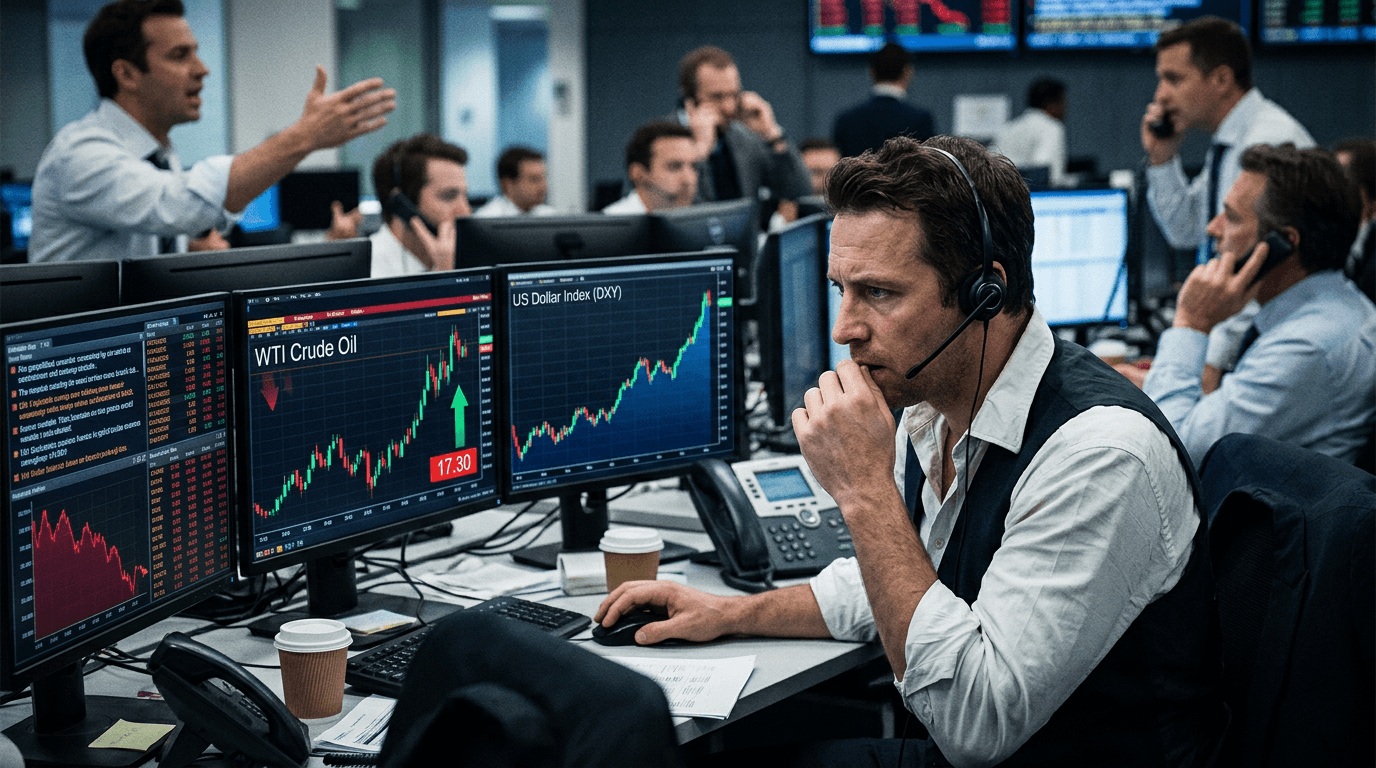
The assassination of Iran's Supreme Leader Ayatollah Khamenei on February 28, 2026, has reverberated across global financial markets, triggering a classic flight-to-safety response that has strengthened the US dollar while crude oil prices surged amid heightened geopolitical uncertainty. As traders reassess regional stability risks following the targeted Israeli-US airstrikes that killed the 86-year-old leader in Tehran, we're seeing the kind of market dislocations that typically accompany major geopolitical shocks—a combination that SimFi traders need to understand for positioning and risk management.
The Safe-haven Usd Rally
When geopolitical risk escalates dramatically, capital flows follow predictable patterns. The US dollar, as the world's reserve currency and perceived safest asset during periods of uncertainty, has benefited from this capital reallocation. In the days following Khamenei's killing, the dollar index climbed sharply as investors worldwide repositioned into dollar-denominated assets and reduced exposure to riskier emerging market currencies and commodities.
The mechanics are straightforward: during geopolitical crises, traders reduce leverage, exit speculative positions, and seek liquidity in the deepest, most stable markets. The dollar provides exactly that—unparalleled liquidity, backed by US Treasury markets and the Federal Reserve's proven capacity to maintain financial stability. This isn't speculation; it's a structural dynamic that has played out repeatedly across market cycles, from the 2011 Arab Spring to geopolitical tensions in the South China Sea.
Market analysts have estimated that for every 10% rise in crude oil prices driven by geopolitical risk, the USD strengthens approximately 0.5% to 1% as regional instability premium gets priced in. This relationship reflects both the oil market's dollar denomination and the broader risk-on versus risk-off shift in trader sentiment.
Oil Market Volatility And Supply Concerns
Oil prices responded sharply to Khamenei's assassination, with crude spiking higher as traders grappled with the possibility of broader regional conflict. Iran has historically used its energy resources as both an economic tool and a geopolitical weapon, and uncertainty about how the new Iranian leadership—Khamenei's son was named Supreme Leader on March 8—will navigate the current crisis created supply concerns.
The theoretical risk is significant: Iran sits atop massive proven oil reserves, and any disruption to Middle Eastern supply chains affects global energy prices. The Strait of Hormuz, through which roughly one-third of seaborne traded oil passes, remains a potential flashpoint. Traders, uncertain about the new leadership's intentions and facing a region engulfed in broader conflict, demanded a risk premium in crude prices.
Beyond the immediate oil market impact, this dynamic illustrates how energy markets transmit geopolitical risk into currency and broader asset price movements. The oil-dollar correlation strengthened considerably, with rising crude prices coinciding with dollar strength—a typical pattern when geopolitical events create both safe-haven demand and supply concerns simultaneously.
CURRENCY PAIR IMPLICATIONS: EUR/USD DOWNSIDE PRESSURE
The implications for major currency pairs have been immediate and observable. The EUR/USD pairing has faced downside pressure as the dollar rally from safe-haven flows outpaced any euro-supportive factors. Europe, geographically closer to Middle Eastern instability and historically more exposed to energy supply disruptions, faced its own capital outflows as investors rotated toward the US.
This creates a trading opportunity for SimFi participants: geopolitical shocks often produce directional clarity in major currency pairs for a period before markets normalize. When US dollar strength accelerates from flight-to-safety flows, currency pairs with weaker fundamentals or regional exposure vulnerabilities tend to underperform. EUR/USD, given the eurozone's energy import dependency and lower yields relative to US dollar-denominated assets, exemplifies this dynamic.
The Broader Market Lesson
What makes Khamenei's assassination particularly significant for traders is that it represents a true exogenous shock—an event with genuine capacity to reshape regional stability and global energy markets. It's not a data miss or policy nuance; it's a fundamental geopolitical restructuring with measurable economic consequences.
SimFi participants should recognize that these moments produce both risk and opportunity. The initial market dislocation created by fear and uncertainty often overshoots fundamentals, eventually mean-reverting as markets digest new information and repriced risk becomes embedded in asset prices. Understanding the mechanics—how safe-haven flows move currencies, how supply concerns move commodities, how these transmit through correlated markets—separates disciplined traders from those simply reacting to headlines.
The assassination demonstrates that traditional macroeconomic factors remain subordinate to genuine geopolitical risk events. Traders who can identify these inflection points and position accordingly often find themselves ahead of less attentive competition.
Taking Away The Lessons
The key takeaway: major geopolitical events create predictable market reactions in the near term, but opportunities for thoughtful traders emerge when initial panic gives way to data-driven positioning. Monitor how new Iranian leadership navigates regional relationships, watch for supply disruption signals, and track the dollar's strength relative to regional currencies for ongoing opportunity sets.
---