
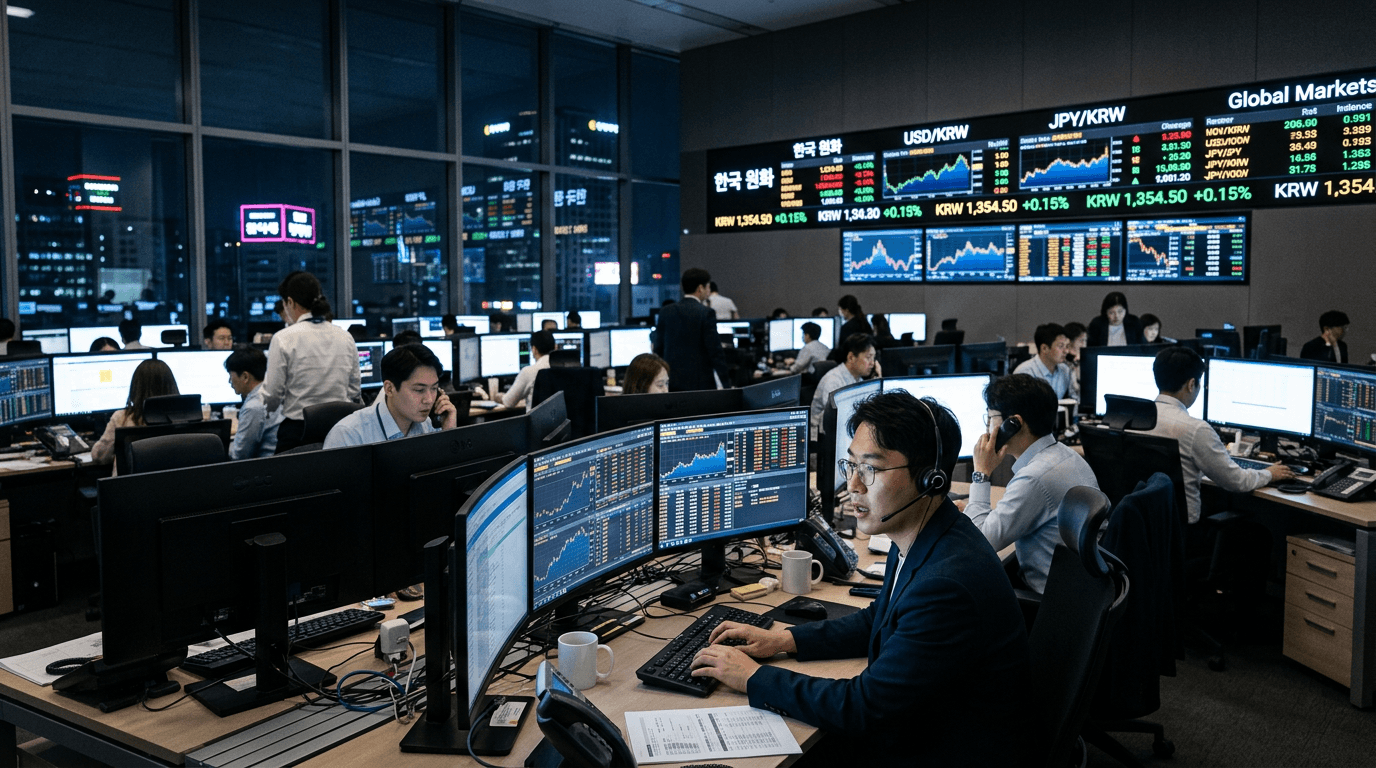
South Korea’s decision to launch 24‑hour trading in the won is more than a technical tweak to its FX market—it is a strategic move aimed at reshaping how global investors access Korean assets and at lifting the country into the ranks of developed markets. By allowing the onshore dollar‑won market to trade almost continuously through the week, authorities are signalling a willingness to open up, deepen liquidity and reduce friction for international capital flows.[1][4] For traders, investors and SimFi participants alike, this is a structural change worth paying attention to.
WHY 24‑HOUR WON TRADING MATTERS
Until now, access to the Korean won in the onshore market has been constrained by local business hours, forcing global investors to rely heavily on offshore derivatives and non‑deliverable forwards when trading outside the Asian day. The new regime extends onshore dollar‑won trading to 24 hours on weekdays, bringing it much closer in line with major global currencies such as the U.S. dollar, euro and yen.[1][4]
Under the reform, trading now runs from 6 a.m. on Monday to 6 a.m. on Saturday local time, and remains open even on public holidays except for weekends and New Year’s Day.[2][5] That means investors in Europe and North America can trade the onshore won during their own business hours without needing to wait for Seoul to open.
The immediate objective is to improve market accessibility and liquidity, making it easier to enter and exit positions and manage currency risk in Korean assets.[1][4] Over time, this should narrow the gap between onshore and offshore pricing, compress bid‑ask spreads and reduce the reliance on synthetic instruments when trading Korea exposure overnight.
How The New Fx Framework Works
The expanded trading window applies to the onshore dollar‑won market, historically one of the most controlled parts of Korea’s financial system.[1] Authorities have spent years gradually liberalizing FX rules, but the 24‑hour trading initiative ranks among their most significant reforms in decades.[1][4]
Operationally, the market now functions as a continuous weekday market, much like other major FX centres. The change allows overseas investors and financial institutions to transact directly in the onshore market, instead of routing flows through offshore hubs or waiting for domestic banks to open.[1][4] This closer alignment with global practice is especially important for asset managers benchmarking to international indices or running cross‑market strategies that depend on real‑time FX liquidity.
The debut session reportedly passed with below‑average volumes, reflecting a cautious start as participants tested systems and risk frameworks.[7] For policymakers, that is not necessarily a negative: the priority is a smooth transition, with stability and confidence in the new structure. Liquidity tends to build over time as more institutions adjust their operations and as market‑makers gain comfort with continuous pricing.
DEVELOPED‑MARKET AMBITIONS AND INDEX INCLUSION
This FX overhaul is part of a broader policy agenda: South Korea wants to be officially recognised as a developed market by major index providers such as MSCI, a change that could unlock substantial passive and active inflows.[4] Classification decisions often hinge on criteria like market accessibility, capital mobility, transparency and the ability to hedge and trade currencies efficiently.
By extending trading hours and improving access to onshore FX, Seoul is directly addressing long‑standing concerns from global investors about the difficulty of trading the won outside local hours.[1][4] Developed‑market status is not just about prestige. It can shift Korea’s weight in global equity and bond benchmarks, compelling index‑tracking funds to rebalance and potentially increasing international ownership of Korean assets.
From a macro perspective, deeper FX liquidity also supports financial stability. When investors can hedge positions and adjust exposures in real time, episodes of stress are less likely to cause sudden, disorderly moves driven by illiquidity. That matters in a region where currency volatility and capital flows can be sensitive to shifts in U.S. rates, Chinese growth and global risk sentiment, and where memories of the 1997 Asian financial crisis still loom large.[3][7]
Implications For Traders And Regional Currencies
For FX traders, both discretionary and systematic, the move opens new tactical and strategic opportunities. More continuous pricing in the won means:
- Greater ability to trade Korea‑related events in real time, including corporate earnings, policy announcements or geopolitical headlines that break outside the Asian session.
- Potential for tighter bid‑ask spreads and improved depth as more market‑makers participate in the extended hours.
- A richer data set for models and backtests, with more intraday price action and volume to analyse.
The change may also influence regional currency dynamics. As the won becomes easier to trade around the clock, it could play a larger role as a proxy for North Asian risk, alongside the yen and offshore yuan. Correlations with other Asia‑Pacific currencies may evolve as investors use KRW more actively for hedging and relative‑value strategies.
For equity and bond investors, more accessible FX hedging can lower the operational barriers to increasing Korean exposure. Global funds can implement hedged share classes, run currency‑neutral strategies or manage cross‑currency portfolios with greater precision, knowing that won liquidity will be available throughout most of the week.
Practical Takeaways For Live And Simulated Markets
Whether you trade live markets or use simulated finance platforms to develop and test strategies, South Korea’s 24‑hour won trading shift offers several practical lessons.
First, it highlights how market microstructure changes can fundamentally alter the trading landscape. A currency that previously behaved like an emerging‑market asset with limited access can, through regulatory reform, begin to trade more like a developed‑market FX pair. That has implications for volatility patterns, liquidity regimes and the effectiveness of different strategy types.
Second, traders should pay attention to how liquidity evolves by time of day. In the early stages, activity may be concentrated around traditional Asian hours, then gradually build in Europe and the U.S. as more participants engage. Monitoring spreads, depth and slippage across sessions can help refine execution algorithms and intraday risk limits.
Third, this is a reminder that regulatory and index‑related developments can be significant catalysts in their own right. Moves aimed at securing developed‑market status can lead to multi‑year flows and structural shifts in how a market trades, often creating opportunities for those who understand both the macro story and the micro details.
For SimFi users, incorporating the new KRW trading regime into simulations can provide a valuable sandbox: testing how strategies perform across an extended trading day, exploring cross‑asset relationships involving Korean equities and bonds, and examining how continuous FX access changes risk‑management behaviour.
As Korea’s FX reform beds in, the won’s journey toward deeper global integration is likely to be gradual rather than explosive. But structural changes rarely announce their full impact on day one. For investors and traders focused on Asia and on evolving market structures, this is a development worth tracking closely.