
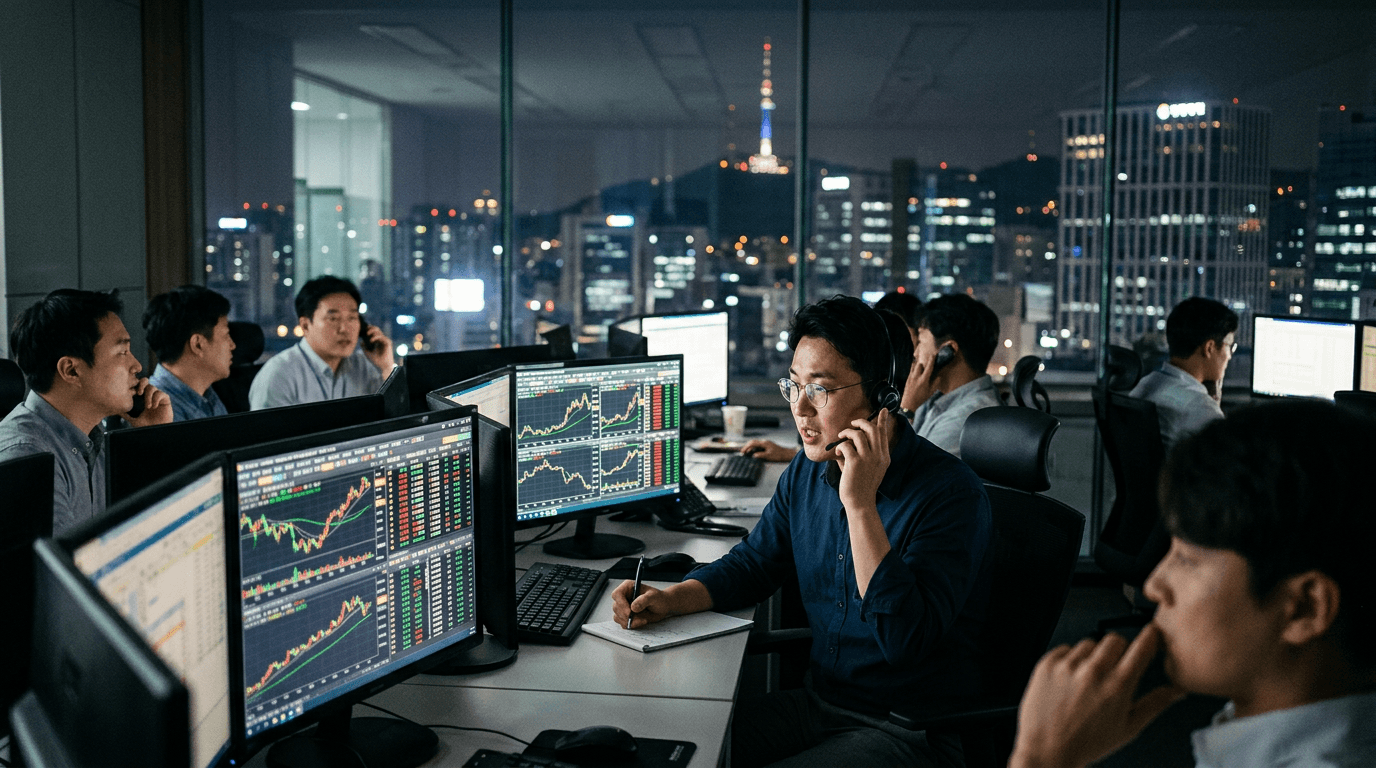
South Korea has just taken a historic step in FX market liberalisation, launching 24‑hour onshore trading in the won against the U.S. dollar in a move designed to reshape KRW liquidity and support its push for developed‑market status.[3][4][5] From now on, USD/KRW can trade almost continuously from Monday morning to early Saturday, bringing the won much closer to the access and transparency standards of major global currencies.[1][3][4]
Market Liberalisation: Korea's Big Fx Step
Under the new framework, the onshore dollar‑won market opens at 6:00 a.m. Seoul time on Monday (21:00 GMT Sunday) and runs uninterrupted until 6:00 a.m. on Saturday.[3][4][6][7] Previously, the market closed overnight, forcing offshore participants to rely on non‑deliverable forwards (NDFs) or other proxies when the local market was shut.[1][3]
The reform is explicitly tied to South Korea’s ambition to be upgraded from “emerging” to “developed” status in MSCI’s global equity indices, where FX access and convertibility have been long‑standing obstacles.[3][4][5][9] By extending trading to cover Asian, European and U.S. sessions with live Seoul pricing, authorities aim to meet key accessibility criteria and make the won more investable for global funds.[1][3][4]
The overnight session will initially be supported by designated domestic lenders and international banks registered to participate in the local FX market, with authorities expecting liquidity to build as more overseas institutions join.[5] This phased approach is meant to balance broader access with close regulatory oversight of system stability and overnight volatility.[2][3][8]
HOW 24‑HOUR WON TRADING REWIRES LIQUIDITY
Around‑the‑clock trading fundamentally changes how and where KRW liquidity is formed.[1][5] Instead of liquidity concentrating during Korean business hours and drying up when the onshore market closes, market depth can now develop continuously across global time zones.[1][3][4]
For corporates and investors, that means no longer having to wait for the Seoul open to execute hedges or adjust positions in response to news from Europe or the U.S.[2][4][5] Exporters, importers and asset managers can transact at live onshore rates in real time, potentially reducing execution lags and slippage.[1][2][4]
At the same time, the pattern of liquidity will not be uniform. Early in the regime, overnight trading volumes are expected to be thinner than during the local daytime, even though the market is technically open.[5] This can translate into wider bid‑ask spreads and more pronounced price moves when large orders hit a less‑liquid book, especially during regional holidays or quiet periods.[2][5][8]
Price discovery in USD/KRW is also likely to evolve. With continuous trading, information from global markets can be incorporated into KRW pricing without overnight gaps, but intraday volatility may be more evenly distributed across the clock rather than clustered at the open and close.[1][3] For active traders, this means more opportunities—but also the need for more sophisticated 24‑hour risk monitoring.
Hedging Costs, Derivatives And The Ndf Shift
A major implication of the new regime is its impact on hedging costs and the relative role of the offshore NDF market.[1][3][5] Historically, many foreign investors and corporates hedged KRW exposure via NDFs because accessing onshore FX was restricted and time‑limited.[1][3][5]
By expanding hours and easing market access requirements for foreign institutions, Seoul is explicitly trying to pull hedging activity back into the onshore spot and derivatives markets.[1][5] If successful, this could reduce basis discrepancies between onshore spot, onshore forwards and offshore NDFs, leading to more coherent KRW pricing across instruments.[1][3][5]
For hedgers, real‑time access to onshore USD/KRW during U.S. and European sessions should make it easier to align hedge execution with underlying asset price moves, potentially lowering the “timing risk” embedded in overnight or delayed hedging strategies.[2][4][5] Over time, tighter spreads and deeper overnight liquidity could translate into more competitive hedging costs, particularly for larger institutions.[2][5]
Derivative markets—options, swaps and structured products referencing KRW—may also see changes in volume and term structure. With more continuous spot trading, volatility surfaces can update more smoothly, and dealers can manage gamma and vega risk across time zones rather than concentrating adjustments into the Korean day.[1][3] For sophisticated traders, this opens the door to strategies that explicitly exploit time‑zone dynamics in KRW volatility and correlation.
What It Means For Simulated And Real Traders
For both real‑money traders and those using simulated finance platforms, the move to 24‑hour won trading is a significant structural shift that demands adaptation.[1][5][9] Strategies built around the old overnight close—such as gap‑trading at the Seoul open or assuming illiquidity outside Asian hours—will need to be re‑evaluated.
Day traders who specialise in USD/KRW can now operate through the full global cycle, reacting to U.S. data, European central bank decisions and Asian local news with access to onshore pricing rather than proxies.[1][3][4] This makes KRW a more viable cross‑time‑zone trading instrument, but also increases the cognitive and operational load of managing positions around the clock.
On simulated trading platforms, 24‑hour KRW opens up realistic training scenarios for managing FX risk in a genuinely global environment. Participants can practise:
- Monitoring changing liquidity and spreads across Asia, Europe and the U.S. sessions.[1][2][5]
- Adjusting position size and leverage to reflect overnight depth and volatility.[2][5][8]
- Testing hedging strategies that use onshore spot instead of (or alongside) NDFs.[1][3][5]
Such simulations can help traders build the discipline to manage orders carefully in thinner overnight markets, use limit orders strategically, and respect the risk of sudden moves when major news hits outside Korea’s traditional business hours.[1][2]
Risks, Volatility And What To Watch
Authorities in Seoul are well aware that longer hours do not eliminate risk; they redistribute and, in some cases, amplify it.[3][8] Regulatory teams have highlighted the need to closely monitor overnight volatility, especially during the early phases as the market structure beds in.[2][3][8]
For market participants, three practical watchpoints stand out:
- Liquidity pockets: Identify which time windows—perhaps late New York or early Europe—show the thinnest depth and widest spreads, and adjust trading size accordingly.[2][5]
- Volatility behaviour: Track whether average intraday ranges expand or contract, and how the distribution of moves shifts as overnight trading volumes grow.[1][3][5]
- Infrastructure and counterparties: Understand which banks are active in the overnight session and how their risk limits, pricing engines and holiday calendars affect market quality.[5][7]
As South Korea continues broader reforms to enhance FX convertibility and capital‑market openness, the 24‑hour won trading system is likely to be only the starting point.[3][4][5][9] For traders who adapt early—both in live markets and in simulated environments—the new KRW landscape offers more continuous opportunity, but also demands more robust risk frameworks and disciplined execution.