
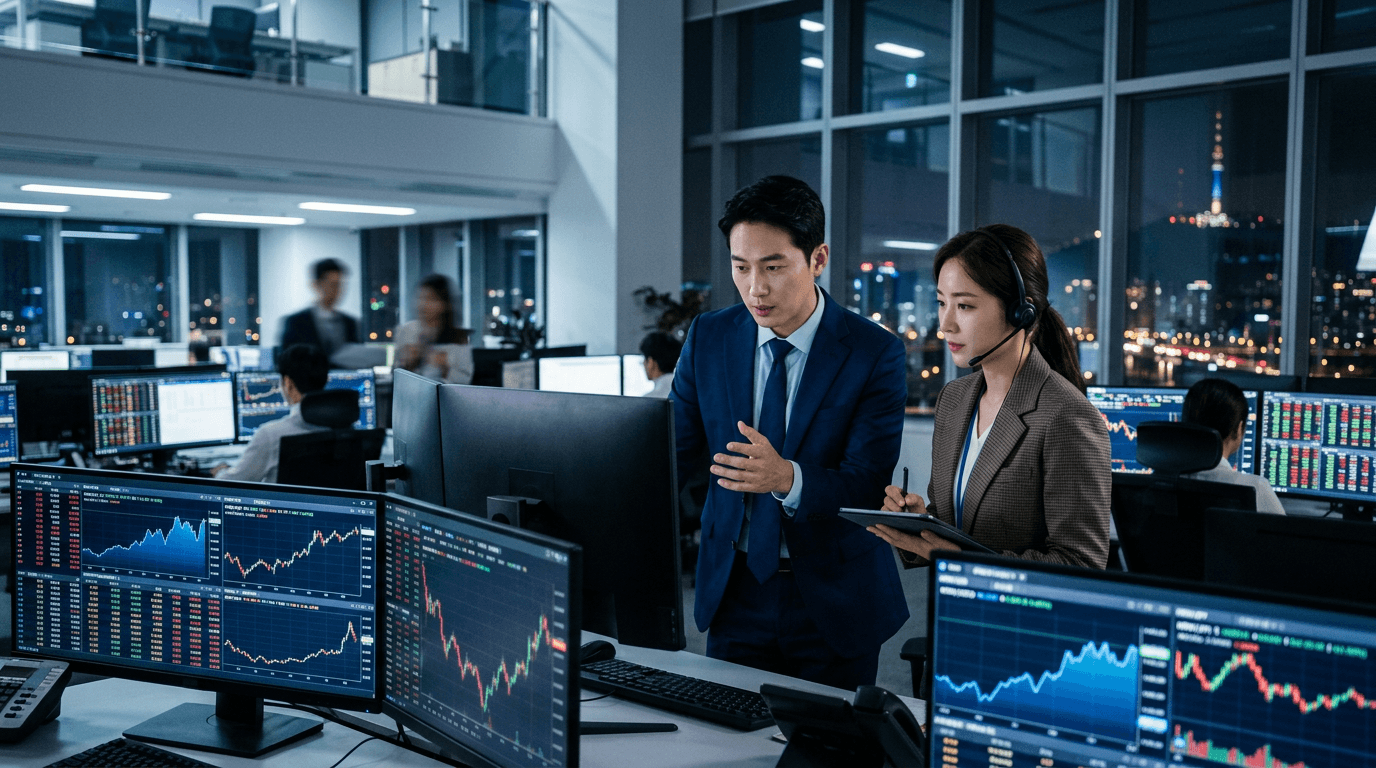
South Korea’s foreign exchange market has just taken a major step toward the global big leagues, launching near 24‑hour onshore trading of the Korean won against the US dollar for the first time.[1][2] This structural change is designed to make Korean assets more accessible to global investors, deepen liquidity in the won and support the country’s long‑running bid to be recognized as a developed market in major equity indexes.[1][5] For traders and portfolio managers alike, this is more than a technical tweak—it’s a shift in how Asia’s fourth‑largest economy connects with global capital.
Globalizing The Korean Won
Until now, onshore dollar‑won trading in Korea was confined to a relatively short window, closing around mid‑afternoon local time.[1][2] That meant international investors in Europe and the Americas often had to rely on offshore instruments like non‑deliverable forwards (NDFs) to gain exposure or hedge Korean risk outside Asian hours.[1] With the new regime, weekday trading in the onshore FX market now runs from 6 a.m. Monday to 6 a.m. Saturday Seoul time, effectively covering all major global time zones.[2]
The overnight session is being supported by designated domestic lenders and international banks registered to participate in the local FX market.[1] This mix of local and global institutions is intended to ensure sufficient liquidity and price discovery throughout the trading day, bringing the won closer in practice to freely tradable developed‑market currencies such as the euro, yen or British pound.[1][5]
Crucially, authorities have framed this reform as a way to “provide the level of accessibility and convenience in foreign exchange trading comparable to advanced markets.”[4] Put simply: Korea wants the won to behave like a core global currency, not a niche emerging‑market instrument with limited hours and uneven access.
WHAT 24‑HOUR TRADING REALLY CHANGES
From a market‑structure perspective, the impact starts with liquidity. Longer hours give market participants more opportunities to transact, which over time can lead to tighter bid‑ask spreads and deeper order books, especially during overlapping trading sessions between Asia, Europe and North America.[1][5] That makes it easier and cheaper to enter and exit positions in Korean assets, a key consideration for large global funds.
It also reshapes how risk is managed. With the won now trading around the clock on weekdays, currency risk linked to Korean equities and bonds can be hedged in real time as global markets move.[1][4] For example, a US‑based fund can adjust its KRW hedges during its own working day instead of waiting for Korea’s onshore market to reopen, reducing overnight gap risk.
At the same time, this move increases the operational demands on policymakers. Inside a restricted‑access room in the government complex in Sejong—known as “the box”—finance ministry officials already monitor every tick in the won to judge when intervention might be necessary.[3] Their task has become more complex now that trading is continuous, particularly at a moment when the won has recently traded near a 17‑year low and ranked as one of Asia’s weakest performers in the first half of the year.[3] Authorities must balance the goals of liberalization and accessibility with the need to manage volatility and protect financial stability.
Implications For Fx Traders And Hedgers
For FX traders, the most immediate impact is the expansion of tradable hours and potential trading opportunities. The won’s price action will no longer be compressed into a narrow Asian window; instead, it can respond more smoothly to global data releases, geopolitical news and cross‑asset flows throughout the weekday cycle.[1][4] This creates more intraday patterns to analyze and potentially more arbitrage and relative‑value opportunities between KRW and other Asian currencies.
Hedging strategies in the region are likely to evolve as well. Historically, offshore KRW exposures often relied on NDF markets that operated when the onshore market was closed.[1] As onshore 24‑hour trading gains traction, some of this activity may migrate onto the domestic platform, narrowing any pricing gap between onshore and offshore markets and changing liquidity dynamics in NDFs.[1][5] Over time, that could make Korea’s FX system more transparent and easier to navigate for global investors.
Portfolio managers with Korean equity or bond allocations will welcome the ability to fine‑tune hedges across time zones. A European asset manager, for instance, can now rebalance KRW hedges during their local afternoon, while US‑based investors can adjust positions into their evening, rather than relying on less precise proxy hedges or accepting unhedged overnight risk.[1][5] That flexibility can improve portfolio risk management and lower friction costs.
PATH TO DEVELOPED‑MARKET STATUS
The FX reform is part of a broader, multi‑year effort by Seoul to secure an upgrade to developed‑market status from MSCI, one of the world’s most influential index providers.[1][5] MSCI has long cited restrictions and limited accessibility in Korea’s FX market as a key obstacle to reclassifying the country from “Emerging Markets” to “Developed Markets.”[1][5] Expanded trading hours and easier access for offshore investors directly address those concerns.
Developed‑market inclusion matters because it can unlock new pools of capital. Many global funds track developed‑market indexes or have mandates that allow higher allocations to countries within them.[5] An eventual MSCI upgrade would likely trigger incremental inflows into Korean equities and bonds, particularly from passive and benchmark‑driven investors.[5] The 24‑hour won market is one important building block in that direction.
That said, index providers also look at other factors: regulatory consistency, capital controls, settlement infrastructure and the overall experience for foreign investors.[5] The FX reform signals Korea’s commitment to modernizing its capital markets, but it will be assessed alongside these other elements as MSCI and peers update their classifications.
What Simulated And Active Traders Should Watch
For traders using simulated environments and strategy development platforms, Korea’s move offers a new testbed for 24‑hour FX trading models centered on an Asian currency. The extended hours allow back‑testing and live simulation of strategies that operate across Tokyo, London and New York sessions using a single currency pair, USD/KRW.[1][2] This can be especially valuable for exploring volatility patterns, session overlaps and news‑driven moves in a newly liberalizing market.
Practically, active traders and portfolio managers should focus on a few key themes in the coming months:
First, watch how liquidity evolves in the overnight session—initially, volumes may be lower, with spreads wider than in the core Asian hours, but this can change as more participants get comfortable trading KRW around the clock.[1][4]
Second, monitor any changes in the relationship between onshore KRW and offshore NDF pricing. Convergence between the two would signal success in centralizing activity and improving transparency in Korea’s domestic FX market.[1][5]
Third, pay attention to policy communication. As authorities adjust to a continuous market at a time of heightened currency sensitivity, official commentary, intervention signals and regulatory fine‑tuning will shape volatility and investor confidence.[3][4] Traders should integrate these policy cues into their risk‑management and scenario planning.
Ultimately, South Korea’s launch of near 24‑hour won trading is a strategic bet that deeper, more accessible markets will bring the country closer to developed‑market recognition and attract more global capital. For FX and multi‑asset traders, it opens a new chapter in Asia’s currency landscape and a fresh set of opportunities—and risks—to analyze.