
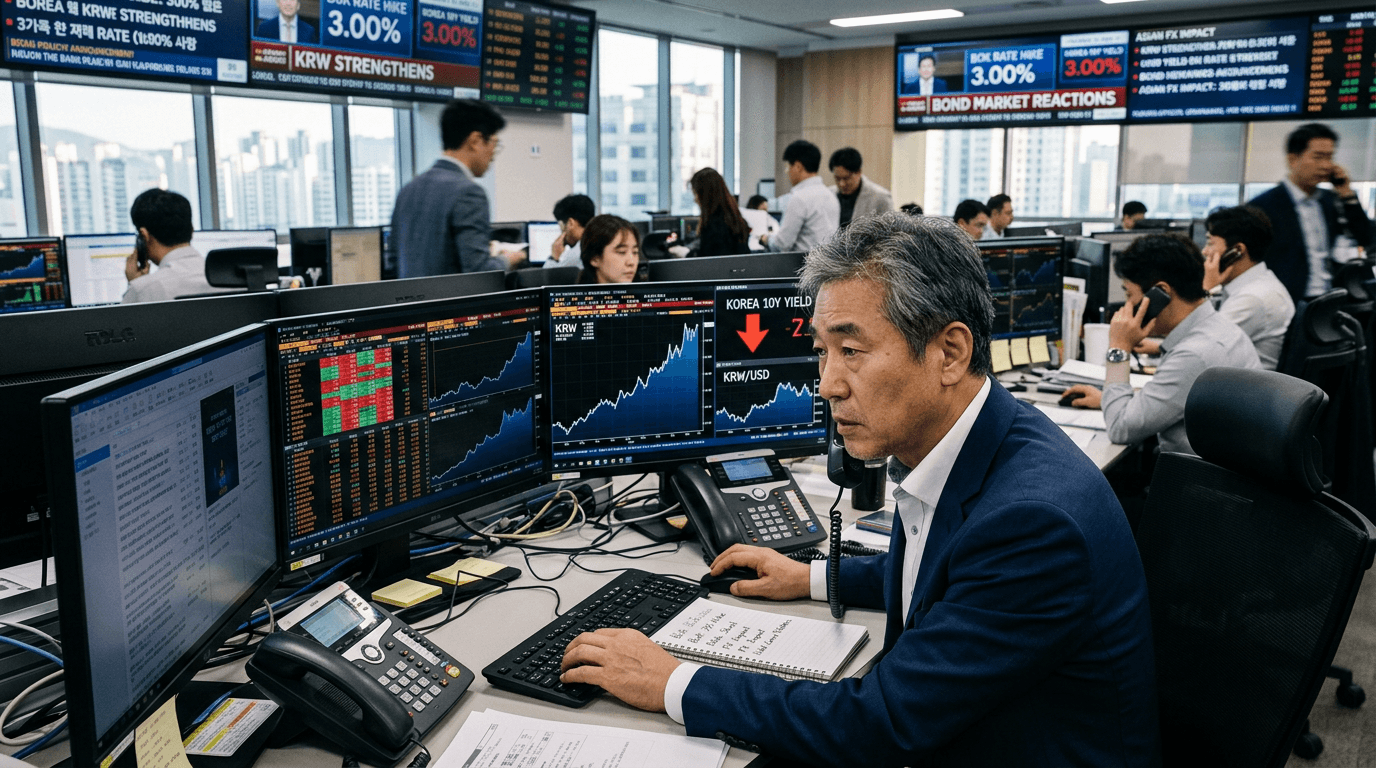
South Korea’s central bank has just delivered another interest rate hike, reinforcing a new tightening cycle that is reshaping the macro backdrop for the Korean won, regional bond markets, and Asian foreign exchange sentiment.[4][7][14][15] For traders, this is more than a local policy move—it is a signal about how policymakers across Asia may respond to persistent inflation and currency pressures.[3][11][13][15]
What Just Happened At The Bank Of Korea
After holding rates steady at 2.50% earlier in the year, the Bank of Korea (BoK) began tightening in July with a 25 basis point hike to 2.75%, its first increase since January 2023.[2][5][12][14] That move ended more than three years without hikes and marked the start of a new policy cycle.[1][9][11][14] In late August, the BoK followed through with a second consecutive 25 basis point increase, lifting the base rate from 2.75% to 3.00% and delivering back-to-back hikes as core inflation stayed elevated.[4][7]
The July decision was unanimous and framed as a response to forecasts of sustained inflation and solid economic growth, with officials explicitly noting that further tightening was likely.[9][15] The August meeting confirmed that guidance, as policymakers pushed rates to their highest level since early 2025 to reinforce efforts to cool prices.[7] Together, these moves underscore that the BoK has shifted decisively from guarding financial stability and currency weakness toward actively restraining demand.[3][13][15]
Why The Bok Is Tightening Again
The BoK’s rate hikes are rooted in a familiar mix of inflation risks, currency dynamics, and financial vulnerabilities.[2][3][11][12] Inflation has been aggravated by Middle East tensions and energy price volatility, with several reports pointing to conflict-driven price pressures that threaten to keep headline and core inflation above the bank’s 2% target.[2][10][11] At the same time, Korea’s economy has been supported by a strong semiconductor and export cycle, which adds to the potential for demand‑driven price increases.[9]
Policymakers are also watching household leverage closely, as South Korea is known for high household debt levels that can amplify the impact of loose financial conditions.[2][12] Earlier in the year, the BoK emphasized financial stability when it kept rates unchanged at 2.50%, particularly as the won hovered near multi‑year lows.[13] Once inflation risks re‑accelerated and the currency remained under pressure, the balance of risks tilted toward tightening, even at the cost of higher borrowing expenses for households and businesses.[3][13]
Implications For Krw And Asian Fx
For FX traders, the clearest near‑term impact is on the Korean won (KRW).[3][7][13] Rate hikes typically provide support to a weak currency by improving carry and signaling policy resolve, and the BoK explicitly noted that stabilizing the slumping won was among the goals of its July move.[3][13] With the policy rate now at 3.00%, Korea offers a more attractive yield profile than it did earlier in the year, which can draw in carry and macro funds that had been cautious on the won.[4][7]
The psychological impact extends beyond Korea. When a major Asian central bank moves from neutral to tightening, it signals that regional policymakers are less tolerant of prolonged currency weakness and imported inflation.[3][9][15] That can shift broader Asian FX sentiment, encouraging short covering in other regional currencies and making traders more sensitive to upside inflation surprises elsewhere in the region.[3][9] In SimFi environments, this provides a timely scenario to test strategies that combine long KRW positions with relative value trades against other Asian currencies that have been slower to tighten.
Ripple Effects In Bonds And Equities
On the rates side, higher BoK policy rates translate into upward pressure on Korean government bond yields and a repricing of duration risk.[3][4][5] As the base rate moves from 2.50% to 3.00%, investors demand higher yields to compensate for tighter financial conditions, particularly at the short and intermediate tenors most sensitive to central bank policy.[4][5][14] A gradual, signaled tightening path—as the BoK has emphasized—helps avoid disorderly moves, but it still forces portfolio managers to reassess exposure to Korean and regional Asian bonds.[3][9][15]
Equities face a more nuanced impact. On one hand, tighter policy can weigh on domestically focused sectors such as real estate, consumer finance, and leveraged consumption plays.[2][12] On the other hand, the BoK’s decision reflects confidence in Korea’s growth outlook, supported by strength in semiconductor exports and tech hardware.[1][9] For macro and multi‑asset traders, this combination invites strategies that differentiate between globally exposed Korean exporters and more rate‑sensitive local names, both in live markets and simulated portfolios.
Key Takeaways For Simulated Traders
For traders using a SimFi platform, Korea’s back‑to‑back hikes offer a rich, real‑time case study in central bank reaction functions. The sequence—from signaling an end to easing, to a first hike at 2.75%, to a follow‑up move to 3.00%—illustrates how policy evolves as inflation, growth, and currencies interact.[3][4][13][14] Simulating trades across KRW, local bonds, and equity sectors allows market participants to stress‑test how their strategies respond to a tightening cycle that is firm but gradual.
Practical applications include building scenarios where the won stabilizes or strengthens as rate differentials widen, modeling parallel shifts in the Korean yield curve, and testing equity factor rotations that favor exporters over domestic cyclicals. Embedding the BoK’s guidance—gradual tightening, data dependence, and sensitivity to FX and household debt—into these scenarios helps traders move beyond simple “rates up, risk off” narratives and toward more realistic multi‑asset positioning.
Conclusion
South Korea’s latest rate hike confirms that the Bank of Korea has entered a new tightening phase aimed at cooling inflation, stabilizing the won, and managing financial imbalances.[3][4][7][15] While the moves have been incremental, their message is clear: policy rates in Asia’s fourth‑largest economy are unlikely to return quickly to the ultra‑low levels seen earlier in the decade.[1][11][14] For traders—whether in live markets or simulated environments—this is a pivotal macro development that deserves close monitoring, not just for its direct impact on KRW and Korean assets, but for the broader signal it sends about how Asian central banks may respond to the next wave of global inflation and currency volatility.[3][9][13][15]