
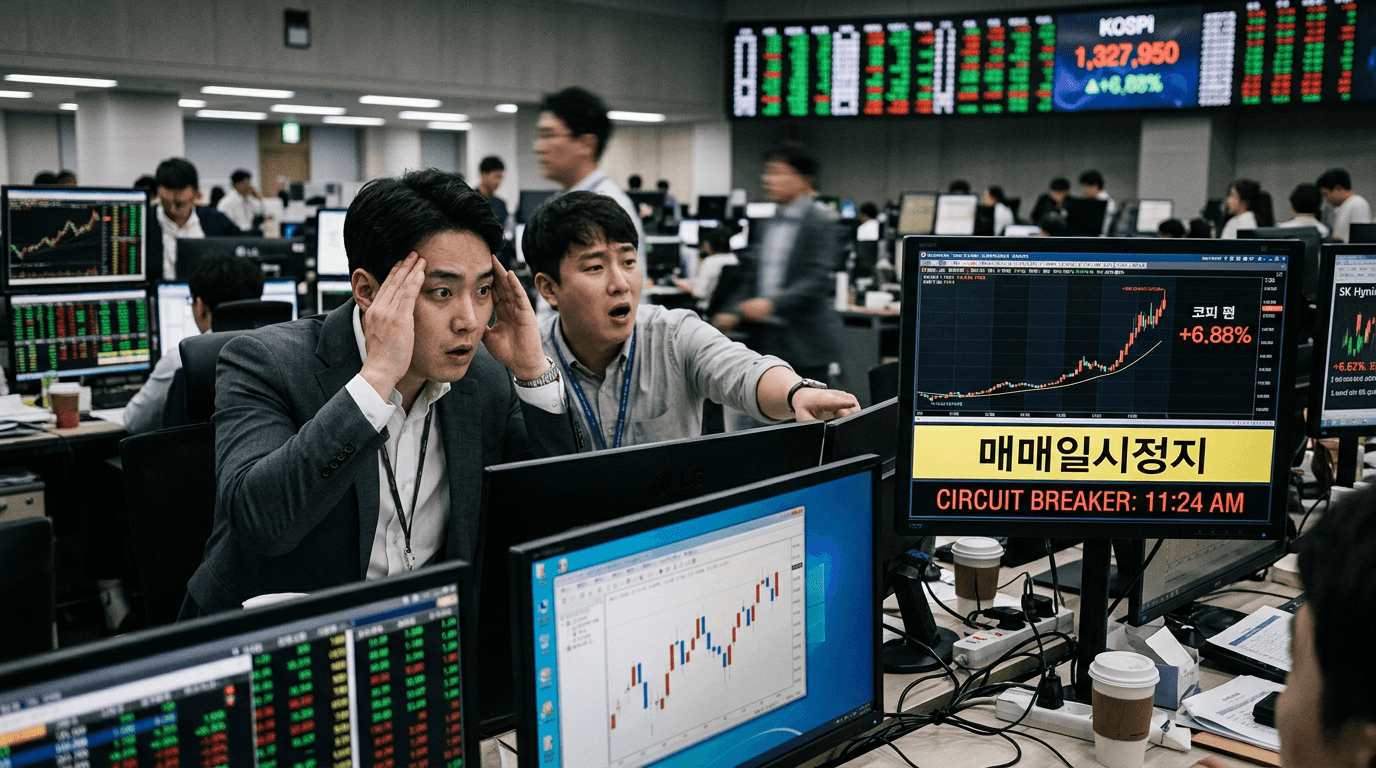
A near-7% spike in Korea’s Kospi futures and a double‑digit surge in SK Hynix is exactly the kind of move that grabs the attention of equity and derivatives traders across the globe. When futures climb this fast and trading halts are triggered, it is not just a headline; it is a real‑time stress test of market microstructure, risk management, and investor psychology in one of Asia’s most important tech‑heavy markets.
WHAT JUST HAPPENED IN KOREA’S FUTURES MARKET
Korean equity futures saw an abrupt and powerful rally, with Kospi futures spiking close to 7% in a short window as buyers rushed into the market on the back of a tech‑led surge. That magnitude of intraday move in a major index future is rare and typically associated with either macro shock or a strong thematic catalyst, in this case, U.S. technology strength and the artificial intelligence (AI) trade spilling over into Asia.
The shockwave was strong enough to trigger “sidecars” and temporary trading halts on both the Kospi and Kosdaq, mechanisms designed to slow the market and allow participants to reassess orders when price moves become extreme[3]. Sidecars were also activated in a prior near‑7% rally in South Korean equities, illustrating that regulators are increasingly relying on these tools to dampen short‑term volatility in a market that has become more sensitive to global risk cycles[3].
For traders, the key takeaway is that such jumps can quickly transform the intraday environment: liquidity thins, bid‑ask spreads widen, and execution quality can meaningfully deteriorate. Anyone trading index futures with leverage in this kind of tape needs to understand how halts and sidecars work, because they directly influence your ability to enter and exit positions during the most critical price swings.
SK HYNIX, AI MOMENTUM, AND THE TECH SUPER‑CYCLE
At the center of this move was SK Hynix, one of Korea’s flagship memory and semiconductor names, which surged sharply as investors piled into AI‑linked hardware exposure. Strong earnings and guidance from U.S. chipmakers such as Intel and AMD have reinforced the narrative that the AI industry is entering a multi‑year investment super‑cycle, benefiting global suppliers of high‑bandwidth memory, DRAM, and related components[4].
Korean chip giants, including SK Hynix and Samsung Electronics, have already been rewriting record books this year, pushing the broader Kospi index to new highs as investors increasingly treat the market as an AI infrastructure proxy[4]. In earlier sessions, the Kospi neared the 7,800 level, with both companies hitting all‑time highs amid a wave of optimism about AI demand and data center spending[4].
This latest futures spike is part of that same story: when a single heavyweight stock with large index weight moves 10–12% in one session, it mechanically drives futures higher. It also tends to attract short covering from traders who were positioned against the tech rally, amplifying the move. For systematic and discretionary traders alike, it is a reminder that index behavior is often dominated by a handful of mega‑caps, especially in sectors tied to powerful structural themes like AI.
Side-cars, Circuit Breakers, And Why Halts Matter
Sidecars and circuit breakers can look like technical footnotes, but they are central to how modern markets manage risk. In Korea, a sidecar is a volatility control mechanism that temporarily restricts program trading when index futures move beyond a set threshold relative to the cash market[3]. The goal is to break feedback loops between algorithmic trading and rapid price changes, which can otherwise snowball into destabilizing cascades.
When the Kospi surged nearly 7% in a prior relief rally, buy‑side sidecars were activated in the morning session as prices jumped on eased geopolitical tensions[3]. In the current case, the trigger was a tech‑driven surge rather than geopolitical news, but the underlying logic is the same: slow things down when the market accelerates too quickly.
For active traders, these mechanisms have practical implications:
They can lock in portfolio mark‑to‑market values temporarily while hindering your ability to hedge or rebalance.
They can create air pockets in liquidity, where prices gap without the usual continuous trading path.
They often lead to increased slippage around the halt windows, as pent‑up orders flood the book once trading resumes.
In simulated finance environments, replicating sidecars and halt rules is critical for realism. Practicing how strategies behave when you suddenly cannot trade for a few minutes in the middle of a volatility spike can reveal hidden weaknesses in execution logic and risk controls.
Ripple Effects Across Asia Equities And Fx
A move of nearly 7% in a major Asian equity future is not just a local story; it tends to ripple across the region. When Korean futures spike on tech strength, investors frequently rotate into higher‑beta markets and sectors, pushing up correlated indices and thematic baskets tied to semiconductors, cloud computing, and AI hardware.
There is also a foreign‑exchange angle. Strong risk appetite in Korean equities can support the won, as overseas investors hedge or increase KRW exposure while adding to local positions. At the same time, rising volatility in equity derivatives can influence regional carry trades and cross‑currency funding flows, as risk‑sensitive portfolios adjust their exposure to high‑beta markets.
Importantly, today’s AI‑centric environment means that moves in Korean chips are often interpreted as signals for the broader global tech cycle. Traders in U.S., European, and other Asian markets closely watch Korean bellwethers for clues about memory pricing, inventory cycles, and data‑center demand. That makes episodes like this more than just a single‑market anomaly; they are part of a live feedback loop in global tech and macro trading.
Lessons For Traders: Volatility, Leverage, And Simfi Practice
For traders using real or simulated capital, this kind of session offers several concrete lessons.
First, volatility can arrive suddenly and from a concentrated source. A single stock, sector, or theme—here, SK Hynix and the AI trade—can drive index futures into territory where leverage becomes dangerous if positions are not sized with tail scenarios in mind.
Second, market structure matters. Sidecars, circuit breakers, and halt rules define the playing field in extreme conditions. Ignoring them can lead to unpleasant surprises, especially for intraday strategies that rely on continuous liquidity and fast execution.
Third, cross‑asset awareness is essential. A 7% move in Kospi futures is not just an equity event; it interacts with FX, rates, and global tech sentiment. Strategies that understand and exploit these linkages are better positioned to navigate and even capitalize on such episodes.
Simulated finance platforms are well suited to turn these events into learning opportunities. By replaying volatile sessions, incorporating realistic halt mechanics, and stress‑testing portfolios against sharp tech‑driven rallies, traders can refine their playbooks without real‑world loss. Whether you are a beginner learning how index futures respond to single‑stock shocks, or an experienced trader optimizing your risk framework, treating this kind of market day as a case study can materially improve your preparedness for the next spike.