
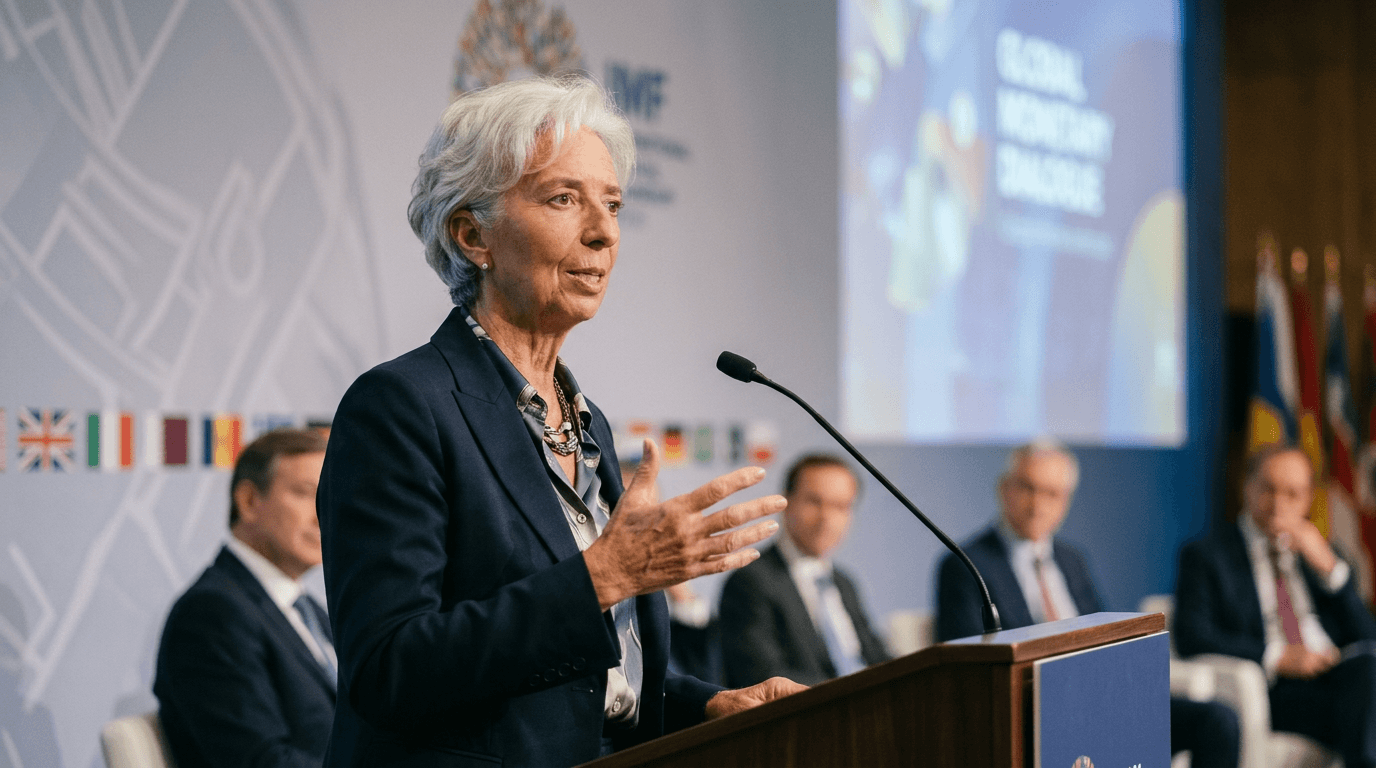
Christine Lagarde’s latest remarks put China’s currency back at the centre of global macro debate. By calling for international talks on an “undervalued” yuan, the European Central Bank (ECB) President is flagging that exchange rates, trade imbalances and industrial competitiveness are set to become more politically charged – with direct implications for EUR, CNY and broader risk sentiment.[1][3][4]
GLOBAL CONCERN OVER AN “UNDERVALUED” YUAN
At the core of Lagarde’s comments is research from the International Monetary Fund (IMF) suggesting that the Chinese yuan (renminbi) is undervalued by roughly 15–16% when adjusted for inflation differences.[1][4] In practical terms, that means Chinese goods are cheaper in foreign currency than they would be under a “fair value” exchange rate, reinforcing China’s export competitiveness and widening its trade surplus.[1][5]
China rejects the idea that it manipulates its currency for trade advantage, arguing that market forces and domestic priorities drive its FX policy.[1] However, persistent and growing trade surpluses, particularly with advanced economies, have made the yuan’s valuation a recurring flashpoint in global economic discussions.[1][3]
Lagarde’s intervention is notable because she is effectively saying that exchange rates are not just a bilateral issue between the US and China, but a multilateral one that affects the entire global system.[3] She has urged G7 and broader international forums to include a currency component when discussing “excessive imbalances” – code for large, one‑sided trade balances that can destabilise growth and fuel political backlash.[1][3]
It is worth noting that not all studies agree on the yuan’s undervaluation. Some academic and policy research has argued at various points that the RMB is closer to fair value, or even overvalued, depending on the model and time period used.[5][9] This disagreement highlights that “undervaluation” is as much about politics and distributional effects as it is about pure economics.
Why Europe Cares: Trade, Industry And Inflation
For Europe, the euro–yuan exchange rate is increasingly more relevant than the traditional euro–dollar focus.[2] European manufacturers source heavily from China and compete directly with Chinese exports in global markets, meaning the price of Chinese inputs and finished goods in euros feeds directly into Europe’s industrial cost base and trade balance.[2][7]
IMF and think‑tank studies suggest that, in real terms (especially when measured using producer prices), the euro has appreciated significantly against the yuan – more than 40% in some estimates over the past decade.[8] This implies a substantial shift in relative costs: European producers have effectively become much more expensive than their Chinese counterparts when selling into global markets.[8]
That gap helps explain why Europe’s trade deficit with China has widened and why policymakers in Berlin, Brussels and Paris are increasingly worried about overcapacity in Chinese heavy industry, electric vehicles, batteries and green technologies.[3][7][8] If Chinese production is both heavily subsidised and supported by an undervalued currency, European firms face a double disadvantage.
The FX angle also interacts with inflation. A weaker yuan relative to the euro makes Chinese imports cheaper, providing some disinflationary pressure for European consumers and firms in the short term.[2] But if this comes at the cost of hollowing out domestic industry and raising political tensions, the net effect can be negative for long‑term growth, wages and investment – outcomes the ECB and EU leaders cannot ignore.[2][7]
Fx Market Implications For Eur, Cny And Risk Sentiment
Lagarde’s call for talks does not immediately change ECB policy, but it sends an important signal to FX markets: currency levels, especially EUR–CNY, are now a political variable, not just a macro one.[2][3] That opens several medium‑term scenarios that traders should consider:
First, a cooperative path. If discussions remain constructive, markets may see only modest adjustments. China could allow a gradual yuan appreciation or tolerate less active support for its currency, while Europe refrains from aggressive trade defence measures. In this scenario, EUR–CNY might trade in a broad range, with volatility contained and risk assets relatively supported.
Second, a rhetorical escalation. If European leaders increasingly frame the yuan as “unfairly undervalued,” the risk of tariff threats, anti‑dumping investigations and industrial subsidies rises.[3][7][8] That would likely be negative for cyclical equities, EM FX and export‑sensitive sectors, and could push safe‑haven flows into the dollar, yen or high‑quality bonds.
Third, a policy confrontation. In an extreme scenario where trade restrictions and counter‑measures escalate, the market could start to price a “mini trade war” between the EU and China. That would likely fuel risk‑off sentiment, widen credit spreads and reinforce a narrative of global fragmentation – themes that have historically supported the dollar and weighed on pro‑cyclical currencies and commodities.
For the yuan itself, sustained political pressure risks narrowing the People’s Bank of China’s room for manoeuvre. If authorities lean too heavily on a weak currency to support growth, they invite more criticism and possible sanctions; if they allow notable appreciation, they risk undermining export performance at a delicate time for China’s domestic economy.[9]
What Traders Should Watch Next
For active traders, this story is less about a one‑day move and more about a new macro theme that could drive medium‑term trends across FX, rates and equities. Key signposts include:
G7 and multilateral statements: Any communiqués that explicitly mention currency misalignments, “excessive imbalances” or the yuan will be market‑relevant, especially if they hint at coordinated pressure on China.[1][3]
IMF assessments and ECB commentary: Updated IMF external sector reports on China’s currency, along with further remarks from Lagarde and other ECB officials on the euro–yuan rate, can shift expectations around how forceful Europe intends to be.[1][2][4]
Chinese policy moves: Daily CNY fixings, changes in FX reserve management, and on‑shore versus off‑shore (CNY vs CNH) pricing are all clues to Beijing’s tolerance for yuan strength or weakness.[9] Any signs of a systematic bias toward depreciation in the face of international criticism would be particularly sensitive.
Trade and industrial policy: EU investigations into Chinese overcapacity, anti‑subsidy cases (for example in EVs and solar), and potential tariffs are critical. The more Europe leans on trade defence tools, the more likely FX becomes part of a broader geo‑economic confrontation.[7][8]
Market positioning and volatility: Options markets in EUR–CNY and USDCNH can provide early hints about how seriously institutional players take the risk of a currency or trade shock. Rising implied volatility or skew toward downside in the yuan would signal growing concern.
Conclusion
Lagarde’s push for global talks on an undervalued yuan marks a subtle but important shift: Europe is stepping more firmly into a debate that has long been dominated by US‑China tensions. By linking currency misalignments to trade imbalances and industrial competitiveness, the ECB is acknowledging that FX levels can no longer be treated as a neutral backdrop – they are part of the policy battleground.[1][2][3]
For traders, the message is clear. The euro–yuan cross, EU–China trade policy, and IMF assessments of the renminbi’s fair value are now strategic variables, not niche topics. This development may not trigger immediate volatility on the scale of a surprise rate decision, but it sets the stage for future moves that could reshape relative performance across currencies, sectors and regions.
In a market where macro narratives often drive multi‑month trends, staying ahead of this evolving FX–trade nexus – and understanding how political pressure on the yuan can ripple through EUR, CNY and global risk sentiment – is likely to be a valuable edge.