
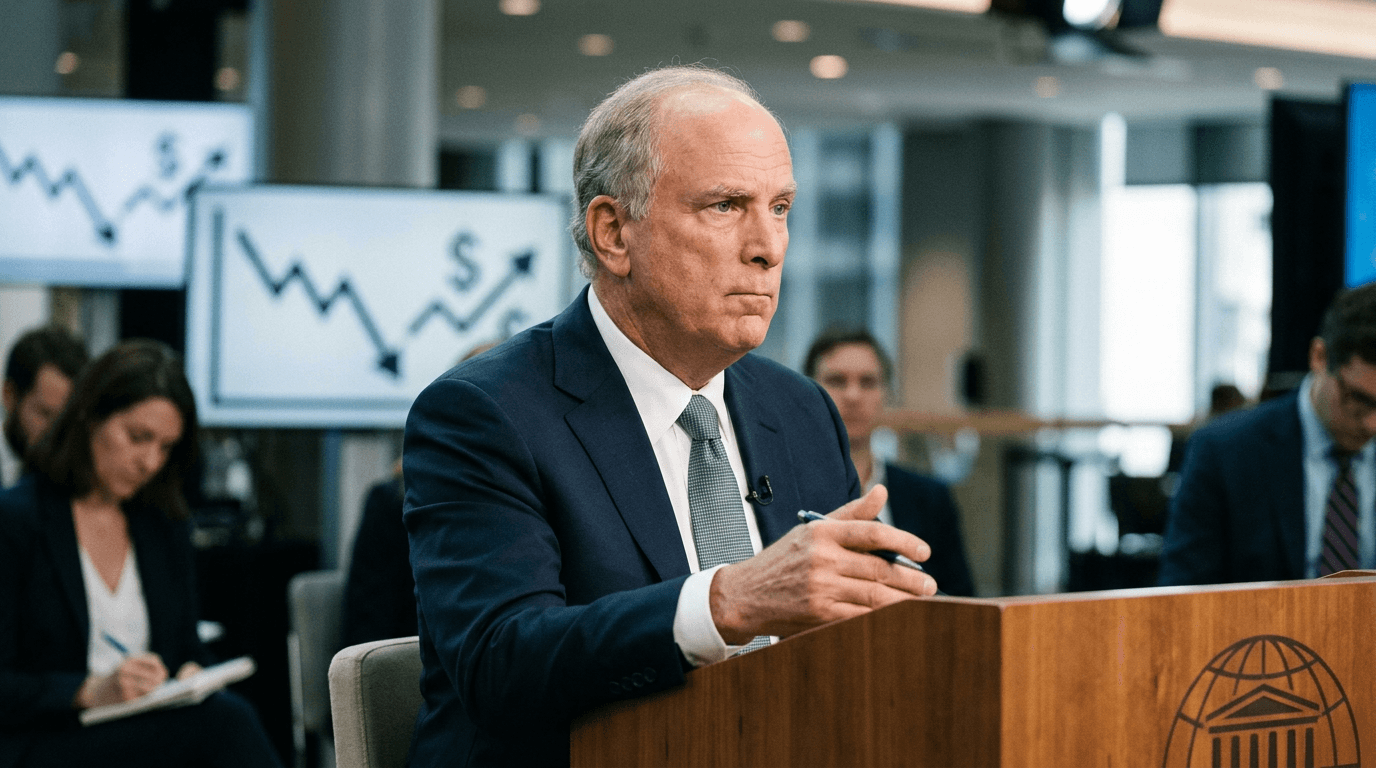
BlackRock CEO Larry Fink’s latest warning that the U.S. economy is “weakening as we speak” is more than a headline—it’s a signal from one of the most influential voices in global markets.[9] When the leader of the world’s largest asset manager highlights softening growth alongside rising inflation expectations, traders and investors pay attention.[9] For anyone active in markets or practicing in simulated finance, understanding what sits behind this message is critical to navigating the next phase of the cycle.
Market Warning From A Systematic Player
BlackRock manages trillions of dollars across equities, bonds, alternatives and cash, giving Fink a front-row view of flows and sentiment across the global financial system.[9] In his recent interview, he emphasized that U.S. growth has weakened to the point where recession risk is now very real, echoing earlier comments that the economy is “very close, if not already in, a recession.”[1][9] That is a notable shift from the resilient-growth narrative that dominated much of the recent market rally.
What makes this warning more powerful is its alignment with incoming data. Producer prices have unexpectedly declined, hinting at pressure on corporate pricing power and potential margin compression.[6] At the same time, consumer sentiment has dropped and one-year inflation expectations have jumped to around 6.7%, suggesting households feel both poorer and more concerned about future price increases.[6] This combination—weakening growth, uneasy consumers and higher inflation expectations—is textbook “stagflation risk,” a scenario markets find difficult to price.
Fink has been consistently vocal about macro risks, from elevated inflation linked to tariffs[5] to the potential for a global recession if oil prices spike toward $150 a barrel amid ongoing geopolitical tensions.[2][8] Taken together, his latest comments fit a broader pattern: structural forces and policy choices are keeping inflation pressures high even as growth loses momentum.
Mixed Data: Weak Growth, Sticky Inflation
On the surface, falling producer prices might look like good news for inflation.[6] But combined with weaker demand, they can also signal that companies are losing the ability to pass on costs, which can hurt earnings and hiring intentions. Meanwhile, rising inflation expectations in consumer surveys matter because they often influence wage demands and future price-setting behavior, making inflation more persistent than headline data alone suggests.
For the Federal Reserve, this is a complicated backdrop. A weakening economy would normally strengthen the case for rate cuts. Yet if inflation expectations are drifting higher and the labor market remains reasonably tight, policymakers may feel compelled to keep policy restrictive longer than markets hope. Fink has gone so far as to say he sees “zero chance” of near-term Fed cuts under current conditions, underscoring his view that high rates are likely to remain in place until inflation is clearly under control.[9]
This tension between growth and inflation is already visible in key asset prices. The dollar, Treasury yields and equity index futures are all reacting as traders reassess both the timing and magnitude of future Fed moves.[6] When the market narrative shifts from “soft landing” to “possible policy mistake,” volatility in rates, FX and equities tends to rise—creating both risks and opportunities for active traders.
What This Means For Fed Policy And Core Markets
If growth data continues to soften while inflation expectations stay elevated, the Fed faces three broad options:
Maintain higher-for-longer rates, prioritizing the inflation mandate even at the cost of slower growth.
Deliver a small number of cosmetic cuts while keeping real (inflation-adjusted) policy restrictive.
Pivot more aggressively if unemployment rises or financial stress emerges—but only with strong evidence that inflation is truly on a downward path.
Fink’s comments imply he expects the first two scenarios to dominate in the near term.[9] For markets, that has several implications:
Treasury yields may remain volatile, with the front end (short maturities) anchored by high policy rates and the long end swinging as growth expectations shift.
The dollar could stay supported as U.S. rates remain comparatively high, though any clear sign of recession could trigger a flight to quality that also benefits Treasuries.
Equity index futures are likely to be sensitive to every data release that affects the growth/inflation mix—PPI, CPI, employment, consumer sentiment and inflation expectations.
For traders, this environment rewards those who can quickly interpret macro data, understand its policy implications and translate that into structured trading ideas rather than simply chasing headlines.
Implications For Traders And Simulated Finance Participants
For participants in simulated finance environments, this is an ideal stress-test scenario for your strategy. You are dealing with:
A major macro narrative shift, driven by a prominent market figure.[9]
Conflicting signals: weaker growth vs. stickier inflation.[6]
Heightened sensitivity of rates, FX and equity markets to incremental data and Fed communication.[6]
Use this backdrop to refine how you react to complex, non-linear information. For example:
In rates: Practice trading yield curves rather than just direction—steepener vs. flattener trades that express views on growth and policy.
In FX: Explore how the dollar may behave if the Fed stays hawkish while other central banks face their own growth constraints.
In equities: Test sector rotation strategies, such as favoring defensive sectors (utilities, staples, health care) when recession risk rises, while being cautious on highly valued growth names that are sensitive to discount rates.
Because there is no real capital at risk in simulation, you can deliberately design scenarios where your base case is wrong and analyze how your portfolio responds. That process is invaluable preparation for live markets, where macro surprises can be both frequent and costly.
Key Takeaways For Your Trading Playbook
The combination of Larry Fink’s warning and recent data sends several clear messages to traders and investors:
Do not assume a smooth soft landing. A weakening economy with rising inflation expectations is a higher-variance environment than the market narrative of the past year may suggest.[6][9]
Watch survey-based indicators as closely as hard data. Consumer sentiment and inflation expectations often move before official growth and inflation numbers, making them useful early-warning tools.[6]
Treat central bank expectations as a trade, not a certainty. If the market is pricing more aggressive rate cuts than Fink and other macro-focused investors deem plausible, there may be opportunities around repricing of Fed expectations.[9]
Embrace scenario thinking. Build at least three macro paths in your playbook—baseline (slow growth, gradual disinflation), downside (recession with stubborn inflation) and upside (productivity-driven growth that tames inflation without deep pain)—and map your strategies to each.
Above all, use episodes like this to sharpen your ability to connect macro narrative, data releases, policy reactions and asset price behavior. Whether you trade live or through a simulated finance platform, that integrated understanding is what turns headlines into edge.