
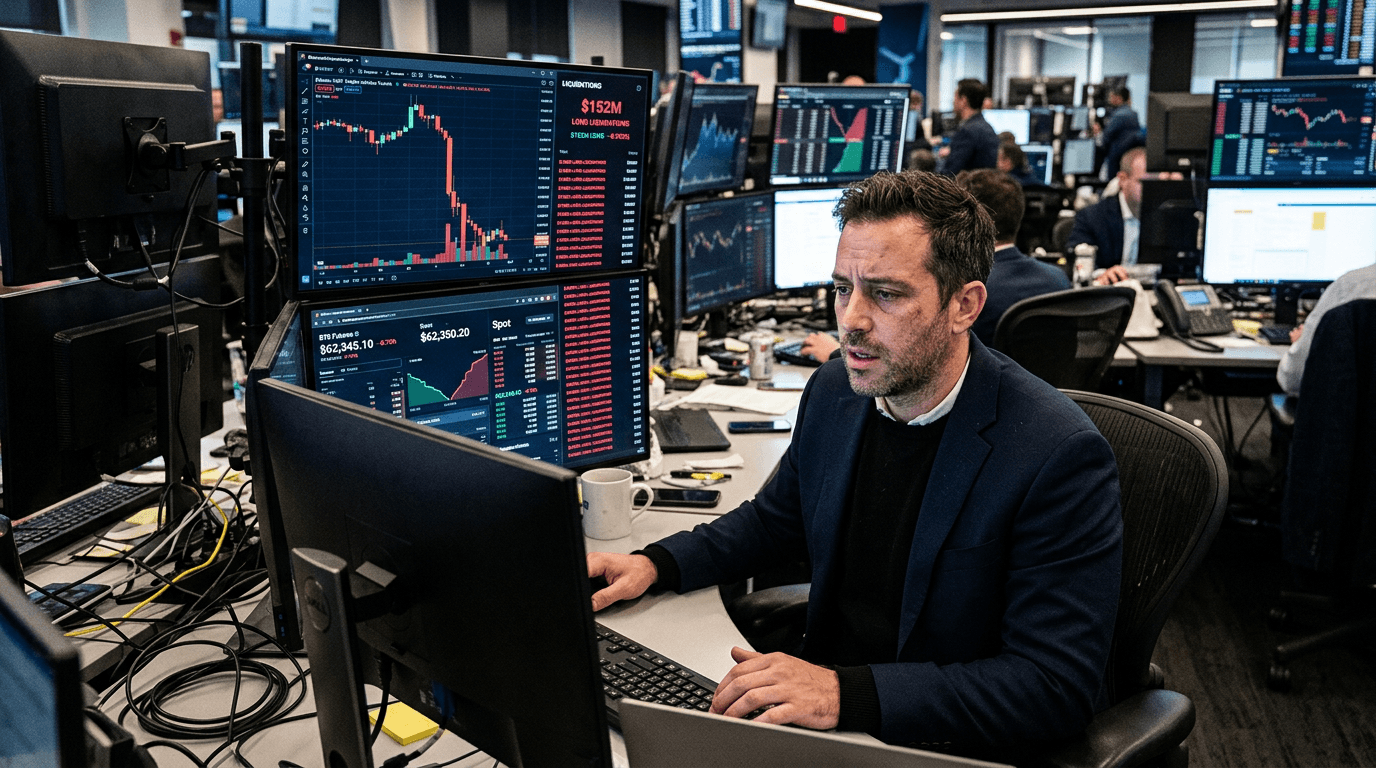
Bitcoin is increasingly a derivatives-driven asset, with leveraged futures trading now overshadowing spot markets on major exchanges. Recent data from Binance show Bitcoin futures volume roughly eight times larger than spot, highlighting that short-term price action is being steered by margin, liquidations, and positioning rather than simple buy-and-hold demand[2][6][10][12]. For traders, this shift changes how risk is created, transmitted, and ultimately unwound across the crypto ecosystem.
Derivatives Now Dominate Bitcoin Trading
On Binance, daily Bitcoin futures turnover has reached around $57–58 billion, while spot trading in BTC sits near $6 billion, producing a futures-to-spot ratio of roughly 7.8 to 1[2][6][10][12]. This imbalance confirms that the bulk of active Bitcoin exposure is now expressed via futures and perpetual contracts rather than outright transfers of coins on the spot market[2][8]. Across crypto exchanges globally, derivatives have come to represent roughly three-quarters of total volume, underscoring how leverage has moved to the center of market structure[8].
When derivatives volumes are eight times spot, Bitcoin’s price discovery shifts away from long-term investors and toward short-horizon traders, market makers, and arbitrage desks[1][8]. Many of these participants rapidly recycle positions, opening and closing leveraged trades within hours or days. As a result, order flow becomes more sensitive to funding rates, margin requirements, and risk limits than to fundamental narratives.
This derivatives dominance does not mean spot markets are irrelevant. Spot still anchors the underlying asset and serves as the reference for perpetual contract pricing. However, it does mean that intraday moves are increasingly governed by how futures books are positioned, how crowded trades become, and where liquidation thresholds cluster.
How Leverage Amplifies Volatility
Leverage allows traders to control a large notional position with relatively small capital. A 10x leveraged Bitcoin futures position, for example, will see its equity wiped out by a 10% adverse move if stop-losses or hedges are not in place. In a market where leveraged positions vastly outweigh spot trading, even modest price fluctuations can push large cohorts of traders into margin stress simultaneously.
Data from derivatives analytics platforms show that crypto markets have repeatedly recorded extreme liquidation events through 2026, reflecting how quickly leverage can destabilize intraday price action[3][4][7]. In the first half of the year, total notional liquidations reached about $73 billion, averaging roughly $405 million per day across major exchanges[3]. One-hour liquidation spikes exceeding $100 million have become routine, often triggered by abrupt Bitcoin swings that catch crowded leveraged positions off guard[4][7].
This dynamic creates a feedback loop. As prices move, leveraged traders’ margin levels shift, prompting forced position reductions that accelerate the move. Higher volatility, in turn, invites more speculative leverage from those seeking to trade the swings, rebuilding the conditions for the next liquidation wave. The market oscillates between periods of relative calm and short, intense episodes of deleveraging.
Liquidation Cascades In Practice
Several recent episodes illustrate how quickly liquidation cascades can build when derivatives positioning is stretched. On some days in 2026, crypto futures markets have seen over $1.2–1.5 billion in positions forcibly closed within 24 hours, with more than $250 million wiped out in a single hour across exchanges like Binance, OKX, and Bybit[14][15]. These flows are heavily concentrated in Bitcoin and Ethereum perpetual futures, where high leverage and deep liquidity attract speculative traders[14][15].
More granular data shows individual traders suffering rapid, outsized losses. In one documented case, a leveraged trader’s 280 BTC futures position was partially liquidated within an hour as volatility surged, contributing to a broader $210 million wave of forced Bitcoin and Ethereum liquidations over a single day[13]. In another period, more than 182,000 traders collectively lost around $1.08 billion in one day, largely on long BTC and ETH futures positions[9].
Analysts increasingly monitor the ratio of open interest to spot volume as a gauge of how stretched derivatives markets have become[11]. Elevated open interest relative to spot activity tends to precede large liquidation events, because it signals that substantial leverage has built up without corresponding spot flows to absorb stress[11]. When prices begin to move against the crowded side of the trade, the lack of spot liquidity magnifies the impact of forced selling or buying.
Implications For Active Traders
For traders, the rise of derivatives over spot trading fundamentally changes the risk landscape. Directional views on Bitcoin now need to incorporate not just macro narratives and on-chain data, but also derivatives-specific signals such as:
1. Futures-to-spot volume ratio: A persistent ratio near 8:1 suggests that leverage is driving short-term moves, and traders should expect sharper, more mechanical swings[2][6][10]. 2. Open interest trends: Rapid increases in open interest, especially without matching spot demand, can indicate crowding and a higher risk of liquidation cascades if sentiment reverses[11]. 3. Funding rates: Extended periods of positive or negative funding signal one-sided positioning in perpetual futures and can foreshadow mean-reversion or violent squeezes.
Risk management must adapt to this environment. Using lower leverage, setting conservative maintenance margins, and deploying pre-defined stop-loss levels are no longer optional safeguards; they are essential survival tools. Position sizing should reflect not only volatility but also the structural propensity for derivatives-driven liquidation waves.
Trading strategies also need to account for the possibility that liquidity can evaporate quickly during stress. Slippage, widened spreads, and temporary dislocations between futures and spot can all occur when large blocks of leveraged positions are unwound at once. Being prepared for these conditions—through scenario analysis and robust execution plans—can be the difference between riding out a shakeout and being forced out at the worst possible moment.
How Simulated Finance Can Help Navigate Leverage Risk
Simulated Finance (SimFi) environments provide a valuable sandbox for understanding how leveraged positioning behaves before committing real capital. By modeling futures-to-spot imbalances and stress-testing strategies against historical liquidation episodes, traders can experience how quickly P&L can swing under different leverage levels and volatility regimes.
Within a SimFi platform, traders can explore questions like: How does a 5x versus 15x leveraged Bitcoin futures position perform during a $500 million liquidation day? What happens to a strategy when funding rates stay elevated for weeks, or when open interest collapses by billions in a single session? Incorporating actual market statistics—such as average daily liquidations and typical one-hour spikes—into simulated scenarios makes this learning process realistic and directly applicable[3][4][7][14][15].
For newer traders, SimFi offers an especially important lesson: most leverage-related mistakes are behavioral rather than purely technical. Overconfidence after a winning streak, failure to reduce exposure as volatility rises, and ignoring signals of crowded positioning are patterns that can be identified and corrected in a risk-free environment. Experienced traders, meanwhile, can refine sophisticated tactics like dynamic hedging, volatility targeting, and basis trading without the pressure of live losses.
Conclusion
Bitcoin’s evolution into a derivatives-led market, exemplified by futures volumes outpacing spot trading by roughly eight-to-one on major venues like Binance, marks a structural shift in how risk and price discovery operate in crypto[2][6][10][12]. Leverage now sits at the center of intraday volatility, turning routine market moves into potential triggers for large-scale liquidation cascades.
For traders, ignoring this reality is no longer an option. Understanding derivatives metrics, respecting the power of leverage, and building robust risk frameworks are prerequisites for participating in today’s Bitcoin market. Simulated Finance platforms add an important layer of preparation, allowing traders to internalize the mechanics of leveraged positioning before they face them in real time. In a world where derivatives lead and spot follows, the edge belongs to those who treat leverage as a risk to be managed, not a shortcut to oversized returns.