
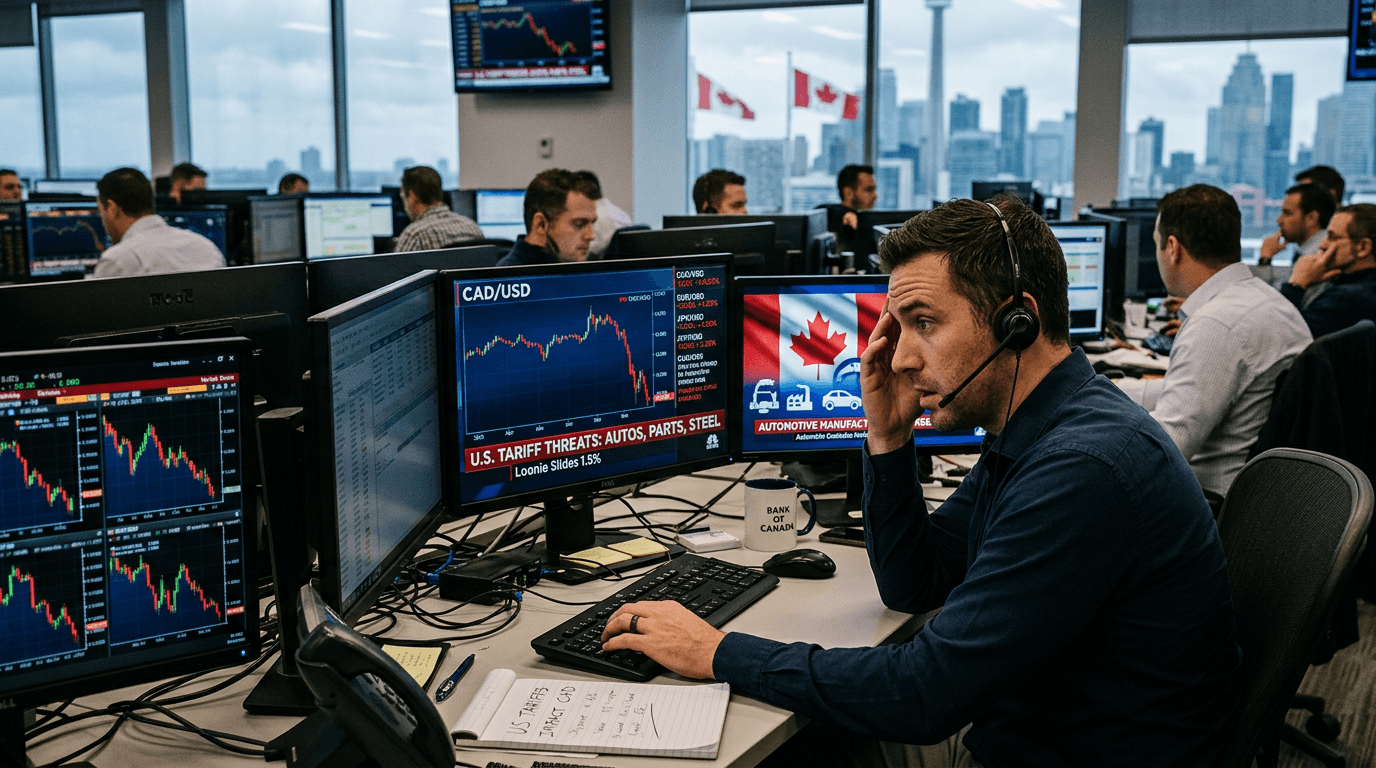
The Canadian dollar’s latest slide is a reminder of how quickly currencies can reprice when politics and policy collide. A single announcement from Washington threatening tariffs of up to 50% on Canadian autos, parts and steel has been enough to turn the loonie into the softest major currency on the board, as traders reassess growth prospects, trade flows and central bank paths across North America.[3][5][7][14] For both discretionary and systematic traders, this is a live case study in how trade shocks ripple through FX markets in real time.[14]
What Triggered The Canadian Dollar Sell-off
The immediate catalyst for the move was a new U.S. threat to sharply raise tariffs on all Canadian cars, trucks, automotive parts and steel, with levies potentially reaching 50% from early 2027.[3][5][7][8] This would roughly double existing top-line tariffs on Canadian auto imports into the United States and broaden them to a wider set of products.[5][7] The announcement followed the breakdown of trade talks between Ottawa and Washington, with both sides signaling a willingness to escalate and Canada pledging to match any U.S. measures “dollar for dollar.”[3][7][8][11]
In FX markets, the loonie weakened around 0.6% against the U.S. dollar, marking its largest one-day drop in weeks and leaving it as the weakest-performing major currency on the day.[14] The move reversed part of the currency’s recent gains that had been driven by hopes of a tariff reprieve and a relatively constructive backdrop for risk assets.[9][15] As the tariff headlines hit, investors trimmed expectations for additional Bank of Canada rate hikes and sought safety in the U.S. dollar, amplifying the downside pressure on CAD.[2][14]
WHY TARIFFS ARE A BIG DEAL FOR CANADA’S ECONOMY
Canada’s economy is deeply integrated into North American supply chains, especially in autos and manufacturing. A large share of Canadian automotive production is destined for the U.S. market, often crossing the border multiple times as parts and subassemblies move between plants.[3][6][7] Imposing tariffs as high as 50% along that chain raises costs, squeezes margins and threatens to disrupt production decisions on both sides of the border.[3][6][7]
From a macro perspective, tariffs act like a tax on trade. Higher barriers tend to reduce export volumes and worsen the trade balance, particularly for an export-oriented economy like Canada’s.[12] Research from the Bank of Canada on hypothetical U.S. tariff shocks shows that higher tariffs can lower Canada’s net exports, reduce terms of trade and ultimately lead to a weaker Canadian dollar as markets price in slower growth.[12] Past episodes of tariff tensions have shown similar dynamics, with the loonie selling off sharply when new measures are announced and recovering only when tensions ease.[13]
There is also an indirect confidence channel at work. Businesses confronted with uncertainty about future trade rules tend to delay investment and hiring, while households may become more cautious about spending. That combination can dampen growth expectations, making the currency less attractive compared with peers and reinforcing the downside move.[12][13]
How Fx Markets Price Trade Shocks Into Cad Crosses
For traders, the loonie’s reaction highlights how quickly trade policy risk feeds into currency pricing. Several mechanisms were visible in this episode.
First, there was a swift repricing of interest rate expectations. As the tariff threat raised the risk of weaker Canadian growth, traders scaled back bets on further Bank of Canada tightening, narrowing the appeal of CAD relative to higher-yielding or more stable currencies.[2] Wider yield spreads in favor of the U.S. dollar made USD/CAD more attractive to hold, contributing to the pair’s rise.[2][14]
Second, risk sentiment deteriorated. Trade-war headlines tend to trigger a broader “risk-off” tone, with investors selling growth-sensitive assets and rotating into safe havens. The Canadian dollar, often seen as a pro-cyclical and commodity-linked currency, can come under pressure as global funds move into the U.S. dollar, the yen or the Swiss franc.[14] That helps explain why CAD underperformed not just against USD but also against other majors such as the euro and yen.[1][14]
Third, cross-asset signals mattered. Equity weakness in North American auto and manufacturing stocks, combined with volatility in commodity prices, reinforced the narrative of a potential slowdown in Canadian exports.[6][7][14] FX traders monitoring these correlated markets had additional confirmation that the macro balance was tilting against CAD, prompting further selling in key crosses like EUR/CAD, GBP/CAD and AUD/CAD.[1][14]
Scenarios Traders Should Watch
With headline risk elevated, scenario planning becomes essential.
In an escalation scenario, Washington follows through on 50% tariffs and Canada responds with equally forceful countermeasures.[3][7][8][11] Over time, this could disrupt auto supply chains, weigh heavily on Canadian manufacturing and push firms to relocate or delay investments.[3][6][7] Under this path, markets would likely price a weaker growth and inflation outlook for Canada, keeping CAD under pressure and potentially pushing USD/CAD towards or beyond prior stress levels.[12][13][14] Volatility would remain high as traders react to each new policy announcement.
In a compromise scenario, negotiations resume and the two sides strike a deal that caps or phases in tariffs, or carves out exemptions for some products.[9][15] Even a temporary suspension of tariffs has previously given the loonie a reprieve, as seen when CAD rallied on news of a short-term pause in new U.S. measures.[9] Under a more constructive outcome, the currency could recover some of its recent losses, especially if global risk appetite stabilizes and the Bank of Canada maintains a steady policy stance.[9][12]
A third possibility is a long “limbo” period where threats and counter-threats proliferate but implementation is delayed or partial. In that environment, uncertainty itself becomes the main driver, capping CAD upside and encouraging range-bound trading punctuated by sharp headline-driven moves.[13][15] For active traders, this kind of regime rewards disciplined risk management and nimble positioning more than directional conviction.
Practical Lessons For Simulated And Live Traders
For participants in simulated finance environments, this episode offers several practical lessons that translate directly to live markets.
First, macro headlines can overwhelm technical setups. A currency pair that looks technically bullish can quickly reverse when a major policy shock hits. Building scenarios in a SimFi platform that stress-test positions against sudden tariff or policy announcements helps traders understand how fragile a given setup might be.
Second, cross-asset awareness is non-negotiable. The Canadian dollar is sensitive not just to domestic data but also to U.S. policy, auto-sector news and global risk appetite.[1][6][14] Simulated strategies that integrate equity indices, bond yields and commodity prices alongside FX can better capture the full picture of risk and opportunity.
Third, trade shocks are rarely one-day stories. The initial reaction to tariff news is often followed by a sequence of negotiations, retaliatory measures and policy adjustments that create a series of tradable swings.[3][7][9][14] Practicing how to scale in and out of positions, adjust stop losses and manage exposure as headlines evolve is a valuable exercise in a low-risk SimFi environment.
Finally, risk management is the constant. Sudden moves like the loonie’s drop on tariff headlines underscore the importance of position sizing, diversification and clearly defined downside limits. Whether trading USD/CAD, CAD/JPY or CAD crosses with European currencies, disciplined risk controls can make the difference between a manageable drawdown and a portfolio-breaking loss.
Conclusion
The Canadian dollar’s decline on the back of threatened 50% U.S. tariffs is a textbook example of how trade policy, growth expectations and market psychology intersect in FX.[3][5][7][14] For Canada, the stakes are high: tariffs on autos, parts and steel strike at the heart of its export engine and its integration into North American supply chains.[3][6][7][12] For traders, the episode reinforces the need to track policy risk, think in scenarios and respect the speed with which markets can reprice when the rules of the game appear to change.
By viewing this event through the lens of both macroeconomics and trading practice, market participants—whether in simulated environments or live accounts—can turn volatility into a learning opportunity. The loonie’s latest slide may be driven by headlines, but the skills developed in navigating it will remain relevant long after the current tariff story has run its course.