
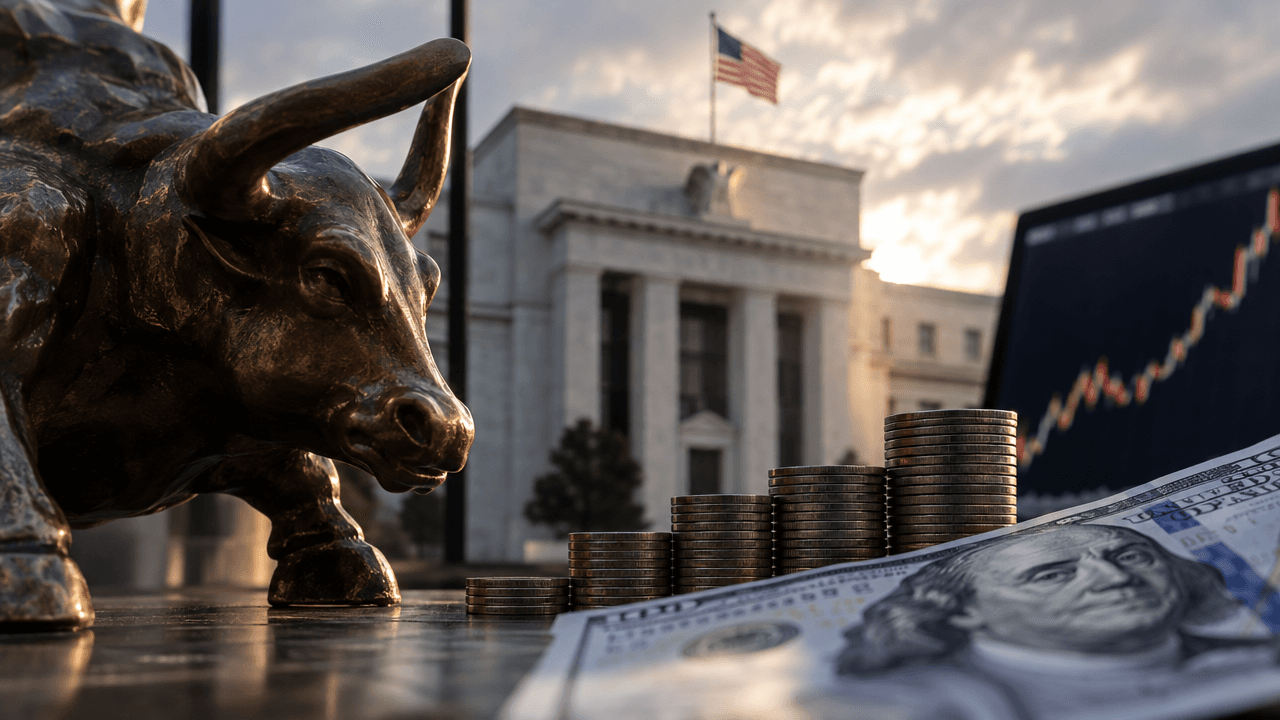
Markets are sending a clear message: the “higher for longer” narrative on U.S. interest rates is alive and well, and an October Federal Reserve hike is firmly on the table. Futures markets are currently assigning elevated odds—roughly in the 50–70% range depending on the contract and methodology—to another 25 basis point increase at the upcoming meeting.[4][8][15] For traders, that probability is high enough that ignoring it is no longer an option.
Why October Hike Odds Are Elevated
The key driver behind the higher October odds is ongoing resilience in U.S. economic data, particularly in business activity measures like purchasing managers’ indices (PMIs).[2][14] Recent services PMI readings in the mid-50s signal expansion, not slowdown, reinforcing the idea that demand remains strong and inflation pressures could prove sticky.[2][14]
This data backdrop comes on the heels of a recent Fed hike, where policymakers raised rates by 25 basis points and signaled in their projections that most of them still expect at least one more increase this year.[1][3][5] With 16 of 18 officials penciling in another move, markets are simply translating that guidance into probabilities and choosing October as a prime candidate.[5][10]
Fed funds futures and tools like CME’s FedWatch have reflected a notable shift over recent weeks. Probabilities for an October hike have climbed from low double digits earlier in the summer to more than half, with some readings pushing toward the 60–70% area after strong data and hawkish commentary.[4][8][15] In effect, the market is saying: an October hike may not be guaranteed, but it is now the base case rather than the tail risk.
Impact On Bonds And The Dollar
Rate expectations show up first and most directly in the bond market. Short-dated U.S. Treasury yields, particularly the two-year note, are highly sensitive to changes in the expected path of the Fed funds rate.[1][9] After the latest hike and the reinforcement of the “one more this year” message, two-year yields have moved higher into the mid-4% range, reflecting investors’ willingness to price tighter policy for longer.[1][9][10]
Further out on the curve, 10-year yields have held near the psychologically important 5% level, underscoring how the market is repricing not just the next meeting but the entire trajectory of policy and inflation.[1][9][10] This combination of elevated short-end yields and firm long-end rates keeps financial conditions tighter and raises the discount rate applied to virtually all asset valuations.
The dollar has responded in kind. A more hawkish Fed relative to other central banks tends to support the U.S. currency, and recent sessions have seen the dollar index grind higher as rate expectations reset.[9][10][12] For global traders, this affects everything from emerging-market funding costs to the relative attractiveness of non-dollar assets, and it increases the importance of FX risk management.
Pressure On Equities, Crypto, And Other Risk Assets
Higher yields and a stronger dollar typically create headwinds for equities, especially growth and tech names with longer-duration cash flows. Recent trading sessions following the Fed’s latest move saw major U.S. indices pull back, as investors digested the prospect of another hike and a prolonged period of restrictive policy.[1][3][9][10] While this is not a panic-driven selloff, it is a clear repricing of risk.
Rate-sensitive assets—such as high-dividend stocks, REITs, and speculative growth names—are particularly vulnerable when the market leans toward further tightening. Crypto assets have also tended to struggle in such environments, as higher real yields and a firm dollar reduce the relative appeal of non-yielding, higher-volatility alternatives.[12] The current backdrop of elevated October hike odds therefore caps upside in these segments, even when short-term technicals look supportive.
In commodities, gold often faces competing forces: on one side, higher real yields and a stronger dollar weigh on prices; on the other, lingering macro uncertainty and inflation worries support demand.[12] The net result is choppier price action, which can be an opportunity for active traders but demands clear risk parameters.
What This Means For Traders And Simulated Finance
For active traders and SimFi participants on platforms like E8 Markets, the current environment is a rich testing ground for macro-driven strategies. Elevated but not certain odds of an October hike create a classic probability-based scenario: markets are pricing a likely outcome, but data and Fed communication can still push those odds meaningfully higher or lower.
This is an ideal setting to practice scenarios such as:
1) Trading the path of yields via simulated bond futures and rate products as odds shift with each new data release. 2) Testing FX strategies that go long the dollar against currencies where central banks are either more dovish or closer to a pause. 3) Stress-testing equity portfolios for valuation sensitivity to higher discount rates, particularly in growth sectors. 4) Exploring crypto strategies that factor in macro headwinds, focusing on risk management and volatility controls rather than pure directional bets.
Because the hike is not guaranteed, traders can explore both “surprise” and “no surprise” outcomes—what happens if the Fed delivers in October versus defers to December, and how markets might react differently depending on the messaging around inflation and growth.
How To Position In A Higher-for-longer Regime
In a world where another Fed hike this year is more likely than not, and policy is expected to remain restrictive for an extended period, several practical principles stand out:
1) Respect the short end of the curve. Short-dated yields are the clearest expression of changing Fed odds and often lead broader risk sentiment. Monitor two-year yields and futures-implied probabilities as key reference points.[1][4][8]
2) Watch PMIs and inflation prints closely. Strong business activity data and upside surprises in inflation are the main catalysts pushing hike odds higher.[2][14] Weakening PMIs or cooler inflation would do the opposite.
3) Avoid over-leverage in rate-sensitive assets. Environments with rising yield expectations can produce sharp drawdowns in equities, crypto, and high-beta trades when market assumptions shift quickly.[3][12]
4) Use simulation to understand nonlinear reactions. Markets rarely move in a straight line; the same Fed decision can produce different reactions depending on positioning, sentiment, and prior expectations. SimFi environments allow traders to model these complexities without real capital at risk.
Conclusion
Markets are not waiting for October to decide how they feel about the Fed’s next move—probabilities are already elevated, and asset prices are adjusting accordingly. Strong PMIs and a hawkish policy backdrop have pushed futures-implied odds of an October hike into a range where traders must take them seriously, even if the outcome is not yet locked in.[2][4][8][14] Higher yields, a firmer dollar, and constrained upside in risk assets are all manifestations of that repricing.[1][9][10][12]
For traders and SimFi participants, the key is not to predict the Fed with false certainty, but to understand how shifting probabilities ripple through bonds, FX, equities, and crypto—and to build strategies that are robust across multiple scenarios. October’s decision will be important, but how markets evolve in anticipation of it may offer even more actionable opportunities.