
Markets Show Resilience Amid Tariff Turmoil: Navigating the Complex Trade Landscape
A Late-Day Comeback
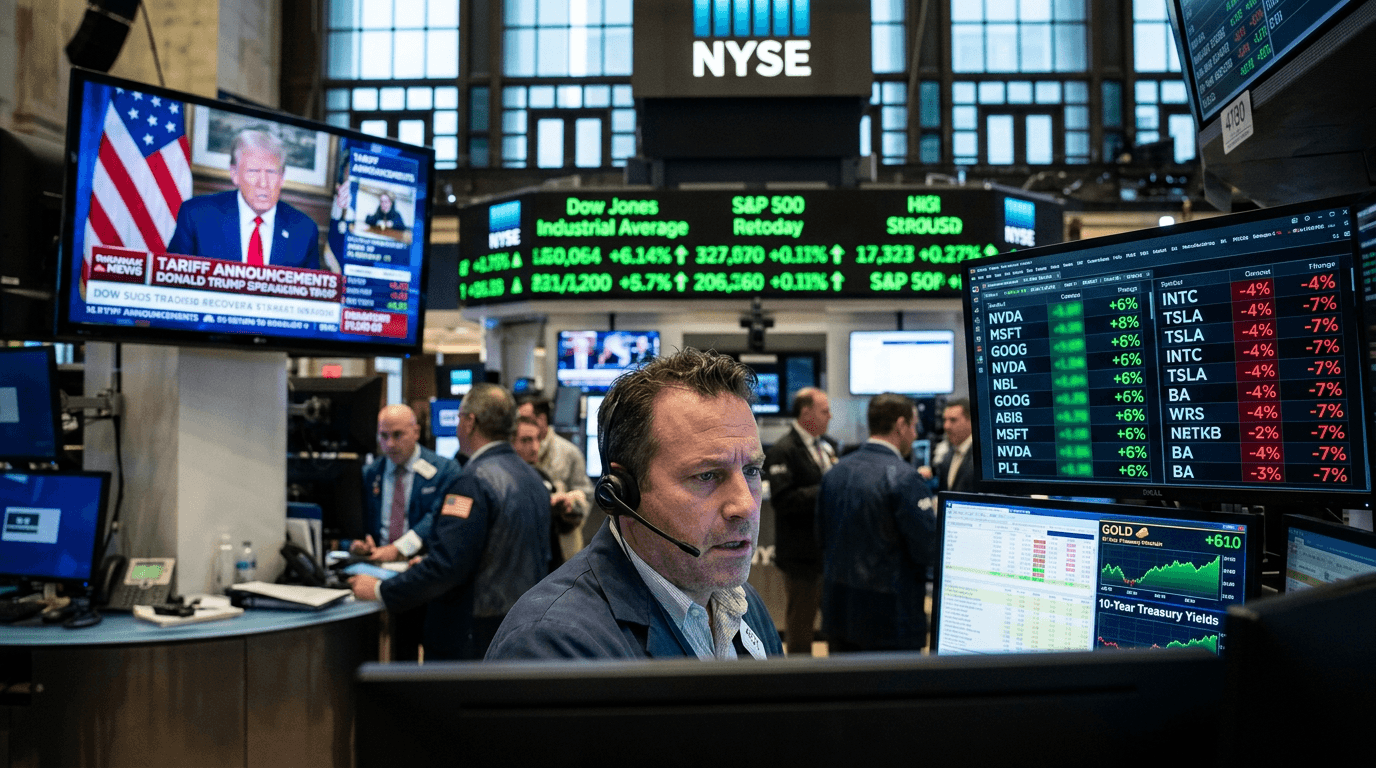
On Monday, U.S. stock markets showcased their resilience in the face of rising concerns over President Trump's escalating tariff plans. Major indices managed a late-day recovery despite investors grappling with conflicting signals regarding trade policy and monetary stimulus. This rebound from early declines highlights a critical dynamic: while tariff uncertainty poses real challenges for equity valuations, investors remain on the lookout for opportunities amidst the volatility, weighing hawkish trade policies against the potential for moderating interest rates.
The Tariff Uncertainty Framework
President Trump's recent announcement of temporary 15% tariffs, an increase from the previously proposed 10%, initially sent shockwaves through global markets. The S&P 500 fell 1%, the Dow dropped 821 points or 1.7%, and the Nasdaq declined 1.1% as investors processed the implications of broader trade restrictions. What makes this situation significant is the complexity of Trump's approach. Instead of relying solely on broad reciprocal tariffs, which the Supreme Court struck down, the administration is employing multiple legal avenues, including Section 232 tariffs that have no upper limit and can be expanded once implemented. This layered strategy suggests an increasingly fragmented and targeted trade war, particularly affecting semiconductor and AI companies reliant on global supply chains.
The uncertainty surrounding these measures has proven more destabilizing than the tariffs themselves. Global trading partners, including South Korea, have expressed concern that new tariffs under alternative legal frameworks could escalate further. Goldman Sachs noted a decline in its Risk Appetite Indicator as traders began realizing the Supreme Court decision would open a new chapter rather than conclude the trade saga.
Sector-Specific Pressures and the AI Divide
Beyond tariffs, the markets revealed another critical fault line: the growing divergence between companies viewed as winners and losers in the artificial intelligence revolution. Cybersecurity and software firms faced significant pressure over fears that AI-powered competitors might cannibalize their customer bases. CrowdStrike's shares plunged 9.8% as new security tools from Anthropic showcased AI's potential to automate vulnerability scanning. AppLovin's stock sank 9.1% amid concerns about AI competition restructuring the software industry. Even companies lending to software firms felt the impact, with Blue Owl Capital falling 3.4%.
This dynamic highlights how tariff fears intersect with technology sector anxieties. Companies in semiconductors and AI face a dual challenge: tariffs could raise input costs and disrupt supply chains, while also raising existential questions about market competition and customer retention. The forthcoming Nvidia earnings report will likely provide crucial insights into whether these cost pressures are translating into actual margin compression or if the market is overreacting.
Currency and Commodity Responses
While equity markets swung dramatically, currency and commodity markets painted a more coherent picture of risk sentiment. The U.S. dollar strengthened against commodity-linked currencies, including the Canadian Dollar, Australian Dollar, and New Zealand Dollar, reflecting a broader risk-off stance. Gold rose 1.81% as investors sought safe-haven assets, with prices nearing record highs amid persistent uncertainty over trade policy and monetary conditions. Bitcoin briefly dipped below $64,000 but showed resilience relative to its monthly lows, suggesting selective risk appetite remained intact despite broader concerns.
These movements indicate that while equities are experiencing volatility, investors are not capitulating entirely. Instead, capital is rotating toward traditional hedges while selectively seeking value in depressed segments. The dollar's strength against commodity currencies is particularly significant for emerging market investors and companies with substantial overseas revenue.
Forward Implications for Traders
The late-session rebound in major indices despite tariff fears suggests several working hypotheses among market participants. First, investors may be factoring in a protracted negotiation process, allowing time for potential political compromise before actual tariff implementation. Second, recognizing the Supreme Court's limitation on Trump's unilateral tariff authority may prevent the most extreme scenarios some feared. Third, some traders view sharp declines as buying opportunities, especially in oversold AI and technology stocks.
However, the persistence of elevated volatility and mixed signals from policymakers suggest caution remains warranted. Global economies face genuine uncertainty about trade flows and supply chain restructuring. Trump's patchwork approach could create specific winners and losers rather than broad market-wide impacts, rewarding selective stock picking over broad index strategies.
For traders navigating this environment, recent volatility has created both risks and opportunities. Managing exposure to tariff-sensitive sectors while identifying companies that benefit from trade policy shifts will likely determine outperformance in the coming weeks.
NEWSIMPACTSCORE: 7