
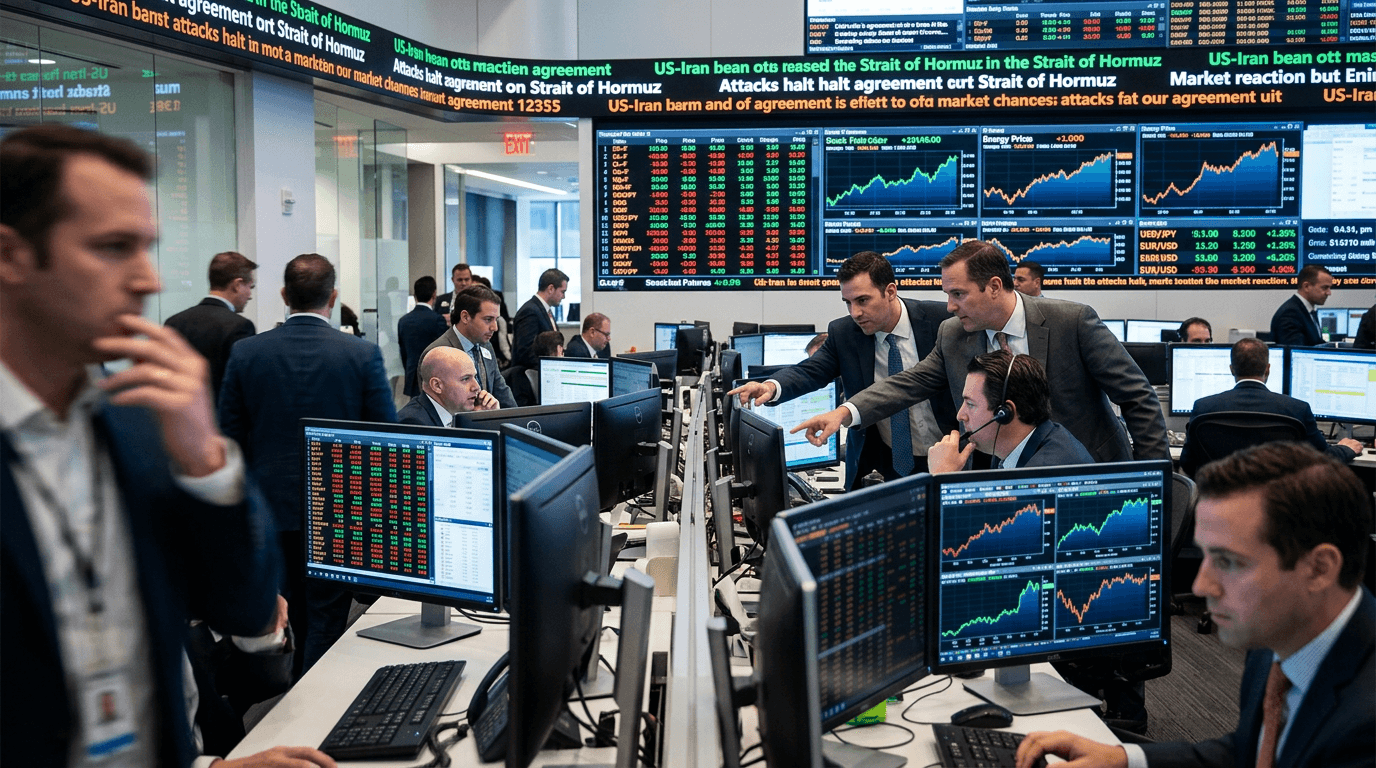
Reports that the United States and Iran have reached a provisional framework to halt attacks and reopen key maritime routes in the Persian Gulf have given global markets a rare moment of relief, firming US stock index futures and energy prices while cooling demand for traditional safe-haven currencies.[6][7] For traders, this is a textbook example of how geopolitical risk quickly translates into moves across equities, commodities, and foreign exchange.
Market Reaction: Futures And Energy Firmer
Initial reports suggest Washington and Tehran have agreed to a framework that includes an immediate suspension of military operations on all fronts and steps toward reopening the Strait of Hormuz and lifting the US naval blockade of Iranian ports.[2][3][6][7] With one of the world’s most critical energy chokepoints potentially moving from “closed and contested” to “reopening under a ceasefire,” futures markets were quick to react.
Oil prices edged higher as traders reassessed the near-term risk of supply disruption and the medium‑term path toward normalized exports from the region.[6] At the same time, US equity index futures, including S&P 500 and Nasdaq contracts, firmed as the most acute geopolitical risk premium in asset prices eased, supporting risk appetite.[6] Safe‑haven currencies such as the US dollar and Japanese yen saw more tempered demand, reflecting a modest rotation back toward risk assets as fears of escalation receded.[6]
This kind of cross‑asset move is typical when markets shift from pricing “tail‑risk escalation” toward “conditional de‑escalation.” The key for traders is recognizing that the reaction is often partial and probabilistic: prices adjust to the new information, but they rarely assume that geopolitical tensions have disappeared entirely.
Why The Persian Gulf Matters For Markets
The core of this story is the Strait of Hormuz, the narrow maritime passage between the Persian Gulf and the Gulf of Oman through which a significant share of the world’s seaborne oil and gas exports flows.[6][7] The recent conflict between the US and Iran led to a US naval blockade of Iranian ports and disruption risks for shipping in the area, raising concerns about energy supply and freight costs.[3][6]
The provisional agreement between the US and Iran is reported to include:
An immediate halt to military operations on all fronts, including in Lebanon.[2][6][7]
Reopening the Strait of Hormuz and lifting the US naval blockade of Iranian ports.[2][3][6]
A 60‑day framework to negotiate nuclear issues, sanctions relief, and the handling of Iran’s stockpile of highly enriched uranium.[6][7]
If these steps are implemented, they would materially reduce the probability of sudden supply interruptions, reroutings of tankers, and sharp spikes in shipping insurance and freight rates.[2][3][6] That, in turn, feeds directly into market pricing for crude, refined products, and even inflation expectations.
However, traders cannot treat this as a guaranteed end to risk. Previous ceasefires in the conflict have proved fragile, with violations and retaliatory strikes undermining confidence in longer‑term stability.[4][5][9] The market’s relief is real, but it is conditional on the ceasefire framework holding.
Energy Prices And The Geopolitical Risk Premium
Over the past months, the conflict and blockade have injected a geopolitical risk premium into oil and gas markets—an extra layer of price elevation driven not by demand and supply fundamentals alone, but by fears of disruption.[6][7] News of a ceasefire and reopening of key routes affects this premium in two main ways:
Near‑term logistics: If shipping lanes are safer and ports are accessible, traders expect fewer sudden outages or reroutes, which narrows the range of extreme price scenarios.[2][3][6]
Medium‑term exports: Draft deal terms reportedly include some relief from sanctions on Iranian oil sales and unfreezing of assets over time, which could eventually increase Iran’s ability to export energy.[6]
In the very short term, markets often react in a counterintuitive way: prices can rise on ceasefire headlines if they signal improved economic activity and broader risk‑on sentiment, or fall if traders focus on improved supply prospects. In this case, prices edged higher alongside equity futures, indicating that risk appetite and a reassessment of worst‑case scenarios played a meaningful role.[6]
For traders, the practical takeaway is that geopolitical risk premiums are dynamic. They compress on constructive headlines and expand rapidly when ceasefires are violated or negotiations break down.[4][5][9] Scenario planning—thinking through “deal holds,” “deal frays,” and “deal fails” paths—is essential.
EQUITY FUTURES, SAFE‑HAVEN FX, AND RISK SENTIMENT
US stock index futures reacted positively as the perceived probability of a broader regional war—and its potential impact on global growth and corporate earnings—declined.[6] Energy‑sensitive sectors, industrials, and globally exposed firms are particularly influenced by shifts in oil prices, shipping costs, and geopolitical uncertainty, so easing tension tends to support index‑level futures.
On the FX side, the same headline triggered a moderation in demand for classic safe‑haven currencies and assets.[6] During periods of heightened conflict, traders often rotate into the US dollar, Japanese yen, and Swiss franc, as well as Treasuries and gold. A credible ceasefire framework reduces the urgency of these defensive moves, allowing capital to flow back into higher‑beta assets such as equities and cyclical currencies.
The nuance is that this rotation is rarely all‑or‑nothing. With reports highlighting that the agreement is provisional, subject to a 60‑day nuclear and sanctions negotiation window, and against a backdrop of previous ceasefire violations, some degree of caution is likely to remain embedded in pricing.[4][5][6][7][9]
How Traders Can Use This In A Simulated Environment
For traders using a simulated finance (SimFi) platform, this type of event is a valuable case study in cross‑asset geopolitics. A few practical exercises can help build skill:
Track correlations: Monitor how oil futures, equity index futures, and major FX pairs move relative to each other on geopolitical headlines connected to the Persian Gulf.[6] Notice which assets lead and which lag.
Build scenarios: Construct three simple scenarios—stable ceasefire, renewed violations, and broadened peace—and map out how you expect energy prices, US stock futures, and safe‑haven FX to react under each. Then compare against real‑world price action as news evolves.[4][5][6][7][9]
Practice risk management: Use simulated positions to test hedging strategies, such as offsetting long equity exposure with energy or volatility instruments when geopolitical risk rises, and gradually reducing hedges when risk premiums compress.
By treating this US–Iran ceasefire framework as a living case study rather than a one‑off headline, traders can sharpen their understanding of how geopolitical developments ripple through markets—and how to respond systematically rather than emotionally.