
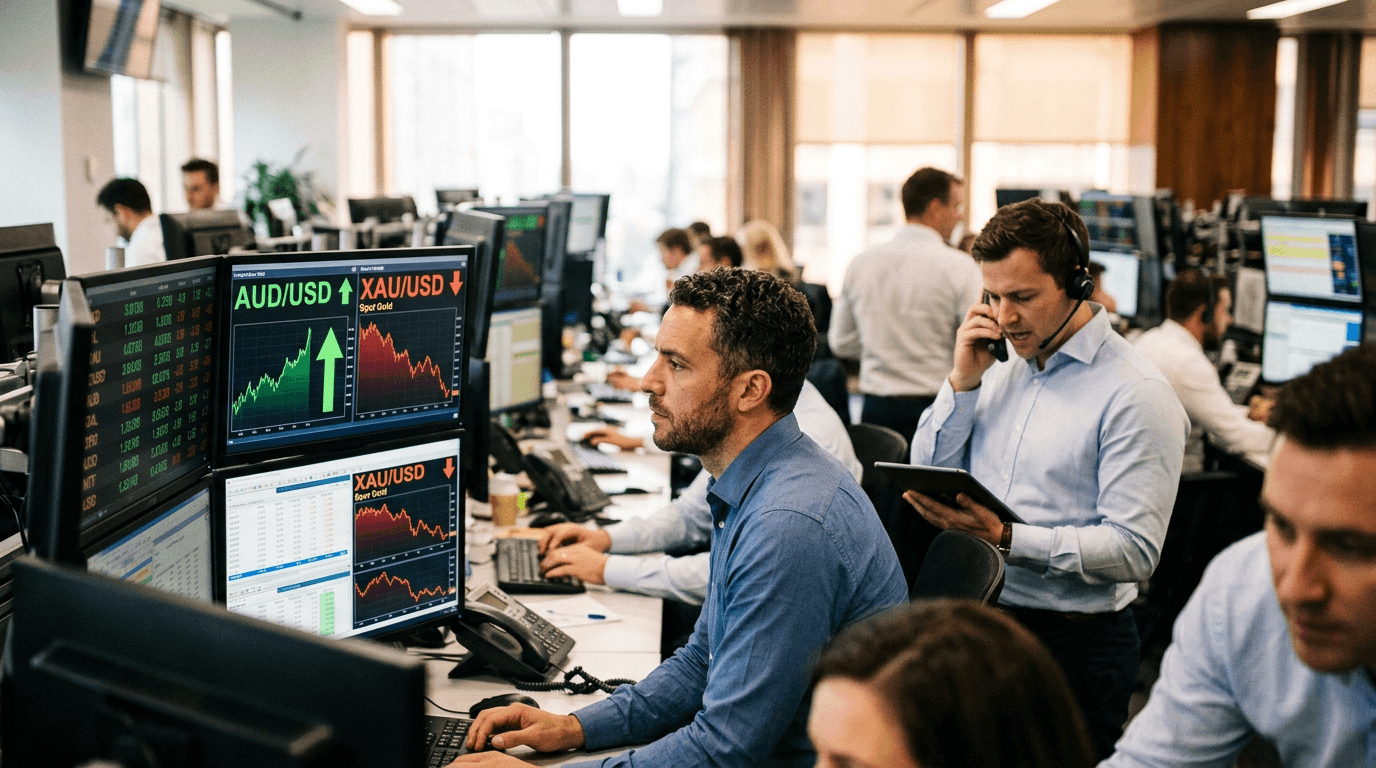
De-escalation in the Middle East is taking markets out of “crisis mode” and back toward a more traditional risk-on environment, with capital rotating out of safe havens and into growth‑sensitive assets.[3][4] A pause in strikes between Israel and Iran has eased fears of a wider regional conflict, unwinding some of the intense safe‑haven flows that built up during the latest spike in geopolitical risk.[2][3][4] For traders, this shift is a textbook example of how quickly geopolitics can flip the cross‑asset narrative—from risk‑off to risk‑on and back again.[2][3]
GEOPOLITICS: FROM RISK‑OFF TO RISK‑ON
When tensions escalated earlier, markets rushed into classic safe havens such as gold, the Japanese yen, the Swiss franc, the US dollar, and US Treasuries.[2][3] That move was driven by fears of tail risks: broader regional conflict, energy supply disruptions, and spillovers into global growth.[2][3][6] Now that immediate escalation risks have eased, those same positions are being unwound as traders reprice the probability of a worst‑case scenario.[3][4]
This is the mirror image of the initial shock. On escalation, we saw a surge in safe‑haven demand and pressure on risk‑sensitive currencies and equity futures.[2][3][6] On de‑escalation, the market reaction runs in reverse: safe havens underperform, while risk assets and high‑beta FX catch a bid.[3][4]
Importantly, the speed of these rotations highlights how geopolitical risk is less about precise forecasts and more about changes in perceived probabilities. When the market believes the path has shifted from “likely escalation” to “tentative de‑escalation,” risk premia compress across assets—sometimes within hours.[2][3][4]
HIGH‑BETA FX: WHY AUD AND PEERS LEAD THE REBOUND
High‑beta currencies like the Australian dollar tend to be among the first beneficiaries when risk appetite recovers.[2][3] These currencies are closely linked to global growth, commodity demand, and broader risk sentiment, so they often underperform during periods of geopolitical stress and outperform when fears subside.[2][3][6]
During the height of Middle East tensions, traders reduced exposure to risk‑sensitive FX such as AUD, NZD, and many emerging‑market currencies, while rotating into defensive FX like JPY, CHF, and the dollar.[2][3] As de‑escalation headlines emerged, that risk‑off positioning became crowded and vulnerable to a squeeze, helping AUD/USD and other high‑beta pairs rebound from recent lows.
Three mechanisms help explain why high‑beta FX can move so sharply when the tone shifts:
1) Positioning: After a risk‑off shock, speculative and hedging flows often leave high‑beta FX short‑squeezed on any sign of relief. 2) Rate and carry dynamics: When geopolitical stress eases, investors are more comfortable seeking carry and growth exposure in higher‑yielding or commodity‑linked currencies. 3) Cross‑asset alignment: Recoveries in equity futures and credit spreads typically support the same pro‑risk basket that includes AUD, NZD, and select EM FX.
For traders, this means that de‑escalation can create tactical long opportunities in high‑beta FX—but only if you understand the context: how stretched positioning is, where key technical levels sit, and how much “war premium” has already been priced out.
Safe Havens Give Back The War Premium
On the other side of the ledger, traditional safe havens are surrendering part of their recent gains as the market sheds its worst‑case assumptions.[3][4] Earlier in the conflict cycle, gold saw strong inflows, the dollar index firmed, and defensive FX such as JPY and CHF outperformed as investors sought safety.[2][3] Now, with de‑escalation in focus, those assets are giving back some of that war premium.
Analysis of earlier episodes shows that intense safe‑haven flows during Middle East or Iran‑related shocks can last 5–10 trading days, with the duration and magnitude highly dependent on subsequent headlines.[3] When the news flow turns less threatening, flows can reverse quickly, particularly in gold and FX, where liquidity allows rapid repositioning.[3][4]
Current price action fits this pattern. Expectations of easing Middle East tensions have driven a visible pullback in safe‑haven demand—especially for the US dollar and other crisis‑linked assets.[4] Gold, which rallied on initial escalation, is now under pressure as investors re‑embrace risk, while Treasury yields and risk‑sensitive assets adjust accordingly.[3][4]
The key lesson is that safe‑haven trades are rarely “set and forget.” They are dynamic expressions of perceived risk, and when that perception changes, the unwind can be just as aggressive as the original move.
Trading Playbook: How To Navigate The Reversal
For both simulated and live traders, this kind of de‑escalation scenario is an ideal testing ground for a structured risk‑event playbook.[2] A robust approach includes:
1) Mapping the cross‑asset chain: Identify which assets are most sensitive to geopolitical risk—gold, energy, JPY, CHF, USD, high‑beta FX, equity indices, and credit. Know how they typically react when risk rises vs. when it falls.[2][3][6]
2) Tracking the “risk premium”: During escalation, ask what portion of a move in gold, crude, or FX is pure war premium versus macro. During de‑escalation, gauge how much of that premium has been priced out and how much might still unwind.
3) Using scenarios rather than single forecasts: Build at least three paths—renewed escalation, fragile status quo, and durable de‑escalation.[2][3] For each, define how you expect AUD, gold, JPY, and indices to respond. This helps avoid overreacting to every headline.
4) Managing size and liquidity: Geopolitical tapes are headline‑driven and can gap. Respect liquidity conditions, especially around key news windows, and use simulated environments to refine execution and risk controls before scaling in size.
5) Watching correlations in real time: In true crisis phases, correlations can spike toward one, with most risk assets selling off together.[2][3][6] As tensions ease, correlations often normalize. Monitoring that transition helps validate whether the risk‑on move has real depth or is just a short‑covering bounce.
For traders on a SimFi platform, this is an opportunity to stress‑test strategies across the full cycle: from escalation to peak fear to de‑escalation and normalization. You can replay scenarios, adjust your assumptions about safe‑haven behavior, and refine the timing of rotations into or out of high‑beta FX.
A Changing Risk Landscape And What Comes Next
Although the latest pause in hostilities has eased immediate market stress, the underlying geopolitical backdrop remains a key macro variable.[2][3][4][6] History shows that Middle East‑related shocks often arrive in waves, with periods of calm punctuated by fresh flare‑ups that re‑ignite safe‑haven demand.[2][3][6]
That is why traders should treat the current de‑escalation not as an endpoint, but as one phase in an ongoing process of repricing geopolitical risk. High‑beta FX, equities, and credit may continue to benefit as long as the news flow remains constructive, but that support can fade quickly if tensions resurface. By the same token, the recent pullback in safe havens does not erase their role; it simply reflects a lower perceived probability of extreme outcomes at this moment in time.[2][3][4]
The most durable edge in this environment comes from preparation rather than prediction. Understanding how safe‑haven flows behave, how risk assets respond as fear rises and falls, and how quickly markets can rotate when the narrative shifts gives you a framework to navigate volatility with more confidence.[2][3] Whether trading in a simulated or live environment, this Middle East de‑escalation episode is a powerful real‑time case study in how geopolitics, risk sentiment, and cross‑asset pricing are tightly intertwined—and how adaptable traders can turn that complexity into opportunity.