
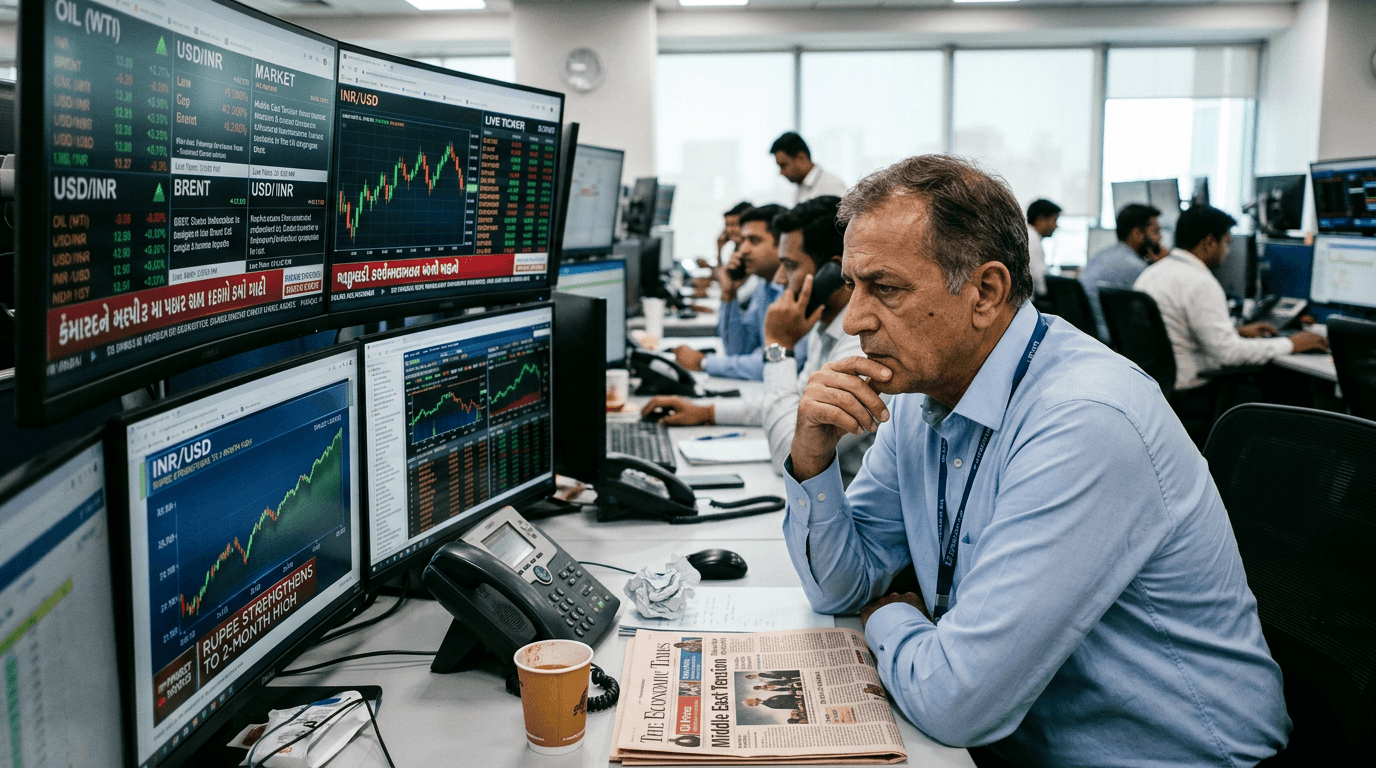
Middle East hostilities are once again rippling through global markets, driving oil higher, supporting the U.S. dollar and yet leaving the Indian rupee trading near a two‑month high around 94.95 per dollar[2][7][8][14][15]. That divergence in FX performance highlights how geopolitics, energy prices and local fundamentals can combine to create very different outcomes across currencies[5][9][11].
Global Market Backdrop
Renewed conflict and tensions across the Gulf and wider Middle East have disrupted energy flows and raised fears of supply interruptions, pushing benchmark crude prices sharply higher[2][3][7][11]. In recent episodes of escalated hostilities, Brent and WTI futures have jumped multiple percentage points in a matter of sessions as markets price in both physical disruption and geopolitical risk premia[2][3][7].
Oil’s surge has reinforced the U.S. dollar’s role as a safe‑haven currency, with the dollar index advancing against a broad basket of peers during recent flare‑ups[2][5][7][9]. Alongside classic risk aversion, traders are also factoring in the U.S.’s position as a major oil producer and the dollar’s central role in energy trade, which can magnify dollar strength when crude prices spike[6][7].
At the same time, other asset classes have responded in a familiar pattern: gold has attracted defensive flows, global equities have wobbled, and bond yields have adjusted as investors reassess inflation and growth trajectories in light of higher energy costs[7][11]. These cross‑asset moves frame the environment in which currency traders must navigate short‑term volatility and longer‑term macro shifts[5][7][9].
Oil, Dollar And Inflation Expectations
Higher oil prices feed directly into inflation expectations, particularly for energy‑importing economies, and that has implications for interest‑rate markets and FX pricing[5][7][11]. As Brent crude has climbed into the 90‑plus dollar range during recent bouts of tension, markets have repriced the path of global policy rates, including renewed speculation about additional tightening by the Federal Reserve[2][5][11].
Rising U.S. Treasury yields, driven partly by energy‑linked inflation concerns, tend to support the dollar by widening rate differentials versus other major currencies[5][7][11]. This dynamic has been visible whenever Middle East risk pushes oil higher: yields push up, rate‑hike bets firm, and the dollar stands tall against lower‑yielding or more risk‑sensitive currencies[2][5][9].
Commodity‑linked currencies, such as those of major oil exporters, can benefit from higher crude prices, while import‑dependent economies face deteriorating terms of trade and potential pressure on their FX rates[6][7][11]. Yet as the rupee’s recent performance shows, local factors like capital flows and central‑bank actions can override textbook relationships, at least in the short term[11][12][13][15].
Rupee Resilience Amid Oil Shock
Despite elevated crude prices and a firm dollar, the Indian rupee has closed near a two‑month high around 94.95 to the dollar, outperforming many Asian peers that have weakened against the greenback[8][12][14][15]. Recent sessions saw the rupee settle in the 94.9–95.0 area, marking its strongest levels since late June even as regional FX faced headwinds from global bond sell‑offs and oil‑driven risk aversion[11][12][14][15].
Several factors underpin this resilience. Robust domestic growth and relatively contained fiscal slippage have improved India’s macro narrative, encouraging foreign portfolio inflows into local assets[11][13][15]. In addition, a large one‑off dollar funding haul of over $130 billion has bolstered confidence in India’s external position, reducing concerns about financing higher energy import bills[15].
The Reserve Bank of India (RBI) has also played an active role, using intervention and liquidity management to smooth volatility and lean against rupee weakness during episodes of global stress[11][12][14]. Market reports note aggressive central‑bank action and strong dollar‑selling flows from foreign banks as key drivers of the rupee’s climb to its recent peak[12][14][15].
That does not mean higher oil is painless for India. Elevated crude remains a structural headwind, feeding into import costs, inflation and the current account, and markets are well aware that a sustained spike could eventually cap rupee gains[11][13][15]. For now, however, the combination of inflows, policy support and solid growth has allowed the rupee to buck the regional trend in the face of Middle East‑driven energy risk[11][13][14][15].
What This Means For Traders
For FX and macro traders, the current backdrop is a live case study in how geopolitical shocks transmit through oil, rates and currencies in uneven ways[2][5][7][11]. The dollar’s strength in response to higher oil and heightened conflict risk fits historical patterns, but the rupee’s outperformance underscores the importance of looking beyond simple “oil up, importer FX down” narratives[6][7][11][14].
In discretionary trading and simulated environments alike, this episode highlights three key analytical pillars: global risk sentiment, energy pricing and country‑specific fundamentals[5][7][11][13]. Focusing on just one of these can lead to incomplete or misleading conclusions about a currency’s likely path. For example, assuming rupee weakness purely on the basis of higher crude would have missed the offsetting impact of inflows, RBI support and India‑specific funding news[11][13][15].
For dollar traders, the lesson is that energy‑driven safe‑haven flows can coexist with divergent moves elsewhere in the FX complex, creating relative‑value opportunities rather than a simple one‑way bet on broad dollar strength[5][7][9]. Crosses such as USD/Asia or oil‑sensitive pairs may react differently depending on their domestic rate outlook, external balances and central‑bank stance[6][7][11].
In simulated finance platforms, these dynamics can be modelled to help traders practice responding to multi‑factor shocks. Scenarios that link oil price jumps, shifts in rate expectations and targeted central‑bank intervention offer a rich environment for testing strategies around carry trades, hedging and regime‑based macro positioning[5][7][11][12].
Practical Takeaways For E8 Markets Users
Traders using simulated environments to build and test their strategies can draw several practical lessons from the current situation:
1) Track oil, rates and FX together Higher oil tends to push up inflation expectations and long‑term yields, supporting the dollar and affecting importers’ currencies in complex ways[5][7][11]. Integrating energy, bond and FX data into scenario building can improve strategy robustness[6][7][11].
2) Respect central‑bank and flow dynamics The rupee’s climb to a near two‑month high around 94.95 despite firm crude and a strong dollar reflects aggressive RBI intervention, robust growth and sizable inflows[11][12][13][14][15]. In simulations, include policy reaction functions and capital‑flow shocks rather than assuming markets move purely on global themes[11][12][15].
3) Differentiate between short‑term shocks and structural trends Middle East hostilities can trigger sharp, short‑term moves in oil and the dollar, but their lasting impact on currencies depends on how long disruptions persist and how inflation and policy expectations evolve[2][3][5][7][11]. Simulated strategies should distinguish between tactical trades around event risk and longer‑term positioning based on macro fundamentals[6][7][11][13].
4) Use divergence as a source of ideas The contrast between a stronger dollar and a stronger rupee amid the same oil shock is a reminder that FX markets price relative stories, not just global ones[7][11][14][15]. Building relative‑value strategies in simulations—long one currency, short another—can help capture these divergences without relying on outright directional bets on oil or the dollar[5][7][9][11].
Ultimately, the current episode is a valuable live case for understanding how geopolitics, commodities and policy interact in the currency market. Traders who study these linkages, test them in simulated environments and refine their frameworks will be better prepared when the next bout of Middle East tension—or any other shock—hits global markets[5][7][11][13].