
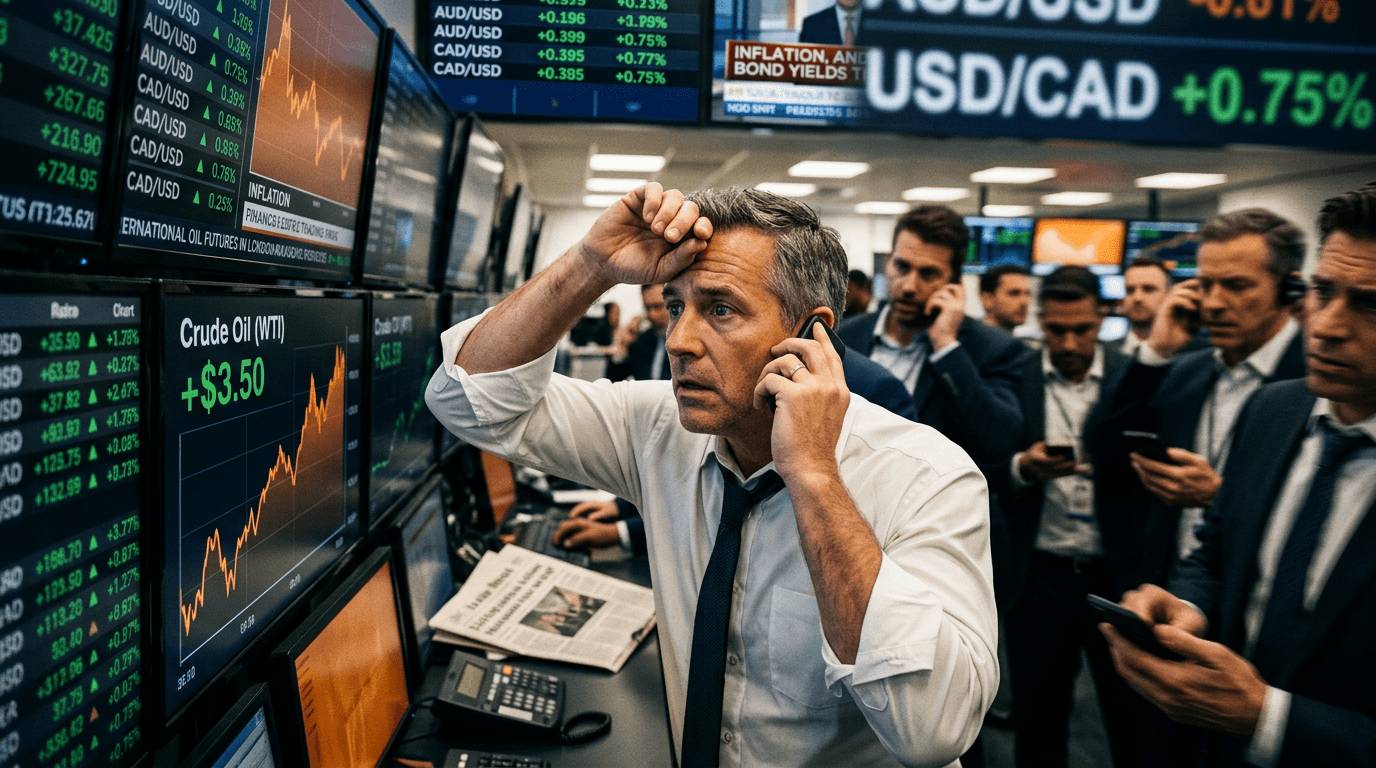
Oil markets are once again at the center of global macro dynamics as renewed tensions in the Middle East and uncertainty around a potential US–Iran agreement push crude futures higher. WTI is extending recent gains with moves in the region of 2–3%, while Brent trades above the psychologically important 90–91 dollar area as traders price in a fatter geopolitical risk premium.[3][10][11] The result is a familiar pattern: commodity-linked currencies are firming, energy-importing economies are under pressure, and inflation worries are creeping back into bond markets.[3][10][14]
Global Backdrop: Crude Rallies On Mideast Risks
The latest leg higher in crude has been driven by escalating hostilities involving the US and Iran, alongside threats to key shipping routes in the Gulf and Red Sea.[3][5][6] Episodes of airstrikes, militia activity, and disrupted tanker flows have reinforced the perception that Middle Eastern supply is vulnerable, even if actual barrels lost so far remain modest relative to global demand.[4][6][15] Markets are pricing not just current disruptions but the tail risk of a wider regional conflict that could significantly constrain exports from several producers.[4][7][9]
Brent futures have repeatedly tested and exceeded the 90 dollar threshold in recent sessions, at times trading above 91 dollars as risk headlines hit the tape.[10][11][15] WTI has followed suit with mid-single-digit percentage gains on days when the conflict narrative intensifies, reflecting both geopolitics and evidence of tightening US inventories.[5][11][15] These moves are less about a sudden shift in global demand and more about the insurance premium that traders demand when shipping lanes and production infrastructure are in the line of fire.[3][6][9]
Commodity-linked Fx: Oil Exporters Get A Lift
Higher crude prices typically translate into stronger terms of trade for oil-exporting economies, and that dynamic is again visible in commodity-linked FX. Currencies such as the Canadian dollar (CAD), Norwegian krone (NOK), and, to a degree, the Australian dollar (AUD) often benefit when energy and broader commodity benchmarks rise because export revenues increase and current account balances improve. This can support GDP growth, corporate profits in the resource sector, and, by extension, domestic equity indices, feeding back into currency strength.
For FX traders, this environment tends to favor strategies that are long oil-sensitive currencies against those of net energy importers, particularly when the move in crude is driven by supply risk rather than demand destruction. When oil rallies on geopolitical tensions, the “petro-FX” complex may outperform general risk assets, even if equity markets are mixed and credit spreads are wider, because their fundamental linkage to higher export prices is direct and powerful.
In addition, carry considerations can amplify these moves. If an oil exporter also offers higher short-term interest rates than an energy importer, the combination of stronger fundamentals and positive yield differentials makes long positions in that currency pair more attractive. Traders should, however, be mindful that commodity FX is cyclical and can reverse sharply if geopolitical risk eases or if central banks signal a growth slowdown.
Pressure On Energy Importers And Bond Markets
On the other side of the ledger are energy-importing economies such as those in the euro area, Japan, and parts of emerging Asia, where higher crude prices act like a tax on households and businesses. Rising input costs squeeze margins, weigh on consumer confidence, and can dampen industrial production if firms slow output in response to more expensive energy. In FX terms, this often manifests as relative underperformance in currencies like the euro or yen versus oil-linked peers when the crude rally is sharp and sustained.
Higher oil prices also interact directly with inflation expectations. Because energy is a visible and volatile component of CPI baskets, sharp increases in crude can reignite concerns that headline inflation will remain sticky or reaccelerate.[3][10][14] This, in turn, feeds into bond markets, where investors may demand higher yields to compensate for anticipated price pressures, particularly at the front end of the curve where monetary policy expectations are most sensitive to short-term inflation developments.[3][10]
If markets conclude that central banks will need to stay restrictive for longer to offset energy-driven inflation, rate-sensitive assets such as growth equities and longer-duration bonds can come under pressure. Conversely, sectors that benefit from higher rates and steeper curves—like financials—may find support. For traders, the key is recognizing that a geopolitical shock in oil can ripple through inflation, rates, and FX simultaneously, creating multi-asset opportunities but also correlated risks.
Trading Implications In A Simulated Finance Environment
For participants using a SimFi platform, these market conditions offer a rich laboratory to practice building and stress-testing macro strategies without real-capital risk. A classic approach is to construct a thematic basket: long an oil benchmark or energy equity index, long a commodity currency such as CAD or NOK, and short an energy-importing currency or equity index to express the full macro narrative. Within a simulated environment, traders can experiment with different position sizes, leverage levels, and stop-loss placements to understand how such a basket behaves when volatility spikes.
Another valuable exercise is scenario analysis. Traders can model three paths: an escalation scenario where crude moves significantly higher, a status quo where prices consolidate near current levels, and a de-escalation path where diplomatic progress leads to lower crude and tighter FX ranges. By running these scenarios in a SimFi setting, they can observe how P&L evolves, which legs of the trade contribute most to risk, and how correlations shift as narratives change.
Risk management is central in these exercises. Geopolitical moves can be fast and headline-driven, leading to gaps and slippage. Using a simulated account, traders can test different hedging tactics—such as options overlays on crude or FX, dynamic position trimming after large intraday moves, or diversification across uncorrelated assets—to see which frameworks best protect against tail events while preserving upside.
Key Takeaways For Traders
Several practical lessons emerge from the current oil-driven environment:
- Treat crude as a macro hub: moves in WTI and Brent often foreshadow shifts in FX, rates, and equities, especially when driven by geopolitics rather than pure demand.
- Distinguish exporters from importers: the same oil rally can be positive for commodity FX and negative for currencies of energy-importing economies, creating relative-value opportunities.
- Watch inflation expectations and front-end yields: sustained higher oil can alter central bank rate paths, reshaping carry trades and bond market dynamics.[3][10][14]
- Use simulation to refine execution: practicing in a SimFi environment allows traders to test ideas, position sizing, and risk controls against real-world volatility without capital at stake.
As Middle East tensions keep a firm floor under crude and Brent hovers above key levels, markets are reminded that geopolitical risk remains a potent driver of cross-asset price action.[3][10][11] For traders, the challenge is not merely to predict the next headline, but to build robust, well-hedged strategies that can adapt as the narrative evolves. Using simulated trading to rehearse these approaches can turn a complex, fast-moving macro backdrop into a structured learning opportunity—and better prepare traders for when similar shocks hit live markets.