
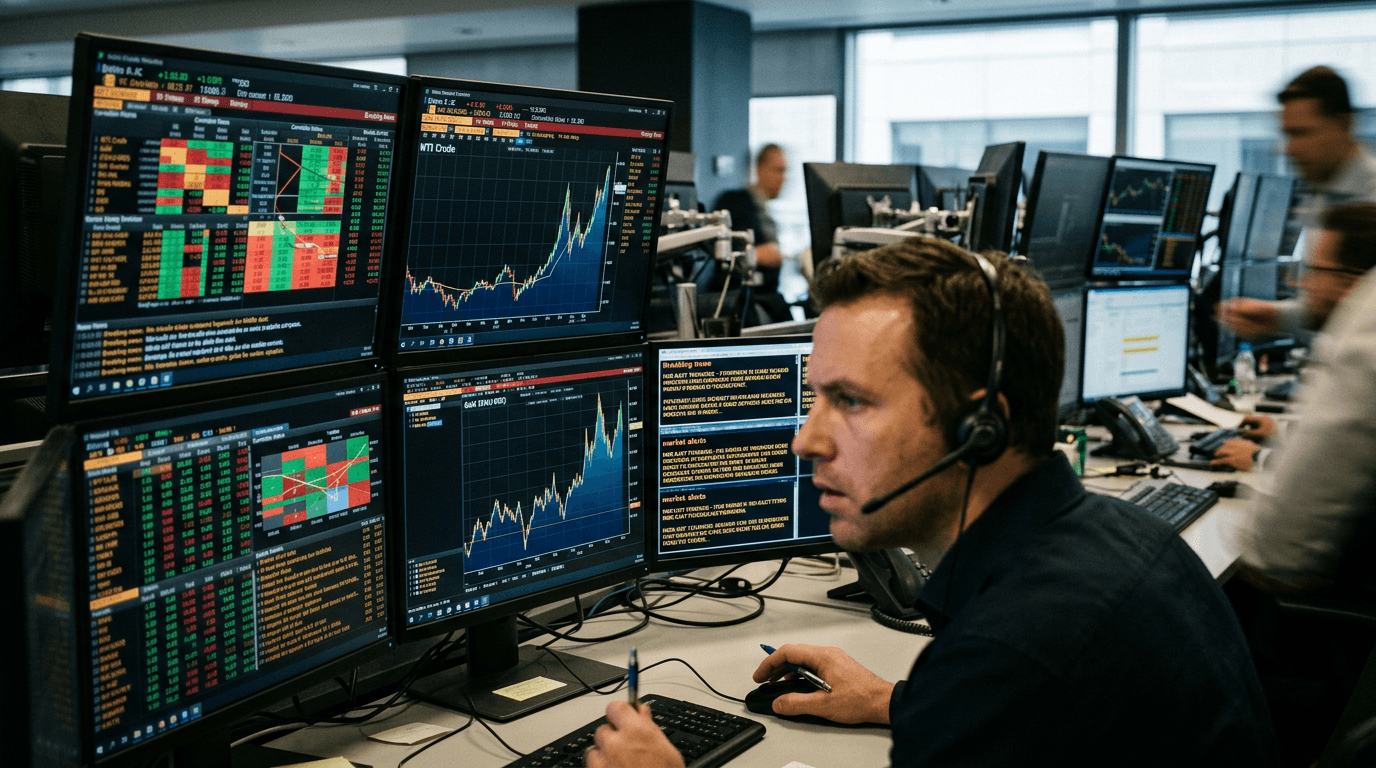
Escalating conflict across the Middle East has reawakened geopolitical risk in global markets, with oil and gold swinging sharply and pushing investors toward defensive FX and futures positioning.[1][2][5] For traders, this is not just headline noise; it is a live test of how war risk, energy supply fears, and safe-haven flows can rapidly reshape cross‑asset correlations.[2][3][12]
Market Landscape: Oil, Gold And Risk Sentiment
Energy markets have moved back to center stage as tensions involving the US, Iran and regional actors drive renewed concern over supply disruptions.[1][2][4] Brent crude has edged closer to the psychologically important $100 per barrel mark, while WTI has pushed back toward recent highs after earlier sharp gains, embedding a visible geopolitical risk premium in prices.[1][2][5][7] These moves reflect not only current disruptions but also market anxiety about what could happen next.
Natural gas benchmarks have also surged, with UK gas prices reportedly jumping more than 60% from pre‑conflict levels as traders price in the threat of extended regional instability.[4][10] The combination of higher oil and gas prices is feeding broader volatility, lifting implied volatility indices and weighing on global risk assets from equities to high‑beta currencies.[3][10][12] For portfolio managers and active traders, the message is clear: energy‑linked shocks are driving a “risk‑off but liquid” regime in the near term.[11][12]
Gold, the traditional safe haven, has seen erratic trading behavior as investors juggle conflicting forces: war‑driven demand for safety versus the drag from a strong US dollar and shifting rate expectations.[5][6][8] Spot and futures prices have swung around key technical levels, with recent price action near the $4,000 region and resistance zones identified closer to $4,200 and beyond.[6][7][9] This tug of war is central to understanding why volatility has risen even in assets usually seen as defensive.
Geopolitical Risk Premium In Energy Markets
The core driver of the latest oil and gas volatility is the perceived threat to critical supply routes and infrastructure, particularly around the Gulf and the Strait of Hormuz.[1][4][10] Roughly one‑fifth of global oil and LNG shipments transit this narrow waterway, making any military escalation or shipping disruption immediately market‑relevant.[10][12] When traders cannot reliably forecast physical flows, they price in insurance—via higher spot prices, wider spreads and elevated volatility.
In futures markets, this geopolitical risk premium often shows up as steeper curves, sudden shifts between backwardation and contango, and wider calendar spreads.[2][5] Short‑dated contracts, which are more sensitive to near‑term disruptions, tend to react first, while longer‑dated futures move as traders reassess the medium‑term supply‑demand balance.[2][3] For active futures traders, those curve dynamics create both opportunity and danger: intraday moves can be large, but slippage and gap risk also increase significantly.
Equity markets have not been spared. Global stock indices have faced selling pressure, with some major benchmarks slipping as higher energy costs and geopolitical uncertainty weigh on earnings expectations and risk appetite.[3][8][10] Volatility indices have climbed as investors hedge via options and volatility futures, reinforcing a feedback loop where energy prices, equity risk premia, and volatility all move together.[10][11][12] Understanding that linkage is crucial for anyone trading index futures or volatility products around geopolitical events.
Safe-haven Flows In Gold And Fx
In the FX space, safe‑haven behavior has reasserted itself, but with a twist: the US dollar has emerged as the dominant beneficiary of risk‑off flows, even against traditional havens like the yen and Swiss franc.[1][8][11] The dollar index has pushed to multi‑week highs as investors rotate out of risk currencies and into USD‑denominated assets, including Treasuries and cash equivalents.[1][8][12] This dynamic reflects both geopolitical fear and the relative resilience of US growth and markets.
Gold’s role as a safe haven is more nuanced in this environment. Conflict headlines have supported bullion as a hedge against tail risks, but the stronger dollar and evolving expectations for interest rates have capped rallies and occasionally triggered sharp pullbacks.[5][6][9] Recent price action has seen gold swing around key psychological levels, with technical traders watching support near $4,000 and resistance clusters above $4,200.[6][7][9] For short‑term futures traders, these zones become focal points for breakout and mean‑reversion strategies.
Risk‑off flows have also affected so‑called “risk currencies” and commodity‑linked FX pairs. Higher oil prices can support exporters’ currencies in theory, but when gains are driven by war risk rather than healthy demand, investors often treat these currencies cautiously and prioritize pure safe havens instead.[2][3][12] That can lead to unusual cross‑asset patterns, such as rising oil prices alongside weaker high‑beta FX and falling equities—an environment where historical correlations temporarily break down.[3][11][12]
What This Means For Fx And Futures Traders
For FX and futures traders, the current backdrop is a live case study in how geopolitics can override macro data and technical trends.[2][3][11] Traditional calendar catalysts—such as economic releases or central bank meetings—may matter less than news flow about military actions, diplomatic breakthroughs or sanctions.[3][10][12] That shift demands more flexible risk management, with position sizes, leverage and stop‑loss levels adapted to higher intraday volatility.
Practically, traders can start by mapping which assets are most directly exposed to Middle East risk: crude and products futures, gold and silver, volatility indices, and safe‑haven FX pairs like USD, JPY and CHF.[1][2][5][7] Monitoring cross‑asset correlations between these instruments helps identify whether the market is in a pure risk‑off mode or a more nuanced regime where some pockets of risk still attract flows.[3][11][12] Correlation breakdowns are a warning sign that standard playbooks may no longer apply.
Another key takeaway is the importance of scenario planning. Traders should outline at least three paths—temporary de‑escalation, prolonged stalemate, and further escalation—and think through how each scenario could impact oil curves, gold levels, and FX baskets.[3][10][12] These scenario maps can then inform how aggressively to position, what hedges to use, and when to sit on the sidelines rather than force trades into an uncertain environment.[11][12]
Simulated Finance As A Training Ground For Volatility
For many traders, live geopolitical shocks are difficult to navigate precisely because they are rare, fast‑moving and emotionally charged.[3][10][11] Simulated finance environments provide a way to rehearse playbooks without real capital at risk, using historical episodes and synthetic scenarios that mirror the current Middle East‑driven volatility.[2][3] Practicing entries, exits, hedging and position sizing in a SimFi framework builds muscle memory that can be invaluable when similar conditions appear in live markets.
In a simulated setting, traders can test how strategies perform when oil gaps higher at the open, gold suddenly reverses on a dollar spike, or safe‑haven FX pairs overshoot and mean‑revert.[1][5][6] They can experiment with different leverage levels, margin buffers and portfolio hedges, tracking how equity curves respond to volatility spikes and correlation shifts.[3][11][12] This kind of structured practice improves discipline and helps traders identify which setups are robust and which are overly reliant on calm markets.
Conclusion
The latest Middle East conflict has injected a significant geopolitical risk premium into oil, gold and related markets, driving risk‑off flows across FX and futures and challenging traditional assumptions about cross‑asset behavior.[1][2][3] For traders, the opportunity lies in understanding these dynamics rather than simply reacting to headlines: mapping exposures, watching correlations, managing leverage and preparing scenario‑based playbooks.[3][11][12] Combined with regular practice in simulated environments, that approach offers a more resilient way to navigate the volatile intersection of geopolitics and global markets.