
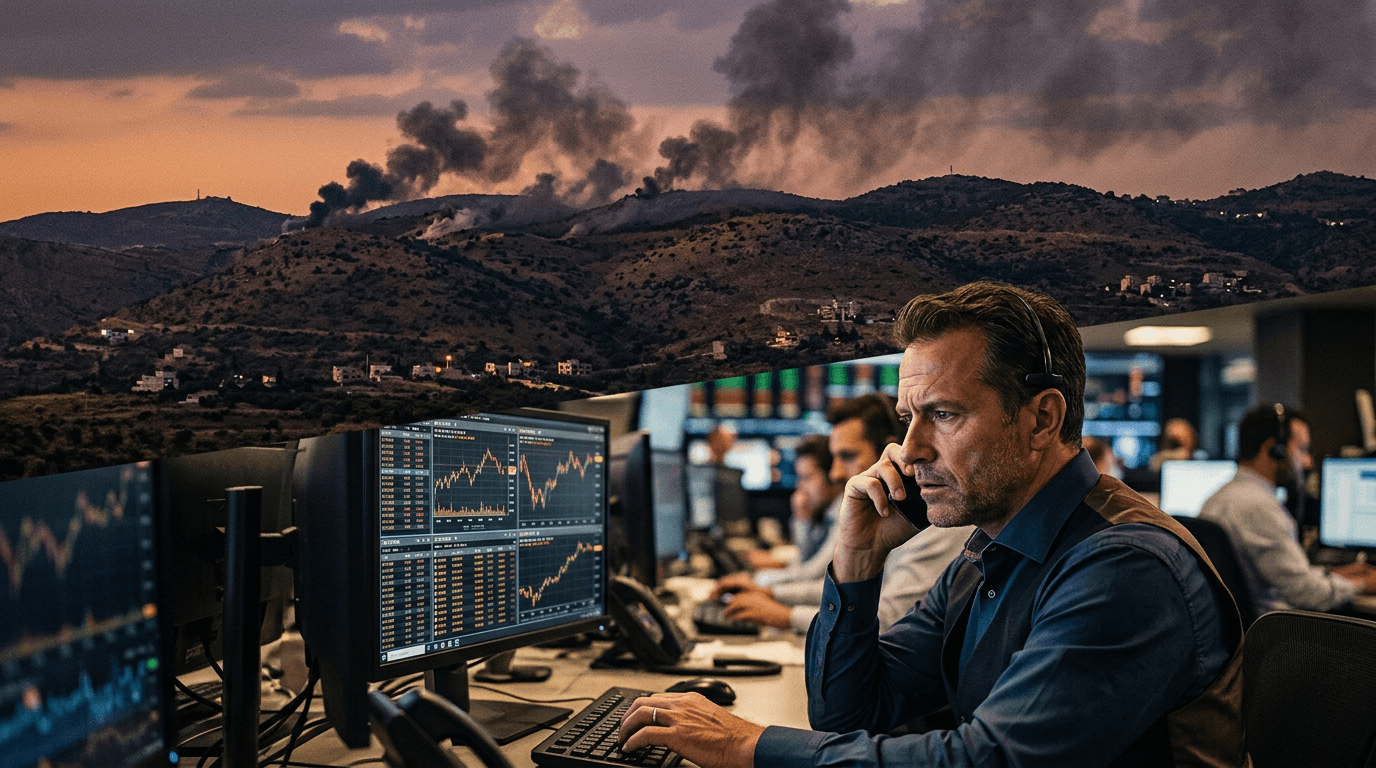
Tensions along the Israel–Lebanon border have intensified again, with reports that the Israeli military has conducted around 28 airstrikes on the Nabatieh ridge in southern Lebanon over consecutive sessions[9]. These strikes have targeted strategically important high ground such as the Ali al-Taher ridge overlooking the Nabatieh district and the Beaufort area, which Israel claims is used by Hezbollah for military infrastructure and fire control[1][3][5]. Lebanese officials report casualties, including children, underscoring the human cost of what they describe as one of the most serious escalations since earlier efforts to ease hostilities[1][5]. For traders, this combination of military escalation and uncertainty is a classic trigger for risk-off sentiment and renewed interest in safe-haven assets.
Current Situation On The Lebanon Border
Recent attacks have focused on the highlands surrounding Nabatieh, including the Ali al-Taher heights and nearby ridges that command views over southern Lebanon[3][5]. Lebanon’s state news agency and health authorities report that strikes in Nabatieh and the village of Ansar have destroyed residential structures and killed at least 11 people, including several children and women, with entire families reportedly wiped out in some incidents[1][5]. Israel, for its part, states it is targeting Hezbollah “terror infrastructure,” including tunnels and weapons facilities, and denies intentionally striking civilian homes[5][11].
This escalation is unfolding against a backdrop of already heightened tension along the UN-demarcated Blue Line separating Israel and Lebanon[4]. The UN mission in the area has documented rising trajectories fired from both sides, noting that recent days have seen some of the highest counts of projectiles launched by the Israeli military since monitoring began[4]. Separate assessments highlight multiple breaches of commitments by both Israel and Hezbollah along the border, reinforcing concerns about a slide toward a broader confrontation[12]. In short, the geopolitical risk profile of the region has clearly moved higher, and markets tend to respond quickly to this kind of shift.
Why Geopolitical Risk Matters For Markets
Geopolitical shocks like the current flare-up matter because they directly affect investor confidence, risk appetite, and expectations for global growth. When conflict threatens to expand or draw in regional actors, traders start to price in tail risks: disruptions to energy supply, pressure on government budgets, and financial stress in vulnerable economies. Even if those worst-case scenarios never materialize, the perception of higher risk can be enough to move prices in foreign exchange, commodities, and equity indices.
Empirical research on the relationship between gold, oil, and geopolitical risk shows that periods of elevated tension tend to raise volatility and can strengthen co-movements between the two markets[13]. That means traders may see simultaneous moves in gold and crude oil as conflict risk rises, with both markets reflecting uncertainty about growth, inflation, and investor demand for hedging instruments. For E8 Markets participants, understanding these dynamics is crucial: Simulated Finance environments allow traders to explore how such risks translate into price action without real capital at stake.
Safe-haven Flows In Forex
One of the first places geopolitical risk appears is in the forex market. When headlines point to conflict escalation, many participants reduce exposure to higher-beta currencies tied to global growth and rotate into perceived safe havens such as the US dollar (USD), Japanese yen (JPY), and Swiss franc (CHF). These currencies benefit from deep, liquid markets and, in the case of the USD, its role as the world’s primary reserve currency.
In practical terms, renewed tension along the Lebanon border can support demand for USD pairs as global portfolios rebalance toward cash and short-dated US assets. The JPY often strengthens as carry trades are unwound, while CHF can see inflows as investors seek stability within the European region. For SimFi traders on a platform like E8 Markets, this environment is ideal for testing risk-off strategies: scenarios where risk-sensitive currencies underperform against USD, JPY, and CHF following negative geopolitical headlines.
A useful approach is to build simulated positions that reflect different degrees of escalation. One scenario might assume localized clashes that remain contained; another might assume a broader confrontation affecting sentiment across the Middle East. Comparing performance across these simulations helps traders see how position sizing and stop-loss placement could protect their capital if similar events occur in live markets.
Gold And Crude Oil As Conflict Hedges
Gold and crude oil often sit at the center of market reactions to Middle Eastern tensions. Gold’s role as a store of value and crisis hedge makes it a natural destination when war risk rises, particularly if investors worry about political instability or pressure on major currencies. Meanwhile, crude oil is sensitive to any threat of supply disruption in a region that houses key producers and transit routes. Even when the immediate conflict zone is not a major production hub, traders tend to price in a risk premium against the possibility of wider regional involvement.
Research on the gold–oil relationship suggests that higher geopolitical risk can amplify volatility and strengthen the transmission of shocks between these two markets[13]. In practice, that means spikes in conflict-related headlines can produce sharp, sometimes correlated moves in both gold and crude. For simulated traders, this offers a valuable opportunity to explore cross-asset strategies—such as long gold combined with risk-managed exposure to crude oil futures—to see how different hedging combinations behave under stress scenarios.
In a SimFi setting, traders might build playbooks around three ideas: gold as a primary crisis hedge, crude oil as a barometer of energy risk, and volatility products as complementary tools. Running backtests on historical conflict episodes and then applying similar logic to the current Lebanon border tensions can sharpen intuition about timing entries and exits around news flow.
How Simulated Finance Traders Can Respond
For E8 Markets users, the key is not predicting the exact path of the Israel–Lebanon situation but understanding how markets typically react to increasing conflict risk. Start by defining clear hypotheses: for example, that escalating airstrikes and rising casualties will support safe-haven currencies, lift gold, and add a risk premium to crude. Then design simulated portfolios that express those views while respecting strict risk limits.
An effective SimFi workflow might include: building small, diversified positions across USD, JPY, CHF, gold, and crude; stress-testing the portfolio under shocks such as additional border incidents or diplomatic breakdowns; and evaluating how correlation between assets changes as headline intensity rises. Traders should pay attention to how quickly markets “fade” geopolitical moves once the news flow stabilizes, since over-staying positions is a common error in risk-off environments.
Risk management remains central. Even in simulation, it is important to use disciplined stop-loss levels, position limits, and scenario analysis to avoid concentrating exposure in a single narrative. Geopolitical events can evolve in unexpected ways; markets may start by rewarding safe-haven trades but then pivot as new information emerges. Practicing flexibility—knowing when to scale back or rotate positioning—is one of the most valuable skills SimFi can help develop.
Conclusion
The latest round of Israeli airstrikes on the Nabatieh ridge and surrounding highlands in southern Lebanon has sharply raised geopolitical risk along an already tense border, with civilian casualties and strategic targets reinforcing fears of broader escalation[1][3][5][9]. In market terms, such developments typically support flows into safe-haven currencies, boost demand for gold, and add a bid to crude oil as traders hedge against regional conflict scenarios[13].
For traders operating in a simulated environment like E8 Markets, this is a live case study in how geopolitics, sentiment, and cross-asset dynamics intersect. By building structured scenarios, testing safe-haven and commodity strategies, and refining risk management around fast-moving news, SimFi participants can convert headline volatility into a practical learning opportunity. The goal is not to exploit tragedy, but to responsibly understand how global markets respond when geopolitical fault lines shift—so that when similar stresses arise in live trading, they are met with preparation rather than panic.