
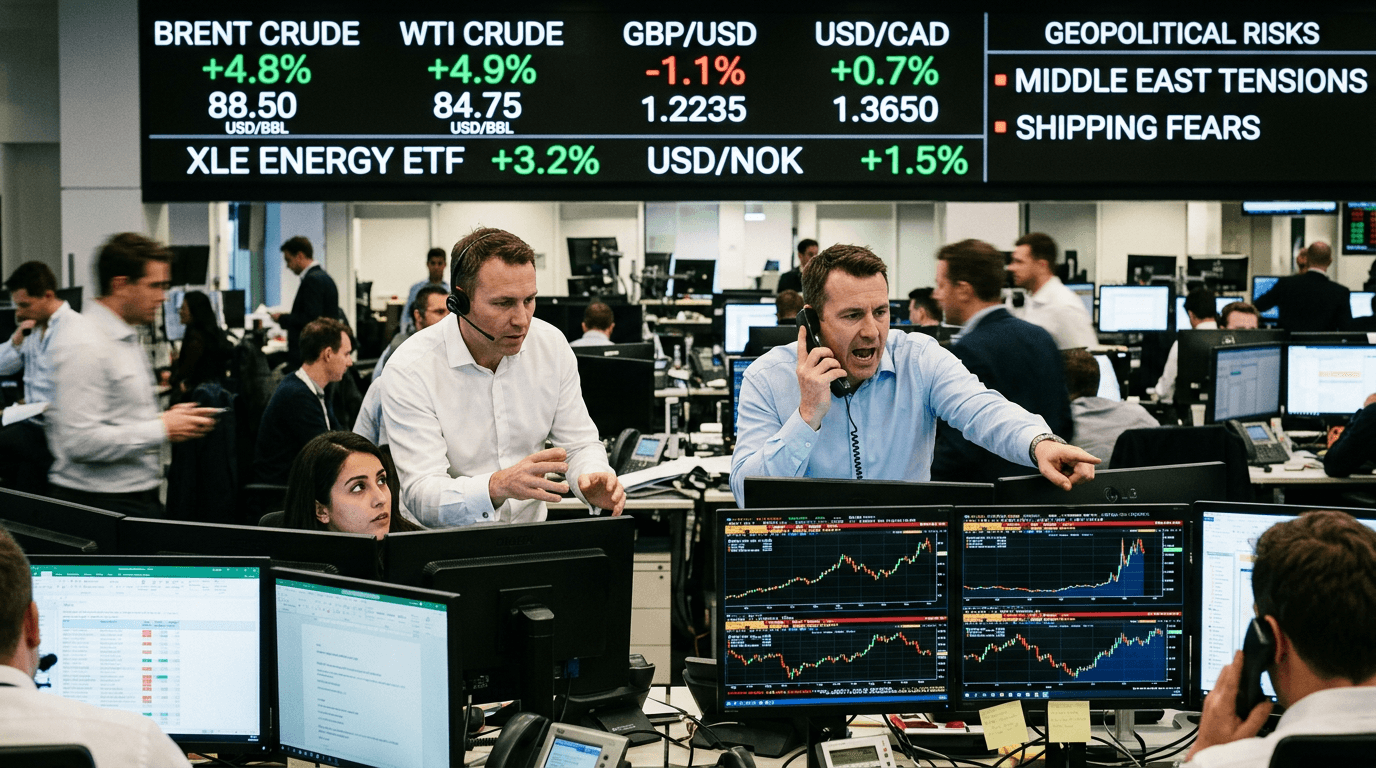
Oil markets are reminding traders that geopolitics can override fundamentals in an instant. After retreating on optimism around a possible U.S.-Iran agreement, West Texas Intermediate (WTI) crude has rebounded back above the high-$70s as conflict and shipping risks in the Middle East disrupt expected energy flows. This fresh move higher is lifting energy-linked currencies and fueling activity across crude futures and volatility products as markets reprice inflation and growth risks.
Global Oil Rebound: What's Driving The Move
The immediate catalyst for the crude rebound is renewed uncertainty around the trajectory of the Middle East conflict and the safety of key shipping routes. Earlier, hopes for a limited U.S.-Iran understanding and a reduction in hostilities had encouraged markets to price in more stable supply and potentially increased Iranian exports, pressuring prices lower.[9][12] That narrative has weakened as violence and risk incidents persist.
Historically, Middle East conflicts have introduced significant risk premia into oil prices by threatening physical supply and shipping logistics. Recent episodes of tanker attacks and seizures, along with drone strikes on energy infrastructure, have reminded traders that disruption can be both sudden and widespread.[1][13] The International Energy Agency has warned that current hostilities have the potential to cut regional output by millions of barrels per day, underscoring why even modest escalations can move prices sharply.[13]
The rebound in WTI above the high-$70s and corresponding strength in Brent is therefore less about demand suddenly surging, and more about supply uncertainty and risk repricing. For traders, that distinction matters: risk-driven rallies can unwind quickly if diplomatic developments or shipping normalizations ease the perceived threat.
Shipping Risks And The Energy Risk Premium
Shipping routes are the critical transmission channel from Middle Eastern conflicts to global oil prices. Chokepoints such as the Strait of Hormuz handle a large share of seaborne crude and refined product exports; any threat to safe passage tends to be priced into futures almost immediately.[12][13] Traders monitor not only official military moves, but also insurance costs, freight rates, and anecdotal reports from tanker operators.
When shipping risks rise, several things typically happen simultaneously:
Insurers demand higher premiums for vessels transiting conflict zones, raising transport costs and effectively adding to the delivered price of oil. Freight futures and spot rates react as capacity is repriced to reflect danger and possible delays.
Some cargoes are rerouted via longer paths or delayed, tightening near-term supply in key consuming regions despite global output not necessarily falling as much as headline suggests.[13] This dynamic is especially visible in prompt futures contracts and regional benchmark spreads.
Governments and agencies may release strategic reserves to offset perceived scarcity, but such measures rarely eliminate the risk premium entirely when violence is ongoing.[13] Instead, they tend to smooth extreme spikes while markets continue to trade on headlines.
For traders, shipping risk is not only a fundamental factor but also a source of event-driven volatility. Price gaps around news flows, intraday spikes, and sharp reversals are more common, rewarding disciplined risk management over aggressive, one-directional bets.
Energy-linked Fx: Who Benefits And Who Suffers
The move higher in crude is feeding directly into foreign exchange markets. Currencies of major oil exporters tend to appreciate when oil rises, particularly when the move is driven by a durable-looking risk premium and stronger terms of trade. This often includes the Canadian dollar (CAD), Norwegian krone (NOK), and some emerging market producers, whose fiscal balances and current accounts improve as export revenues rise.
At the same time, currencies of large net importers, especially those with already elevated inflation, can come under pressure. Higher energy import costs worsen trade balances and raise concerns about domestic price stability. That can force central banks into a difficult trade-off between growth and inflation, adding another layer of uncertainty to FX pricing.
The current rebound, rooted in geopolitical and shipping risk rather than booming demand, has a particular profile:
Exporters with stable politics and diversified economies may see relatively steady support, as investors view them as safer ways to gain exposure to higher energy prices.
Import-reliant economies with limited fiscal space or policy credibility may see their currencies weaken, as markets anticipate higher inflation and potentially slower growth.
For traders, energy-linked FX moves offer both directional opportunities and cross-asset signals. A synchronized rise in crude and exporter currencies often confirms the strength of the oil move, while divergence can hint at skepticism or other macro forces at play.
Futures, Volatility, And Hedging Opportunities
The rebound in crude is not just a story of spot prices and FX. It is also driving renewed activity in energy futures, options, and volatility-linked products as market participants hedge exposure and position for further swings. Recent episodes of conflict-driven price spikes have kept traders sensitive to the possibility of another large dislocation.[3][5][8]
Several patterns are common in this type of environment:
Open interest and volume in front-month crude futures tend to rise as hedgers and speculators adjust to new price ranges and risk perceptions.[3][5]
Options activity increases, with traders buying upside calls as insurance against a further supply shock, and sometimes downside puts in case diplomatic breakthroughs trigger a sharp pullback.
Volatility indices and implied volatilities on crude options often trend higher, reflecting greater demand for protection and expectations of larger price ranges.
Beyond outright oil exposure, traders also look to related contracts—such as refined product futures, freight and tanker-related contracts, and equity index derivatives for energy-heavy sectors—as tools to express or hedge views.
For investors and traders focused on macro themes, these instruments provide a way to manage inflation and growth risks. Higher oil prices can filter into headline inflation, squeeze consumer spending, and alter central bank expectations. Hedging via energy and volatility products is one way to mitigate portfolio sensitivity to these shifts.
How Simulated Traders Can Navigate This Environment
For participants using simulated finance platforms, this kind of geopolitical-driven market is an ideal laboratory for building robust trading frameworks without taking real-world risk. The current backdrop combines trending behavior, event risk, and cross-asset linkages—exactly the mix that challenges both beginners and experienced traders.
A few practical takeaways
First, treat geopolitical and shipping headlines as catalysts, not trading systems. Use them to frame scenarios—such as “escalation with higher risk premium” versus “partial de-escalation with reduced shipping risk”—and then test how crude, FX, and indices might react.
Second, practice risk management under volatility. This includes sizing positions conservatively, using stop-losses intelligently, and stress-testing portfolios against gap moves and news-driven reversals.
Third, experiment with multi-asset approaches. For example, simulate how a long crude futures position might interact with an energy-exporter currency trade, or how hedging equity exposure with oil-related options changes your overall risk profile.
Finally, focus on process over prediction. No one can consistently forecast the next headline, but traders can build repeatable methods for assessing information quickly, adjusting positions, and avoiding emotional decisions in fast-moving markets.
Conclusion
The latest rebound in crude, driven by Middle East conflict and shipping risks, is a reminder that energy markets sit at the crossroads of geopolitics, macroeconomics, and market microstructure. As WTI pushes back above the high-$70s and energy-linked FX and futures reprice, traders are once again confronted with the challenge of navigating an environment where fundamentals, sentiment, and event risk collide.
For active and aspiring traders alike, the lesson is clear: understanding how conflicts translate into shipping disruptions, risk premia, and cross-asset moves is essential to making informed decisions. Whether in live markets or simulated environments, those who combine solid macro frameworks with disciplined risk management will be best placed to turn volatility from a threat into an opportunity.