
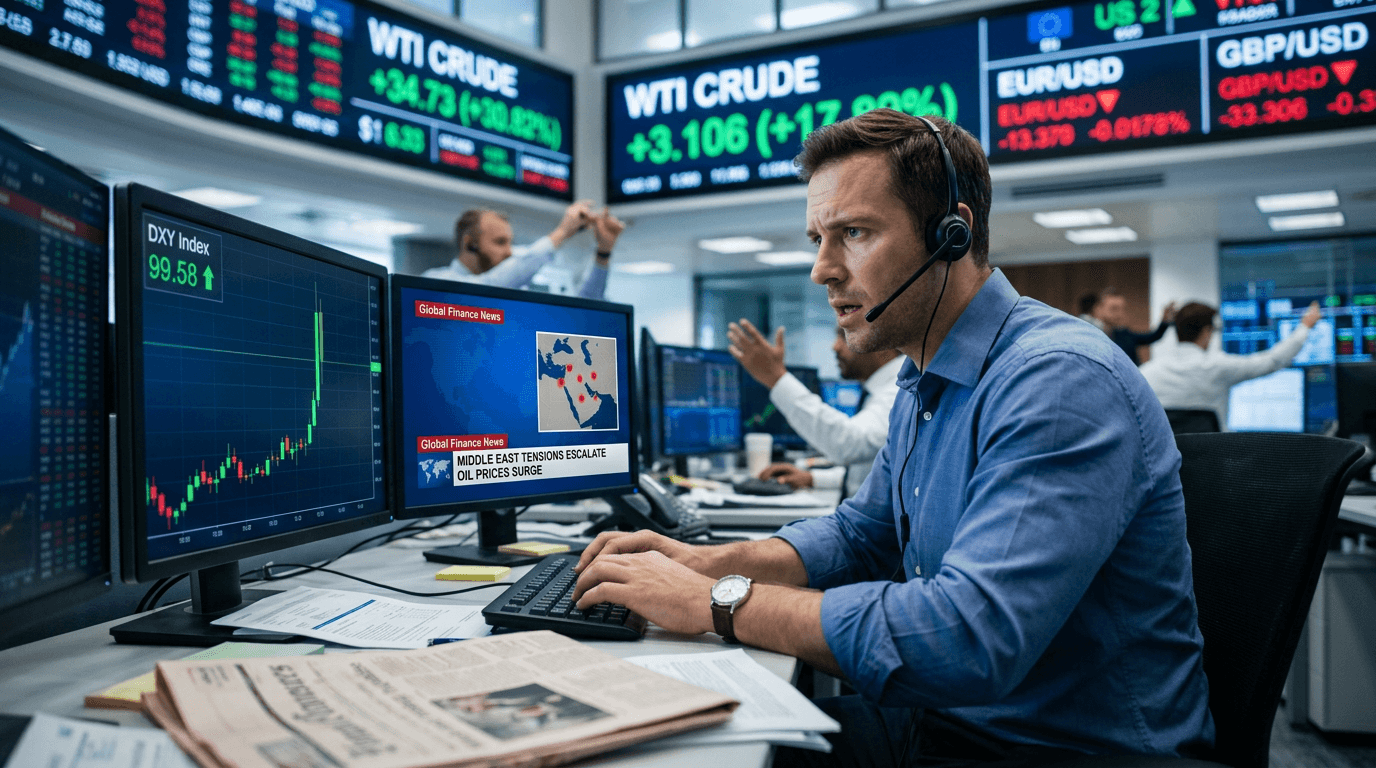
Geopolitical tensions in the Middle East have once again reminded financial markets why the US dollar remains the world's ultimate safe-haven currency. As fresh hostilities escalated in early March 2026, investors rushed toward dollar-denominated assets, driving the Dollar Index (DXY) to multi-month highs around 99.65 and reshaping short-term dynamics across the forex landscape.[1][2] This shift in risk sentiment demonstrates how quickly market sentiment can pivot when uncertainty strikes, and it offers valuable lessons for traders navigating volatile conditions.
The speed of the dollar's response to Middle East tensions underscores a fundamental principle in foreign exchange markets: during periods of acute geopolitical risk, investors gravitate toward the currency they perceive as most liquid and stable. The DXY jumped from around 97.6 at the end of February to approximately 98.75 by March 2nd, a sharp move that set the tone for the week ahead.[1] This wasn't a gradual drift but rather a pronounced shift driven by genuine flight-to-safety dynamics. According to analysts, the dollar caught favor specifically because of its perceived liquidity and the confidence investors place in US financial infrastructure during times of global uncertainty.[2]
Understanding The Safe-haven Premium
The concept of safe-haven demand is straightforward in theory but complex in practice. When geopolitical shocks occur, investors don't necessarily move into assets they believe will generate returns. Instead, they prioritize capital preservation and liquidity above all else. The US dollar fits this profile perfectly, particularly when tensions threaten energy supplies or disrupt global shipping routes.[1] What makes this dynamic especially important for traders is that safe-haven flows can be remarkably durable if underlying tensions persist, but they can also unwind with surprising speed if risk sentiment stabilizes.
Matthew Ryan, head of market strategy at Ebury, captured this sentiment precisely: "The dollar has been seen as the ultimate safe-haven due to its liquidity, while also being buoyed by the rise in oil prices."[2] This observation touches on a crucial element that distinguishes the current environment from previous geopolitical episodes—the feedback loop between currency flows, energy markets, and inflation expectations.
The Energy Shock Driving Dual Pressures
While safe-haven demand supports the dollar directly, the conflict also drives oil prices higher, creating secondary effects that amplify dollar strength through a different mechanism. As energy prices surge due to Middle East disruptions, inflation concerns resurface across global markets.[3] This inflation dynamic has profound implications for interest rate expectations, which in turn influences currency valuations.
The data supports this narrative. Traders have scaled back expectations for Federal Reserve rate cuts in June, with probability estimates falling from nearly 46% a week prior to just 31.5% by early March.[3] When investors perceive higher inflation risk, they become less enthusiastic about holding currencies of central banks expected to cut rates aggressively. Conversely, if the Fed maintains a more hawkish stance to combat inflation, dollar strength finds additional fundamental support beyond pure safe-haven mechanics.
Interestingly, traditional safe havens like gold and government bonds exhibited unexpected behavior during this episode. Germany's 10-year bond yield actually rose 6.1 basis points as prices declined, suggesting that even supposedly safe assets faced selling pressure.[3] This disruption of normal safe-haven relationships highlights how novel or severe geopolitical shocks can force investors to reevaluate their hedging strategies and gravitate toward the assets they trust most—which, in this case, meant the US dollar.
Major Currency Pairs Adjust To New Realities
The impact of dollar strength rippled across major forex pairs with distinct patterns. GBP/USD retreated from its 52-week highs near 1.37 down to approximately 1.3380, the lower end of its recent range.[1] The pair could bounce back toward 1.3460 if risk sentiment improves, but sustained sterling weakness reflects sterling's vulnerability when investors turn risk-averse.
EUR/USD experienced even sharper pressure, falling to its lowest level since November as safe-haven flows favored dollars over euros.[4] This deterioration in the euro reflects both direct flight-to-safety dynamics and changing interest rate differentials, as the European Central Bank faced the prospect of raising rates earlier in the year to combat potential inflation from energy disruptions.
USD/CAD remained relatively contained within a tight 1.35–1.37 range, reflecting Canada's proximity to US markets and its own energy sector benefits from higher oil prices.[1] However, if geopolitical tensions ease, traders should watch for USD/CAD weakness back toward 1.3630 or lower.
USD/CHF climbed toward the upper end of its range near 0.7800, as the Swiss franc—another traditional safe-haven asset—faced competition from dollar inflows.[1]
What Traders Need To Know
The current environment rewards vigilance over aggressive positioning. While safe-haven demand can provide reliable dollar support in the near term, its sustainability depends entirely on whether Middle East tensions escalate further or begin to stabilize.[1] Traders employing reasonable position sizing and tight risk controls are better positioned to navigate the increased volatility that characterizes geopolitical episodes.
Looking ahead, central bank meetings throughout March, particularly the Federal Reserve's March 17–18 decision, will likely provide crucial guidance on how policymakers view the inflation and growth trade-off.[1] These decisions will ultimately shape whether current dollar strength persists or gives way to other themes as the month progresses.
---