
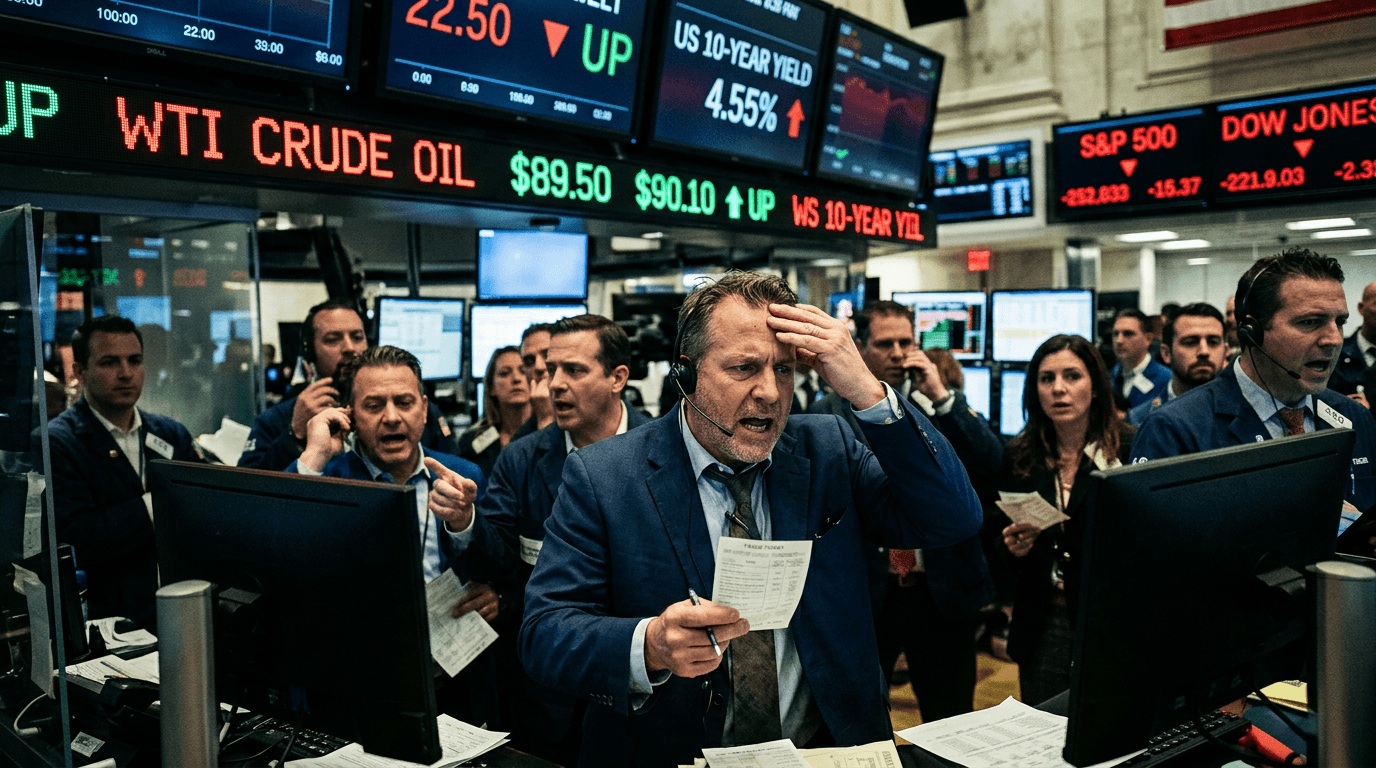
Renewed kinetic conflict between Iran and the United States has snapped markets back into a full risk-off regime, with investors rushing to reduce exposure to volatile assets and protect capital.[4][7][11] As military exchanges resume and shipping lanes around the Strait of Hormuz come under renewed threat, global bond yields have jumped to multi‑year highs, equities are under pressure, and oil has surged toward the $90 per barrel area, reviving inflation concerns that many thought were fading.[7][9][12] For traders, this is not just a geopolitical headline—it is a regime shift that demands swift adjustments in positioning, risk management, and expectations.
Global Risk-off: What Just Happened
The rekindling of the Iran–US conflict follows the breakdown of a fragile ceasefire and the expiry of earlier peace understandings, opening the door to a renewed wave of strikes across Iran and the wider region.[4][7][10] With attacks reported around key coastal hubs and commercial shipping targeted near the Strait of Hormuz, the market is suddenly repricing the probability of persistent disruption to one of the world’s most important energy arteries, through which roughly a fifth of global oil and liquefied natural gas trade normally passes.[7][10] This escalation has acted as a classic trigger for a risk-off shift: uncertainty has jumped, headline risk is high, and investors are rotating out of cyclical and high-beta assets into perceived safe havens.[5][8][11]
In risk-off conditions, the market’s priority flips from chasing returns to preserving capital.[2][5][11][14] Equities, high-yield credit, emerging-market assets and leveraged trades tend to be trimmed or unwound, while flows move toward government bonds, cash-like instruments, defensive sectors, and safe-haven currencies such as the US dollar, Swiss franc, and Japanese yen.[5][8][11] The renewed Middle East war has triggered exactly this pattern, with equity indices under pressure, volatility gauges elevated, and correlations between risk assets rising as investors de-risk broadly rather than selectively.[5][8][14]
Bonds, Equities And Oil: Cross-asset Repricing
One of the most notable features of this episode is the jump in global bond yields to multi‑year highs, even as risk-off sentiment intensifies.[9] Typically, risk-off phases support government bonds, but here the oil shock is colliding with already-sensitive inflation expectations, pushing nominal yields higher as markets reprice the path of future policy rates.[6][9] Higher yields pressure growth stocks, leveraged positions, and valuations across risk assets, reinforcing the negative feedback loop for equities and credit.
Equity markets are absorbing both higher discount rates and greater macro uncertainty.[9][11] Cyclical sectors tied to global trade and industrial activity—such as autos, transportation, and discretionary consumption—are particularly vulnerable when geopolitical stress threatens shipping routes and energy supply.[9][10] By contrast, defensive sectors like utilities, consumer staples, and some healthcare names may outperform, as their earnings are perceived as more resilient in volatile macro environments.[11]
Oil is the key transmission channel from the conflict to global macro conditions. Crude prices have pushed back toward the psychologically important $90 per barrel area, reflecting both immediate supply risks and a geopolitical risk premium layered on top of fundamentals.[9][12] Historically, such spikes in oil prices act as negative supply shocks: they compress real incomes, raise production costs, and deliver a one‑off boost to headline inflation that can last several months.[6][9] For inflation‑sensitive assets and strategies, this changes the calculus quickly, especially in economies where inflation had recently begun to ease.
Inflation, Central Banks And Policy Risk
The combination of higher oil prices and renewed geopolitical uncertainty raises the risk that inflation data will reaccelerate over the short term, even if underlying core pressures remain contained.[6][9] Central banks, many of which had been signaling a gradual path toward policy normalization or rate cuts, must now weigh the risk of an energy-driven flare‑up against still-fragile growth.[6][9][11] If they interpret the shock as persistent rather than temporary, markets could face a longer period of restrictive policy, sustaining elevated yields and tightening financial conditions.
This policy uncertainty is a major driver of risk-off behavior. Fixed-income traders must reassess duration exposure, inflation-linked instruments, and curve positioning, while equity traders reprice earnings expectations and valuation multiples.[9][11] Currency markets respond as well: higher rates and safe-haven demand tend to support the US dollar, while economies with high energy import dependence can see their currencies weaken as terms of trade deteriorate.[5][8][11] For macro and FX strategies, the Iran–US conflict is therefore not just a regional story but a global regime event.
Trading The Risk-off Regime On Simulated Markets
On a Simulated Finance platform like E8 Markets, this environment creates a valuable opportunity to test and refine playbooks for geopolitical shocks without putting real capital at risk. Traders can explore how different asset classes behave under stress by constructing cross‑asset scenarios: long defensive equities versus short cyclicals, long safe‑haven FX pairs versus high‑beta currencies, or relative value trades in bond markets based on differing inflation exposures.[5][8][11]
Risk management is central in such regimes. In a simulation setting, traders can practice:
1) Reducing leverage and tightening position sizing as volatility increases.
2) Using stop-losses and volatility-based position limits to avoid outsized drawdowns.
3) Stress-testing portfolios against scenarios of higher oil, wider credit spreads, and sharper equity corrections.
4) Evaluating hedging tools such as options or volatility instruments to cushion against tail events.
By iterating these strategies in a SimFi environment, traders build intuition on how quickly correlations can change, how liquidity can dry up, and how macro narratives can overpower idiosyncratic fundamentals during periods of kinetic conflict and heightened risk-off sentiment.[5][8][11]
Key Takeaways For Traders
First, treat renewed kinetic conflict in the Middle East as a catalyst for regime change, not a one‑day headline. As long as shipping risks, energy infrastructure threats, and geopolitical uncertainty remain elevated, risk-off dynamics can persist even in the absence of daily escalation.[7][9][10] Second, monitor oil and bond markets closely: the interplay between crude prices, inflation expectations, and yields will shape equity valuations, FX trends, and credit spreads.[6][9][12]
Third, distinguish between temporary shocks and structural shifts. If oil prices retreat quickly and shipping lanes stabilize, the inflation impact may prove transitory and support a gradual normalization in yields and risk appetite.[6] If, however, conflict continues to threaten supply and central banks stay cautious, traders should prepare for an extended period of higher volatility and more selective risk-taking.[6][9][11] Finally, use simulated environments to rehearse reactions to such events: having a tested playbook when the next geopolitical shock hits can be a decisive edge.
Conclusion
The reignition of kinetic war between Iran and the United States is a clear reminder that geopolitics can rapidly reshape global markets, flipping sentiment from risk‑on to risk‑off in a matter of days.[4][7][11] With bond yields at multi‑year highs, equities under pressure, and oil near $90 per barrel, the current episode is forcing traders to reassess inflation, policy paths, and cross‑asset correlations.[7][9][12] For both new and experienced market participants, the priority now is to understand how these forces interact, build robust risk management frameworks, and use simulated trading to prepare for a world where geopolitical shocks remain a recurring feature of the macro landscape.