
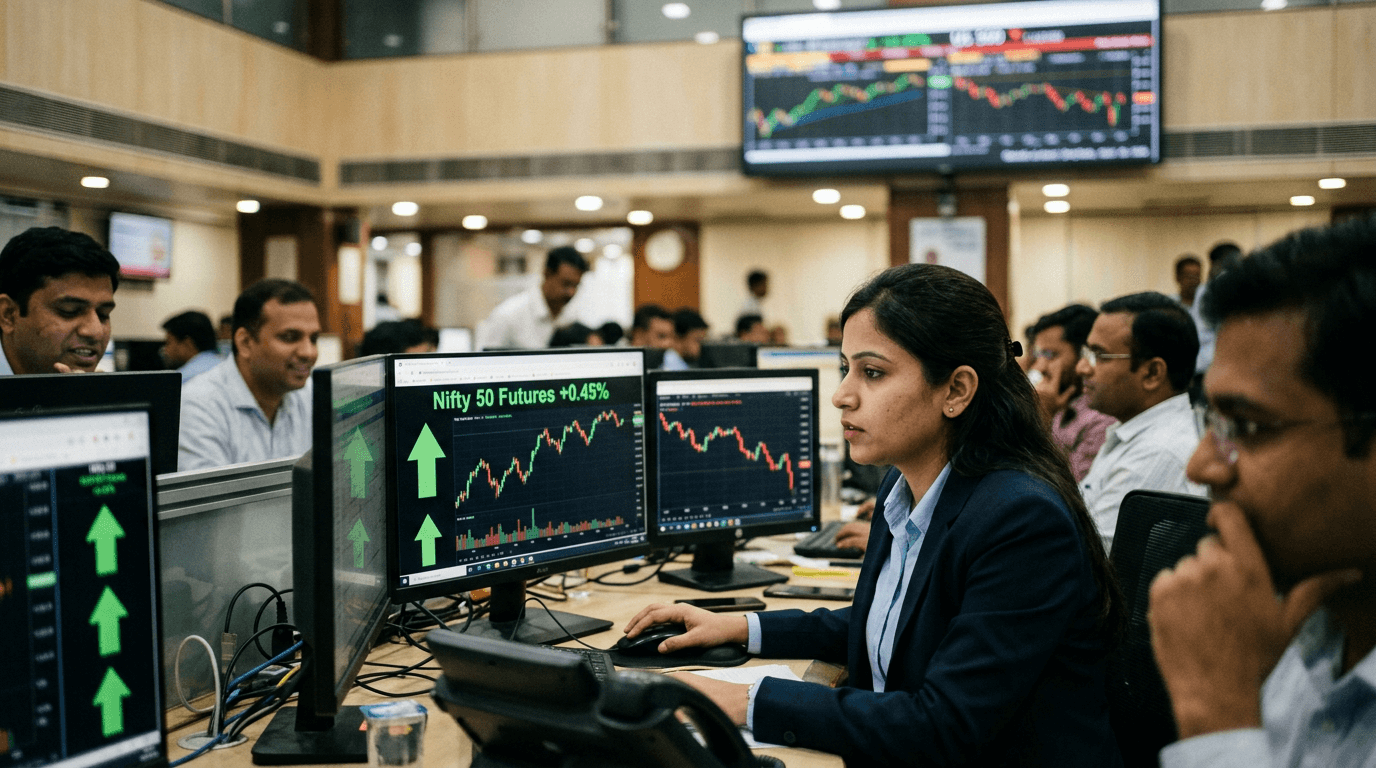
Equity index futures are sending a nuanced signal today, with US 500 futures slipping about 0.5% while India’s Nifty 50 futures trade modestly higher. This kind of divergence is a reminder that “the market” is rarely a single story; instead, it is a mosaic of regional growth expectations, policy paths, and sector dynamics that traders must learn to interpret and navigate.
Global Futures Snapshot
On one side of the board, US 500 futures are under pressure, reflecting cautious sentiment around upcoming global data releases and ongoing concerns about growth, inflation, and earnings resilience. A 0.5% move may not be dramatic in isolation, but it often signals that traders are reassessing risk rather than aggressively adding exposure.
On the other side, Nifty 50 futures in India are edging higher, suggesting a comparatively more constructive view on domestic growth, corporate earnings, or policy stability. Even a modest positive move can be significant when global risk sentiment is mixed, as it hints at investors favoring certain regions over others instead of pulling back uniformly.
For traders, this split screen between US and Indian equity futures is a practical example of how regional narratives can diverge, even when global macro themes—such as interest rates, energy prices, or geopolitical risks—are shared.
What The Mixed Tone Signals
A “mixed tone” across equity index futures typically points to selective risk-taking rather than broad risk-on or risk-off behavior. When major indices move in opposite directions, it often means traders are rotating capital rather than exiting or entering markets in one big wave.
In the US, pressure on the 500 futures contract may reflect sensitivity to upcoming data on inflation, employment, or manufacturing, as well as the potential implications for central bank policy. Traders may be reluctant to chase recent rallies, preferring to wait for confirmation that growth can remain resilient without reigniting inflation.
In India, a firmer Nifty 50 futures market can signal confidence in domestic drivers such as consumption, infrastructure spending, technology, and financials. Relative valuation, strong corporate earnings, or expectations of supportive policy can all contribute to this kind of outperformance versus developed markets.
For learners and active traders alike, the key lesson is that risk sentiment is layered. It is possible to have caution at the global level while seeing pockets of optimism in specific regions or sectors.
Regional Growth And Policy Expectations
Divergent index futures often trace back to differing growth and policy expectations. In practice, that means traders are constantly comparing:
Growth momentum: If investors expect India’s GDP growth and corporate earnings to outpace the US over the coming quarters, they may favor Nifty futures even when they are trimming exposure to US indices.
Monetary policy: Expectations around interest rates and liquidity matter greatly. A central bank perceived as being closer to easing—or at least not tightening further—can support equity valuations and futures pricing, especially in rate-sensitive sectors.
Currency dynamics: FX expectations feed directly into index futures positioning. If traders anticipate relative currency strength in India versus the US, equity exposure to that region can become more attractive on a risk-adjusted basis.
Understanding these drivers is crucial not only for live trading, but also for simulated trading environments. SimFi platforms like E8 Markets allow participants to test scenarios: for example, how a surprise inflation print in the US might push US 500 futures lower while leaving Nifty 50 futures comparatively resilient, or even higher, if local dynamics remain supportive.
How Traders Are Positioning Across Asset Classes
The current setup also suggests that traders are not simply making one-way bets on equities. Instead, they are rotating exposure across index, FX, and commodity futures to fine-tune their risk profile.
Equity index futures: A tilt away from US 500 futures and toward Nifty 50 futures can be part of a relative value strategy—effectively expressing a view that Indian equities will outperform US equities over a given horizon.
FX futures: Currency pairs involving the US dollar and Indian rupee may be used to hedge or amplify these equity views. For instance, a trader bullish on India could pair long Nifty futures with a position that benefits from a stable or stronger rupee.
Commodity futures: Changes in energy prices or industrial metals often influence both US and Indian markets. Traders can use commodity futures to hedge sector exposure, particularly in energy-intensive or export-oriented industries.
Simulated trading offers an ideal environment to practice these multi-asset rotations without capital at risk. Participants can build and stress-test strategies that link equity index futures to FX and commodities, exploring how correlations shift when data surprises or policy expectations change.
Practical Takeaways For Simulated Traders
For traders using a SimFi platform, today’s mixed futures tone is more than a headline—it is a learning opportunity. A few practical steps can help translate this market backdrop into skill-building:
1. Study relative performance: Track how US 500 and Nifty 50 futures move around key data releases. Note whether one index consistently leads or lags and under what conditions.
2. Build “spread” strategies: In a simulated environment, experiment with long Nifty/short US 500 futures positions (or vice versa) to understand the mechanics and risk profile of relative value trades.
3. Integrate macro triggers: Map upcoming events—such as inflation prints, central bank meetings, or GDP releases—to potential scenarios. Create simulated trades that express a view for each scenario and review outcomes.
4. Practice risk management: Use position sizing, stop-loss levels, and diversification across indices, FX, and commodities to manage volatility. Track how small changes in futures prices affect overall portfolio risk.
5. Review and iterate: After each simulated session, analyze what worked and what did not. Focus on whether your interpretation of regional growth and policy expectations matched market reactions.
Conclusion
The divergence between declining US 500 futures and rising Nifty 50 futures illustrates how global markets can be cautious overall yet selectively optimistic on specific regions. For traders, the message is clear: understanding regional narratives, policy paths, and cross-asset linkages is essential for effective index futures trading. Simulated finance environments offer a powerful way to practice these skills, turning today’s mixed futures tone into a hands-on lesson in multi-region, multi-asset strategy design and risk management.