
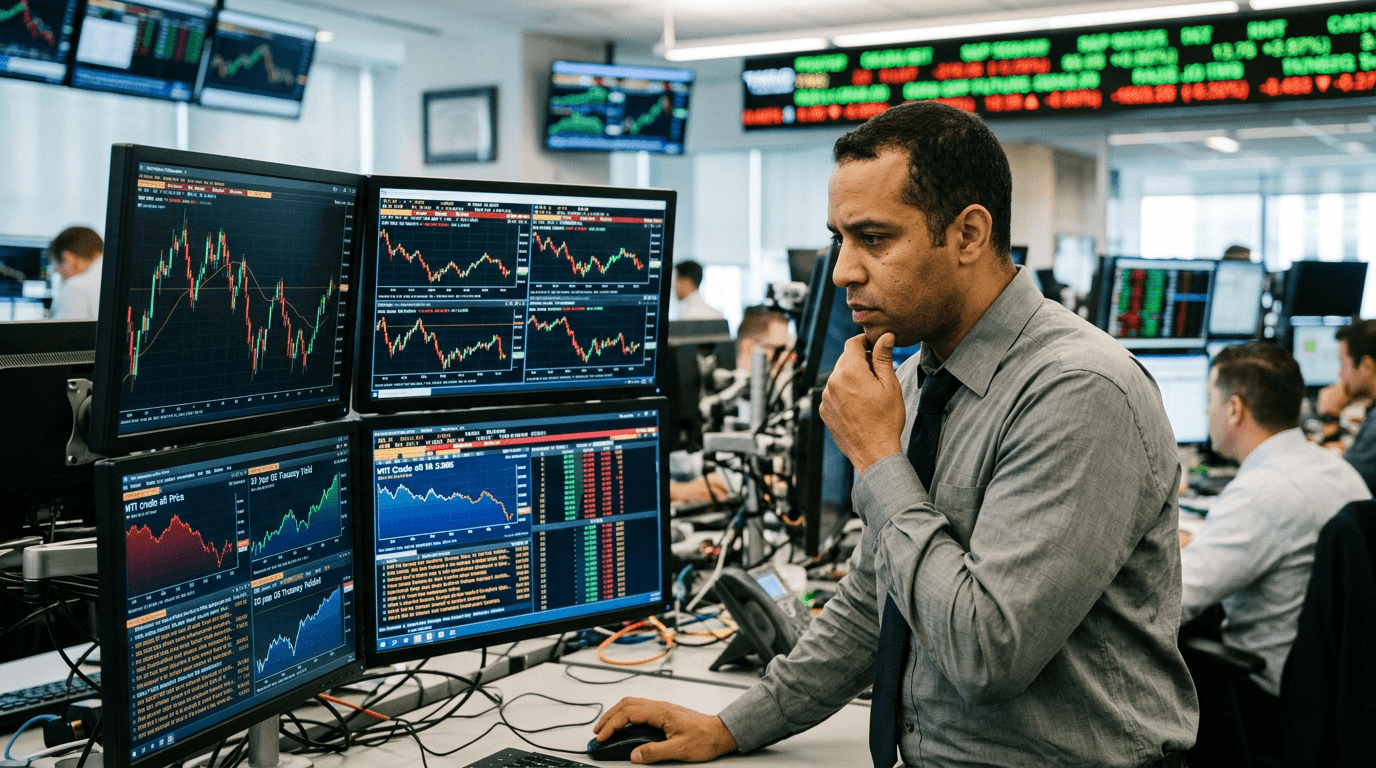
US index futures are pointing to a cautious start for Wall Street, with S&P 500 and Nasdaq contracts modestly lower while Dow futures edge slightly higher in live trade. This kind of mixed picture often reflects a market that is reassessing risk, digesting cross-currents from commodities, interest rates, and upcoming policy events rather than expressing a clear risk-on or risk-off view.
Market Snapshot: Futures Signal A Cautious Open
Recent live quotes show S&P 500 and Nasdaq 100 futures trading marginally in the red, while Dow futures are either flat or fractionally positive, highlighting the absence of strong conviction ahead of the cash open[3][14]. That contrasts with sessions where futures move decisively in one direction, often following major data releases or earnings surprises, and instead suggests traders are fine-tuning positions rather than making aggressive bets[11].
For discretionary traders and systematic strategies alike, a slightly mixed futures tape is a reminder that direction is only part of the story. The size of the move matters, but so does context: whether prices are reacting to specific catalysts, moving in tandem with other asset classes, or simply drifting within a recent range. Understanding these nuances is essential when decisions must be made before the opening bell.
How Index Futures Shape Intraday Trading
Index futures are more than just a preview of the open; they are central tools for price discovery, hedging, and intraday risk management. S&P 500, Nasdaq, and Dow contracts allow participants to express views on broad equity baskets with leverage, deep liquidity, and nearly 24-hour trading, making them the first place where global sentiment appears as news flows hit.
When futures are modestly lower, as they are today for the S&P and Nasdaq, traders often read that as a signal of mild profit-taking or a pause after prior gains rather than a clear trend reversal. The gap between the futures indication and “fair value” – which adjusts for dividends and funding – also shapes expectations about whether the cash market will open lower, flat, or even slightly higher as arbitrage relationships are restored during the opening auction.
Mixed signals across indices can also set up relative value opportunities. A slightly firmer Dow versus softer Nasdaq, for example, may hint at rotation away from high-growth names toward more cyclical or value-oriented shares. Active traders watch these spreads closely, using index futures both to implement and to hedge such views in real time.
KEY DRIVERS BEHIND TODAY’S MOVE
Today’s action is being driven by several overlapping forces: weaker crude oil prices, firmer yields observed earlier in the session, and looming Federal Reserve event risk. Weaker oil typically acts as a double-edged sword. On one hand, lower energy prices can ease input costs for businesses and moderate headline inflation. On the other, declining crude often signals concerns about global demand, which can weigh on cyclicals and energy stocks.
Firmer yields – particularly on US Treasuries – tend to pressure growth and technology names, which dominate the Nasdaq and carry significant weight in the S&P 500. Higher rates raise discount factors used in valuation models and increase funding costs, dampening the appeal of long-duration cash flows. That dynamic helps explain why futures tied to tech-heavy indices can lag even when broader sentiment is only mildly risk-off.
Overlaying those moves is anticipation around upcoming Fed-related events, whether a policy meeting, symposium, or key speech. When markets expect potential shifts in rate guidance or balance sheet policy, traders often pare risk, rebalance portfolios, and reduce leverage ahead of time. The result is a cautious tone, with futures reflecting an incremental, rather than dramatic, repositioning as participants wait for clarity.
Practical Takeaways For Active Traders
For both new and experienced traders, a slightly mixed futures session offers several practical lessons:
1. Treat small, mixed moves as information about uncertainty, not as a strong directional signal. Modest declines or gains need to be read in context of recent volatility and macro drivers.
2. Track correlations. If equities are soft while yields firm and oil weak, that combination can point toward specific sector impacts – growth, financials, and energy – and inform your watchlist for the open.
3. Distinguish between noise and narrative. A few basis points’ change in yields may matter less than the messaging at a Fed event; futures often reflect the anticipation of that narrative rather than the move itself.
4. Prepare scenarios, not predictions. Build trading plans for “small gap and fade,” “small gap and continuation,” and “no gap and range,” and define risk limits for each. Mixed futures are ideal environments for this flexible planning.
In short, the right response to cautious futures is often disciplined observation and preparation, not reactive trading. Patience and a robust process are competitive edges when the tape is indecisive.
Using Simulated Finance To Practice Mixed Market Opens
Simulated Finance (SimFi) platforms such as E8 Markets provide a valuable laboratory for practicing exactly this kind of environment: modest index moves, conflicting signals across benchmarks, and important event risk on the horizon. Because no real capital is at stake, traders can stress-test ideas, execution styles, and risk frameworks under realistic market conditions.
One useful exercise is to recreate past sessions with similar futures behavior – for example, days when the Nasdaq opened slightly lower while the Dow was flat to higher and the Fed was in focus – and run multiple playbooks against the same data. This can include contrasting an open-drive strategy versus a mean-reversion approach, comparing tight versus loose stop placement, or experimenting with different position sizes.
Another powerful application of SimFi is building and refining multi-asset dashboards. By simultaneously tracking simulated index futures, bond yields, and commodity prices, traders learn to recognize recurring patterns: when mixed futures resolve higher, when they lead to choppy ranges, and when they precede more pronounced risk-off moves. Logging trades and outcomes over many such sessions helps convert qualitative “tape-reading” into measurable edge.
Conclusion: Trading Through Cautious Sentiment
Today’s slightly mixed US index futures underline a familiar reality: markets often move not on certainty, but on the balance of competing forces. Weaker oil, firmer yields, and looming Fed communication are pulling sentiment in different directions, leaving S&P 500 and Nasdaq futures modestly lower and the Dow fractionally firmer rather than signaling a clear trend.
For traders, that environment rewards preparation, scenario analysis, and disciplined risk control more than bold predictions. Using tools like index futures thoughtfully – and reinforcing skills in a SimFi setting – can turn a cautious pre-open into a learning opportunity. The goal is not to forecast every tick, but to build a robust process that remains effective whether futures are surging, sliding, or simply edging lower in a slightly mixed, watchful market.