
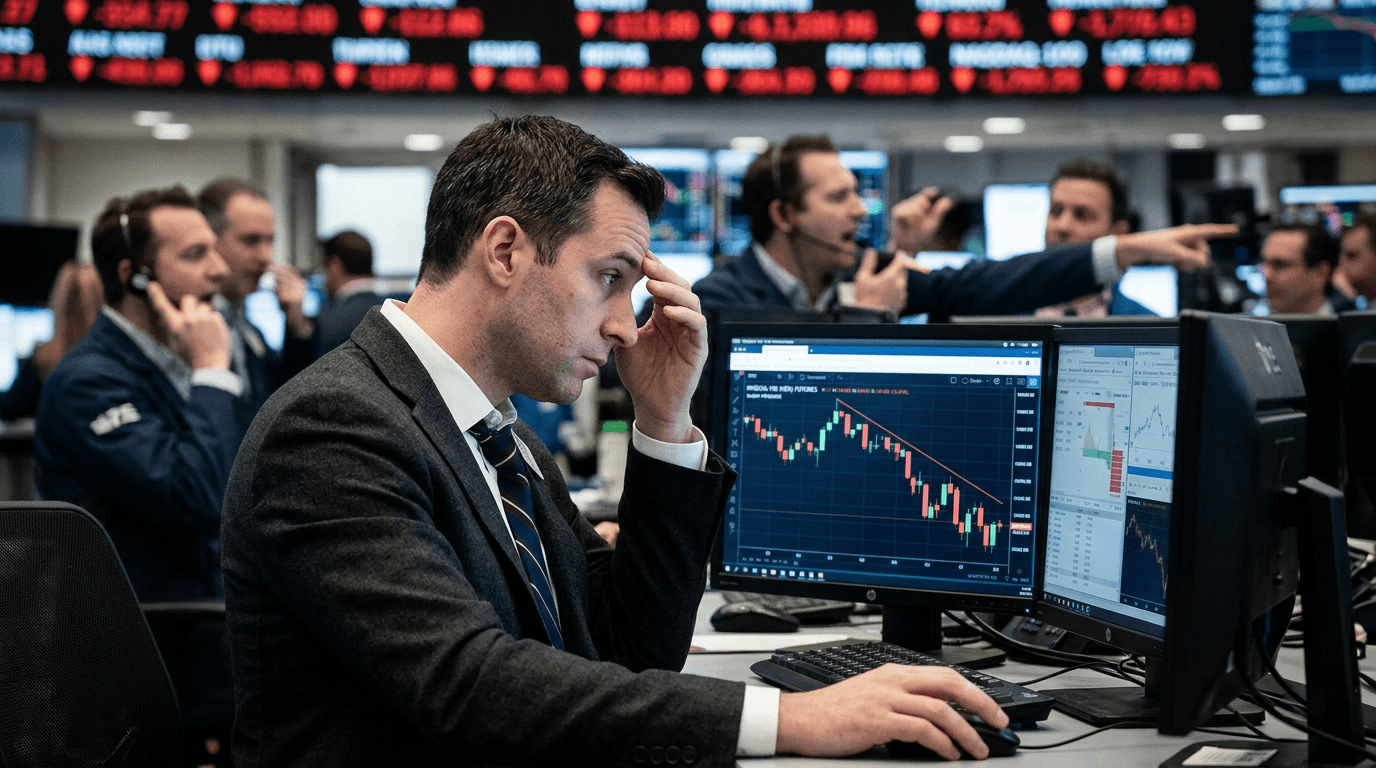
Nasdaq-100 futures are under pressure as traders quickly reprice the odds of a more hawkish Federal Reserve, dragging down tech-heavy benchmarks and reinforcing a cautious tone across U.S. risk assets.[1][3][8] This shift reflects growing acceptance that policy may stay restrictive for longer, compressing valuations in growth and AI-linked names that had been key drivers of the index’s gains.[1][2][15]
Market Move: Tech Leads The Pullback
Nasdaq-100 futures have slipped as markets digest a series of policy signals pointing toward higher-for-longer interest rates and the possibility of fresh hikes in 2026.[2][5][8] In recent sessions, NQ futures have traded below psychologically important levels such as 30,000, underscoring a change in sentiment from “buy-the-dip” toward more defensive positioning.[1][9] The weakness is not isolated to one headline; rather, it reflects an evolving macro narrative that clashes with stretched tech and AI valuations.[1][2]
This repricing has pushed the Nasdaq 100 into correction territory, with volatility gauges such as the VIX breaking above 20 and signaling a regime of higher equity risk.[8][15] Traders are increasingly unwilling to pay peak multiples for long-duration growth stories when the path of rates looks less benign, creating a feedback loop between Fed expectations, bond yields, and equity prices.[2][8]
Hawkish Fed Repricing: What Has Changed
The core driver of the latest downside in Nasdaq-100 futures is not an immediate rate hike, but a meaningful shift in the Fed’s forward guidance and dot plot projections.[2][5][8] In recent meetings, the Federal Reserve has held the policy rate at a target range of 3.50–3.75%, keeping the nominal stance unchanged.[2][5][8] Under the surface, however, a growing number of Federal Open Market Committee participants now pencil in at least one or even two additional hikes in 2026, a clear hawkish tilt versus earlier expectations for eventual easing.[2][5][8]
In one key meeting, nine of eighteen officials indicated they expect another rate increase later this year, signaling limited appetite to relax policy despite moderating growth data.[1][2][5] Markets have responded swiftly: futures linked to short-term rates and SOFR have repriced toward tighter policy, while tools tracking meeting probabilities show a significant chance of a 25-basis-point hike at upcoming Fed gatherings.[3][11][13] For example, implied odds of a September increase have climbed into the 57–67% range in some estimates, a notable jump from prior pricing.[3][13]
When the market moves from expecting cuts to contemplating multiple future hikes, the discount rate applied to equities rises, hitting sectors most sensitive to long-term cash flows.[2][8] That is the essence of hawkish repricing: investors must rebuild models and risk assumptions around a more restrictive baseline.
Why Tech And Ai Names Bear The Brunt
The Nasdaq-100 is dominated by growth, technology, and AI-exposed companies whose valuations depend heavily on profits expected many years into the future.[1][2][8] These “long-duration” assets are especially vulnerable when the market raises its estimate of the real policy rate and long-term yields.[2] As the discount rate rises, the present value of distant cash flows falls, making high-multiple stocks more fragile than shorter-duration sectors such as value or dividend names.[2][8]
Recent price action has reflected this dynamic clearly: skepticism toward stretched AI valuations has combined with the hawkish Fed shift to pressure the index, even as some cyclical or defensive areas hold up relatively better.[1][2][8] Semiconductor and cloud names, which had benefited from aggressive growth narratives, have seen sharper swings as traders re-evaluate whether earnings momentum can compensate for higher financing costs and tighter liquidity conditions.[1][2][11]
This is why the Nasdaq-100 often reacts more violently than the Dow or broader benchmarks when rate expectations change; its sector mix effectively embeds more macro duration risk.[2][6] For portfolio builders, the message is simple: interest rate risk is not only about bonds—it is embedded in equity factor exposure.
Broader Risk Sentiment And Portfolio Implications
The decline in Nasdaq-100 futures has broader significance because tech has been a key pillar supporting U.S. equity performance.[3][8][15] When that pillar wobbles, correlations across risk assets tend to rise, and investors may de-risk across credit, small caps, and higher-beta sectors.[6][8] The hawkish repricing has already been accompanied by higher Treasury yields and elevated volatility, creating tighter financial conditions even without a formal rate hike.[5][8][15]
For diversified portfolios, this environment raises several practical questions. First, how exposed is the allocation to long-duration growth relative to value, quality, and income strategies?[2][8] Second, do existing hedges—such as index puts, volatility products, or duration exposure in bonds—adequately reflect the risk of further hawkish surprises?[8][15] Third, is cash now a more attractive strategic asset than it was in a low-rate world, given the improved carry and optionality it offers?[5][8]
Investors who rode the AI and megacap growth wave may need to consider rebalancing toward more resilient sectors or factors, particularly if upcoming data on employment, inflation, and manufacturing confirms the Fed’s resolve to keep policy restrictive.[8] At the same time, fundamental strength—such as robust earnings growth in parts of the Nasdaq-100—provides some offset, making this more a valuation and rate story than an outright collapse in corporate performance.[8]
How Traders Can Navigate Via Simulated Strategies
For traders and learners using simulated finance environments such as E8 Markets, the current backdrop offers a valuable live case study in macro-driven equity risk.[8] The combination of hawkish Fed signals, shifting rate probabilities, and tech-heavy index dynamics creates a rich setting to test strategies without capital at risk.
Several practical exercises stand out. One is to backtest how different levels of Fed funds expectations impact Nasdaq-100 futures, comparing periods of easing bias to periods of hawkish repricing.[2][6][8] Another is to model factor rotations—tilting between growth, value, quality, and low volatility—and observe how simulated portfolios behave when rates and volatility rise.[2][8] A third is to run scenario analyses around key data releases, such as CPI or NFP, and map how shocks to inflation or employment might alter the path of policy and the pricing of index futures.[8]
Simulated trading allows participants to stress-test risk management rules—such as maximum drawdowns, position sizing, and hedging tactics—under conditions that resemble real-world macro volatility.[8][15] By tracking how hypothetical positions in Nasdaq-100 futures respond to hawkish or dovish surprises, traders can build intuition that translates into more disciplined decision-making if and when they trade live markets in the future.
Conclusion: Watch The Fed, Watch The Duration
The drop in Nasdaq-100 futures on hawkish Fed repricing is a reminder that macro expectations remain a central driver of modern equity markets, especially for tech and AI-heavy benchmarks.[1][2][8] As long as the market assigns a meaningful probability to additional rate hikes and higher-for-longer policy, long-duration assets will stay sensitive to every shift in guidance, dot plots, and data.[2][5][8]
For investors and traders alike, the key is to link views on the Fed to concrete portfolio choices—sector tilts, hedging strategies, and risk limits—rather than treating macro as background noise.[2][8] Using simulated environments to practice these adjustments can help transform complex policy narratives into actionable trading and investment frameworks, turning volatility into a learning opportunity rather than just a source of stress.[8][15]