
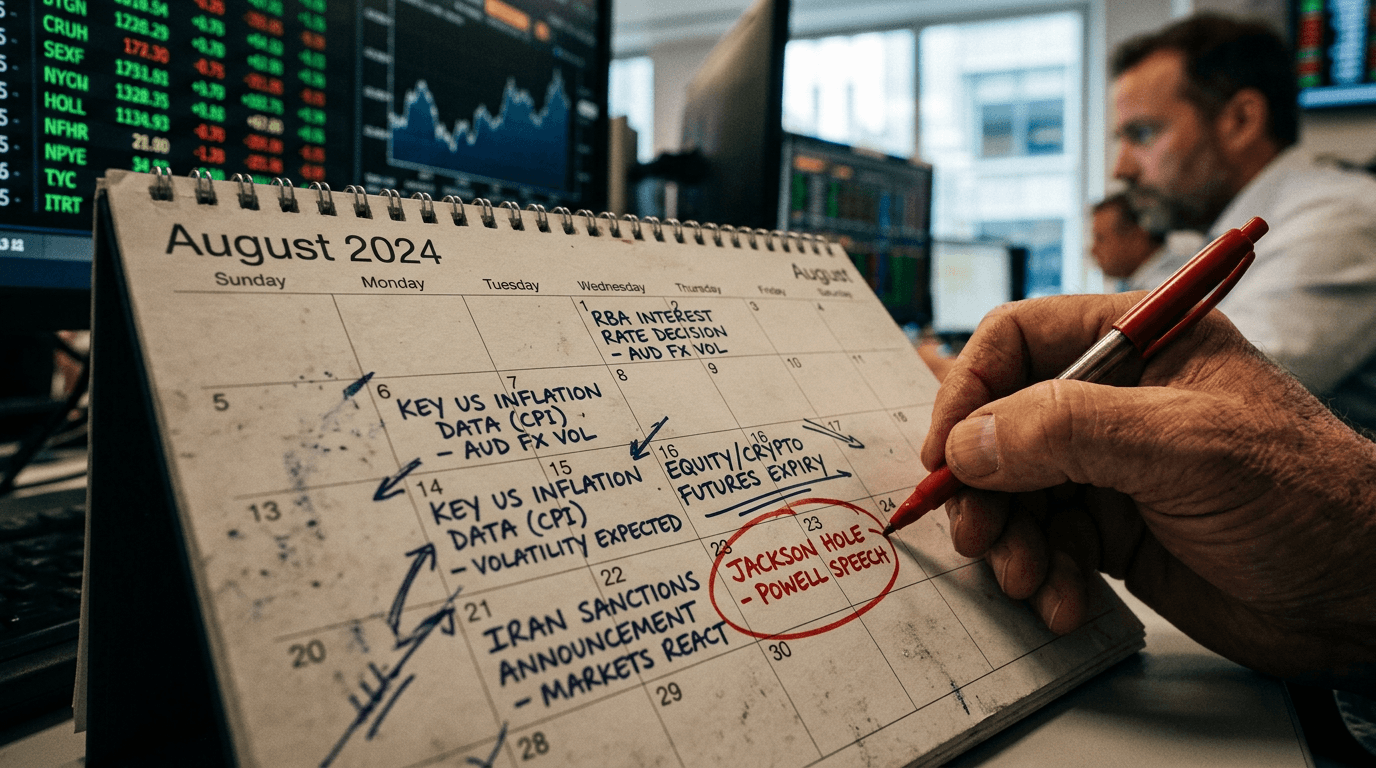
Markets are heading into a dense macro risk cluster where geopolitical shocks, high-impact data releases, central bank communication, and mega-cap earnings all land in the same week. For traders across rates, FX, equity, and crypto futures, this convergence is less about any single headline and more about how these events interact to reshape volatility, narrative, and positioning.
Iran Sanctions: Geopolitics Meets Markets
The first focal point is Monday’s announcement of new US sanctions on Iran, framed by officials as “the toughest sanctions in history” and part of a broader economic warfare campaign[9][10][11]. Treasury Secretary Scott Bessent has flagged a push for “the greatest coordinated economic isolation in the history of the world,” with penalties aimed not only at Iran but at any country or institution that provides a financial lifeline to Tehran[11][12]. This introduces a potent extraterritorial risk for global banks, refiners, and trading houses that touch Iran-linked flows[3][7][12].
Markets will pay close attention to whether the measures extend deeper into secondary sanctions on Chinese “teapot” refineries, larger banks, or shipping and insurance companies that move Iranian crude[3][15]. A more aggressive package that reinforces the naval blockade around the Strait of Hormuz would tighten perceived oil supply, support crude and energy equities, and pressure importers with large energy bills[15]. In FX, petrocurrencies could catch a bid, while currencies of energy importers may underperform, particularly if risk sentiment deteriorates and safe-haven flows increase.
From a trading perspective, the key is that sanction headlines can trigger sharp, gap-style moves in energy markets, regional FX, and high-beta assets even before details fully filter through. Short-term traders should be prepared for headline risk and whipsaw price action, while macro-focused investors will be thinking in terms of sustained risk premia embedded in oil and geopolitical-sensitive assets.
Us Data And Nvidia: Stress-testing The Soft-landing Narrative
The macro picture is further complicated by US consumer confidence data and Nvidia’s earnings, both of which speak directly to the durability of the US growth and AI narratives underpinning equity valuations. Strong consumer confidence readings would reinforce the idea that households can support continued expansion, keeping pressure on the Fed to maintain restrictive policy for longer and potentially nudging rate expectations higher. That typically supports the dollar and weighs on duration-sensitive assets but also bolsters cyclical and consumer-linked equities.
Weak confidence would do the opposite: it would revive concerns about demand softening just as policy remains tight, potentially flattening the rate path and encouraging a rotation into defensives and quality growth. Nvidia’s results add a powerful micro lens—recent quarters have seen the company repeatedly beat revenue and EPS forecasts, driving AI-related risk appetite across indices and sectors[14]. A positive surprise this week would signal that AI investment remains robust, supporting tech-heavy indices and crypto narratives linked to digital infrastructure and computing[14]. A miss or cautious guidance, however, could act as a sentiment shock far beyond one ticker, cooling risk appetite and amplifying any negative read-through from US data.
For traders in simulated environments, this cluster is a textbook opportunity to test scenario analysis: one path where data and earnings reinforce the soft-landing and AI stories, and another where cracks in confidence or tech margins trigger a broader de-risking. Positioning strategies, from momentum in growth names to volatility trades in index futures, can be rehearsed without capital at risk.
Australian Cpi And Rba Minutes: Antipodean Signals, Global Carry
Australian CPI and the RBA minutes may seem local, but they matter for global carry trades and the broader inflation narrative. Stickier-than-expected inflation would validate the idea that price pressures remain stubborn in smaller open economies, encouraging the RBA to maintain or even strengthen its hawkish posture. That tends to support AUD, especially against currencies from jurisdictions where inflation is cooling faster, and can make AUD crosses more sensitive to risk sentiment.
Conversely, a benign CPI print and more cautious tone in the minutes would signal that the RBA sees disinflation gaining traction, which could open the door for a more balanced or even mildly dovish tilt over coming meetings. That scenario typically weighs on AUD and reduces the attractiveness of AUD-funded carry trades. For global traders, watching how AUD responds to both local data and the broader risk backdrop is a useful gauge of cross-asset confidence; sharp moves in AUD often coincide with shifts in equity and commodity sentiment.
In a SimFi context, Australian data offers a compact case study in how domestic inflation and central bank communication transmit into FX and rates. Simulated portfolios can be structured around AUD pairs, front-end interest rate futures, and commodity-linked equities to observe how one data point can ripple across asset classes.
Jackson Hole: Central Bank Narrative Risk
All of these threads ultimately converge at Jackson Hole, where Fed Chair Warsh’s keynote has the potential to re-anchor global expectations for the policy path. The symposium has a long history as a platform for pivotal narrative shifts—from signaling tapering to rethinking inflation frameworks—and markets will scrutinize every signal around growth risks, inflation persistence, and the balance between rate policy and balance sheet management.
If Warsh leans hawkish, emphasizing upside inflation risks and tolerance for slower growth to ensure price stability, front-end yields are likely to push higher, the dollar could strengthen, and risk assets may reprice to a higher discount-rate regime. A more balanced or cautiously dovish message that acknowledges disinflation and global fragilities would instead encourage markets to price a gentler path for policy, supporting duration, EM FX, and higher-beta equities and crypto.
Trading Playbook: How To Navigate The Risk Cluster
A week like this rewards traders who treat macro events as a connected system rather than isolated headlines. Practical takeaways include:
1) Map scenarios, not predictions: Build at least two coherent paths—hawkish sanctions plus strong data and earnings, versus sanctions-induced risk aversion plus softer data and guidance—and stress-test positions against both.
2) Stagger risk around events: Rather than going all-in before announcements, scale into and out of positions as information arrives: sanctions detail, data releases, earnings, then Jackson Hole.
3) Watch correlations: Geopolitical stress may tighten correlations between energy, FX, and equity volatility. If oil spikes on sanctions, be ready for knock-on effects in petrocurrencies, EM credit, and high-yield equities.
4) Use volatility strategically: Options—whether in real or simulated markets—can express directional views while capping downside, or monetize expected volatility spikes around known event windows.
5) Leverage simulation to refine execution: In platforms like E8 Markets, traders can rehearse event-driven strategies, test reaction functions to surprise data, and refine position sizing and timing without financial losses, improving discipline for when it truly matters.
As this macro risk cluster unfolds, the most important edge is not predicting each print or headline perfectly but understanding how they connect to the broader narrative about growth, inflation, and policy. Geopolitics, data, central banks, and earnings are all pieces of the same puzzle. Traders who stay nimble, respect the potential for regime shifts, and use structured scenarios—ideally honed in simulated environments—will be better positioned to navigate the volatility and convert uncertainty into opportunity.