
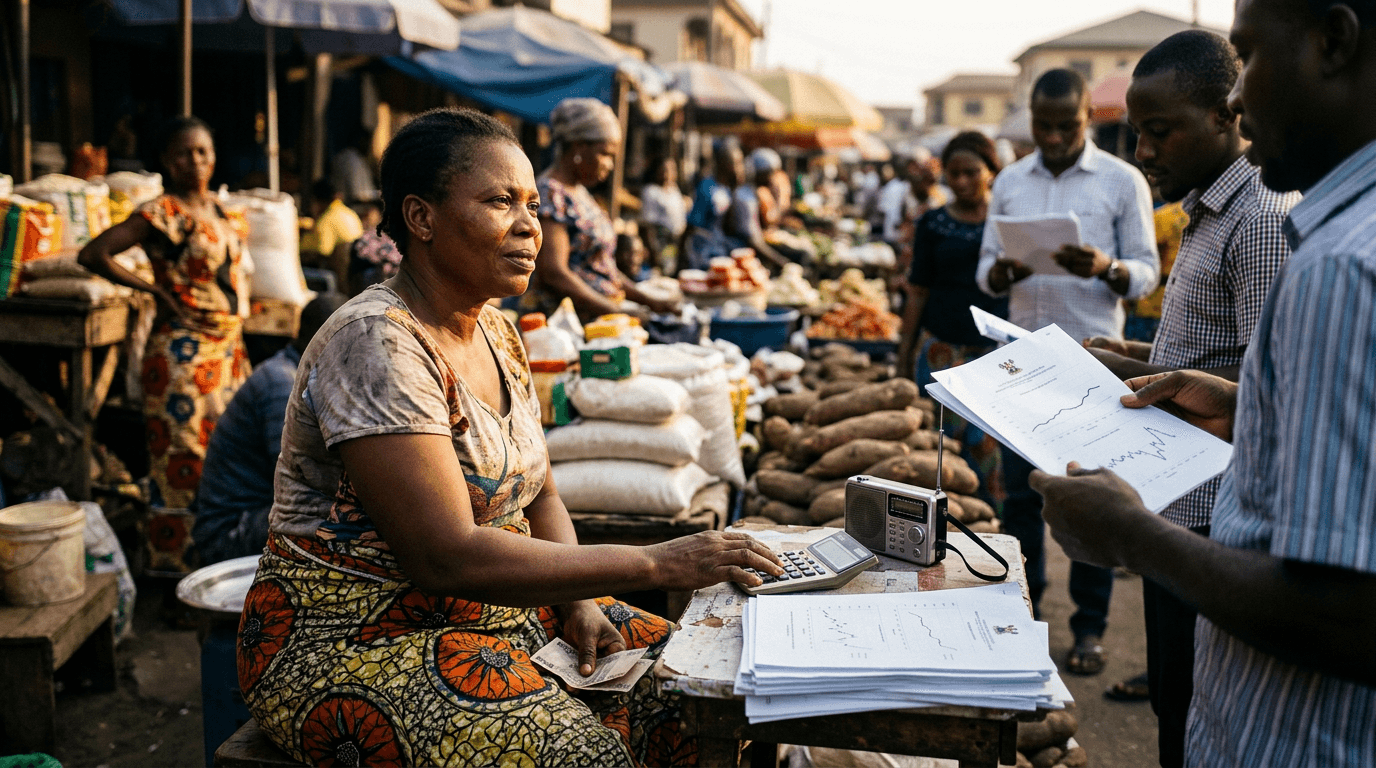
Nigeria’s decision to begin regularly publishing new poverty, income and inequality indicators is more than a technocratic tweak – it is a strategic move that could reshape how investors, analysts and currency traders assess the country’s reform story.[4] In a market where sentiment often swings on confidence rather than just growth numbers, credible data on living standards can become a powerful signal of whether policy changes are truly delivering shared prosperity.[4]
Why New Poverty And Income Metrics Matter
For the past two years, Nigeria has embarked on tough macroeconomic and FX‑related reforms, including efforts to unify exchange rates and restore fiscal discipline.[4] These measures have been welcomed by many investors, but they have also contributed to sharp adjustments in prices and incomes, raising questions about who is bearing the burden and who is benefiting.[4]
By committing to track poverty, incomes and inequality, the government is effectively inviting the market to judge reforms not only by GDP, reserves or the naira’s level, but by whether ordinary Nigerians see tangible improvements in their standard of living.[4] That is particularly important in frontier markets, where political risk, social stability and reform durability are tightly linked to whether households feel better off. Transparent social indicators can therefore reduce uncertainty, support policy credibility and inform longer‑term capital allocation decisions.
For currency traders, the new metrics could become a complementary data set alongside inflation, FX reserves and growth figures, helping to explain why the naira might strengthen on reforms in one period but weaken if social stress mounts in another. Over time, the relationship between these indicators and market pricing could itself become a tradable signal.
A Complex Poverty Landscape
To understand why these indicators matter, it helps to look at the scale of Nigeria’s poverty challenge today. The World Bank estimates that the share of Nigerians living in extreme poverty rose from 34.7% in 2018/19 to 41.8% in 2022/23, using an international poverty line of $3.00 per person per day.[2] Projections suggest that more than half of all Nigerians – about 52.5% – could be living in poverty in 2025 if current trends persist.[2]
National data paint an even more sobering picture when deprivation is measured beyond income. Nigeria’s Multidimensional Poverty Index (MPI) survey indicates that about 63% of people – roughly 133 million individuals – are multidimensionally poor, meaning they face overlapping deficits in areas like health, education, housing, and access to basic services.[3][7] The intensity of these deprivations is high: on average, people in multidimensional poverty experience more than half of all possible deprivations, reflected in an MPI intensity score of 52.9%.[6]
Rural Nigeria is particularly exposed. Recent assessments suggest poverty rates among rural populations exceed 75%, compared with around 41% in urban areas, highlighting deep regional and structural inequalities.[7] This rural‑urban divide and the concentration of poverty in northern states underline why aggregate growth has not automatically translated into broad‑based welfare gains.[7][8] For investors, these statistics emphasize that headline GDP growth alone does not guarantee social stability or sustained reform momentum.
WHAT EXACTLY WILL NIGERIA TRACK?
According to Finance Minister Taiwo Oyedele, the government plans to assess “shared prosperity” through three main lenses: reductions in multidimensional poverty, growth in real income per capita, and lower inequality.[4] Each of these measures captures a different dimension of economic wellbeing and together they provide a more holistic view than a single poverty line or income statistic.
Multidimensional poverty focuses on access to education, healthcare, clean water, electricity, housing quality and employment, among other factors.[3][6] Tracking this indicator over time will reveal whether reforms and social programs are expanding real opportunities for households, not just boosting nominal incomes. Real income per capita adjusts for inflation and price changes, showing whether purchasing power is improving or eroding.[4] This is crucial in a high‑inflation environment where wage increases can be quickly wiped out by rising food, transport or energy costs.
Finally, inequality metrics – such as changes in income distribution or regional gaps – help answer the question of who gains from reform. A reform package that lifts average incomes but widens inequality may be less politically sustainable and more prone to social tension than one that delivers modest but broad‑based improvements.[4] For markets, the composition of gains can matter as much as their size in assessing long‑term risk.
SIGNALS FOR FRONTIER‑MARKET INVESTORS AND CURRENCY TRADERS
For global investors with exposure to Nigerian debt or equities, regular publication of these indicators can serve as an early warning system on reform fatigue or social strain. If macro fundamentals improve while multidimensional poverty and inequality remain stubbornly high, markets may begin to question how durable the reform path really is. Conversely, clear progress on poverty reduction and real incomes can reinforce the narrative that difficult policy steps are paying off, supporting confidence in the naira and in local assets.[4]
Currency traders, in particular, can use these indicators to contextualize price action. For example, a period of naira appreciation driven by FX inflows and positive sentiment might be more likely to sustain if accompanied by rising real incomes and falling poverty.[4] If, however, the currency strengthens while social indicators deteriorate, the rally may be more vulnerable to reversal on political or social headlines.
As liquidity and data coverage in frontier markets improve, systematic strategies may start incorporating social indicators into their risk models, linking them to probabilities of policy reversal, unrest, or shifts in fiscal stance. Nigeria’s new data regime could thus become part of a broader evolution toward “social‑macro” trading, where markets price not just central bank decisions but also the social foundations under them.
Practical Takeaways For Traders And Market Watchers
For traders and analysts who follow Nigeria, the move to publish poverty and income indicators offers several practical steps:
First, treat the new series as core macro data, not background statistics. Build historical time series as they become available and explore correlations with inflation, FX moves, bond spreads and equity performance. Over time, you may identify thresholds or trends that tend to precede market turning points.
Second, pay close attention to real income per capita alongside inflation. These two metrics together provide a sharper picture of household purchasing power than either alone. In a context where reforms have front‑loaded costs – such as higher fuel prices or FX adjustments – evidence of recovering real incomes can be an important signal that the worst of the pain is passing.[4][2]
Third, differentiate regional and rural‑urban dynamics where the data allow. High and persistent rural poverty has been identified as a key vulnerability in Nigeria’s growth model.[7][8] If new indicators show improving outcomes in urban centers but stagnation or deterioration in rural areas, that may imply uneven political risks and could influence sectoral or regional allocations.
Finally, for those using simulated trading environments or back‑testing strategies, incorporating non‑traditional macro indicators like multidimensional poverty and inequality can be a way to stress‑test positions against social risk scenarios. It is an opportunity to move beyond price‑only models and experiment with a richer set of drivers that better reflect how frontier economies evolve in practice.
Conclusion
Nigeria’s plan to publish regular, transparent indicators on poverty, incomes and inequality signals an important shift: reforms will increasingly be judged not just on macro stability or market access, but on whether they improve everyday life for millions of citizens.[4] For frontier‑market investors and currency traders, that means a new layer of data – and a new lens – for evaluating the reform story. Those who take the time to understand and integrate these metrics into their analysis will be better positioned to distinguish durable progress from superficial gains, and to navigate the complex intersection of economics, politics and markets in Africa’s largest economy.