
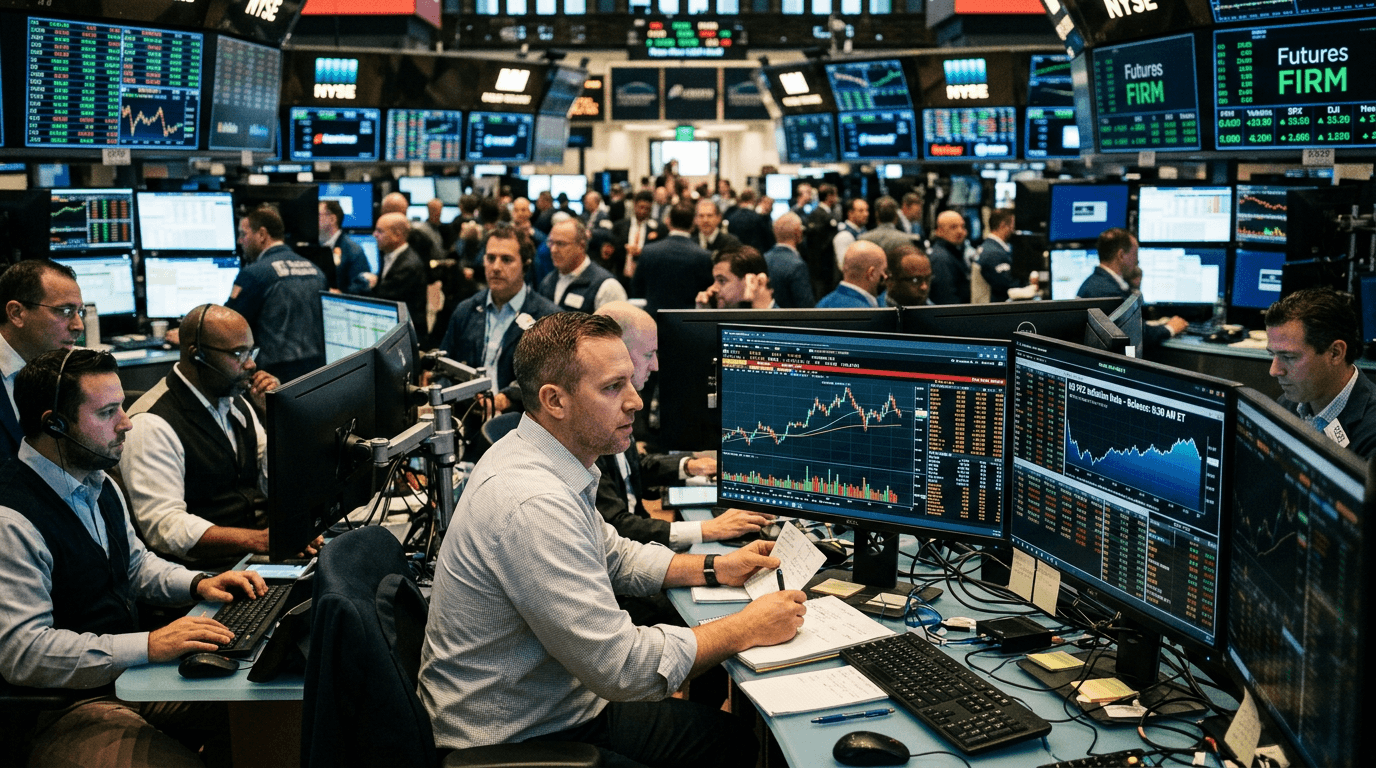
US stock futures are modestly higher, with Nasdaq 100 futures leading gains on renewed AI optimism as traders position ahead of Nvidia’s earnings and the July PCE inflation release[1][10][14]. The twin events are landing within hours of each other, concentrating market risk into a single trading day and setting up a potential volatility spike across equities, FX, and rates markets[10][12][14]. For active traders and SimFi participants, this is a textbook case of how micro-level earnings and macro-level inflation data can jointly reshape risk appetite.
Nvidia Earnings As An Ai Sentiment Barometer
Nvidia has become the bellwether for the entire artificial intelligence trade, with its data center business effectively serving as a proxy for global AI infrastructure spending[11][15]. For fiscal Q2 FY27, the company has guided revenue to around $91 billion, plus or minus 2%, while consensus expectations cluster closer to $92 billion with adjusted earnings per share in the $2.08–$2.09 range[11][14][15]. Some analysts even see room for an upside surprise, looking for revenue in the mid-$90 billion range and stronger forward guidance if AI demand remains robust[6][15].
Because of Nvidia’s outsized weight in major indices and its role in AI-related sentiment, futures have firmed as traders anticipate another strong print that would validate the recent rebound in semiconductor and growth stocks[1][10][12]. A clear beat on both revenue and EPS, coupled with confident guidance, could unleash another leg higher in high-beta tech and AI names, with knock-on effects for broader risk assets through improved sentiment and index reweighting flows[6][10][15]. Conversely, any sign that AI demand is normalizing or that supply bottlenecks are easing too quickly could trigger profit-taking in the sector and pressure the Nasdaq, even if headline numbers look solid[1][7][12].
For traders, the lesson is straightforward: it is not just whether Nvidia beats or misses; it is how the numbers compare to very high expectations and what management says about future demand. In event-driven markets, the “expectations vs reality” gap often matters more than the raw figures.
PCE INFLATION – WHY THIS DATA PRINT MATTERS
Just hours before Nvidia reports, the Bureau of Economic Analysis releases July PCE inflation at 8:30 a.m. ET, the Federal Reserve’s preferred inflation gauge[10][14]. Consensus forecasts point to headline PCE rising about 0.1% month-over-month, with the annual rate easing from 3.7% to roughly 3.6%[14]. Core PCE, which strips out food and energy, is expected to print at 0.2% m/m, leaving the year-on-year rate around 3.3%, unchanged from the prior month[14].
Those numbers matter because they sit between the Fed’s 2% target and the much higher inflation seen earlier in the cycle, reinforcing the narrative of gradual disinflation rather than a quick return to target[14]. A softer-than-expected PCE print would likely support risk assets via lower rate expectations, potentially pulling Treasury yields down and weakening the dollar as markets price a more dovish policy path[12][14]. A hotter reading, particularly on core PCE, could have the opposite effect: higher yields, stronger dollar, and pressure on duration-sensitive growth stocks even if Nvidia’s results look strong[12][14].
For traders and investors, PCE is not just another data point; it is a direct input into Fed reaction function. Watching how yields and Fed funds futures move in the minutes after the release can provide valuable clues on whether the central bank is more likely to lean hawkish or stay patient.
Market Reaction Across Asset Classes
The combination of Nvidia earnings and PCE inflation creates a two-stage test for risk sentiment. In equities, the first impulse will likely come from the PCE report: growth and high-beta sectors tend to benefit when inflation surprises lower and yields fall, while financials and value names may outperform if inflation proves sticky and rate expectations rise. The second impulse will come after the close with Nvidia’s results, particularly for semiconductors and AI-linked software and hardware.
In FX, a dovish PCE surprise would typically weigh on the dollar, supporting higher-yielding and risk-sensitive currencies, while a stronger-than-expected print could trigger a defensive bid into the dollar and other safe havens. In rates, the PCE release will be crucial for the front end of the curve, while Nvidia’s results may influence the longer end via equity-risk channels—strong risk appetite can sometimes encourage duration selling as investors rotate back into equities.
Practically, this means traders should think in scenarios rather than single predictions: soft PCE plus strong Nvidia is a “risk-on” cocktail; hot PCE plus disappointing guidance is clearly “risk-off”; mixed outcomes demand more nuanced positioning.
Practical Playbook For Traders And Simfi Participants
Ahead of such clustered events, risk management is as important as trade selection. Many discretionary traders reduce position size or hedge exposures going into the PCE release to avoid being caught on the wrong side of a surprise move in yields or the dollar. Once the inflation data is out and the initial volatility has passed, they reassess whether the macro backdrop supports leaning into Nvidia-related risk or staying cautious.
Simulated finance platforms like E8 Markets allow traders to rehearse these event-driven strategies without real capital at risk, which can be invaluable when dealing with high-impact days. Participants can test different approaches: trading index futures around the PCE release, running sector rotation strategies in equities, or structuring options around Nvidia’s earnings to capture potential volatility bursts.
Three practical actions stand out: 1. Map scenarios for PCE (soft, in line, hot) and define in advance how to adjust risk under each. 2. Clarify what would constitute an “upside surprise” or “disappointment” in Nvidia’s numbers and guidance relative to consensus. 3. Use simulated environments to practice execution speed, order placement, and risk controls under fast-moving conditions.
Key Takeaways
1. US stock futures are firm, with Nasdaq 100 futures leading gains as markets position for both Nvidia’s earnings and the July PCE inflation report on the same day[1][10][14]. 2. Nvidia’s results are a real-time referendum on the strength and durability of the AI investment cycle, with expectations already very elevated around revenue and EPS growth[11][14][15]. 3. PCE inflation remains central to the Fed’s decision-making; even small surprises in core PCE can meaningfully shift rate expectations, yields, and the dollar[12][14]. 4. Cross-asset reactions will hinge on the combination of macro and micro outcomes, making scenario planning more effective than single-point forecasts. 5. Practicing event-driven strategies in a simulated environment helps traders refine their processes before committing real capital on high-volatility days.
In a market increasingly driven by both macro data and a handful of dominant growth narratives, the pairing of Nvidia earnings and PCE inflation is a powerful reminder that fundamentals still matter. Whether the outcome is risk-on or risk-off, traders who prepare with clear scenarios, disciplined risk management, and well-tested execution plans will be best positioned to navigate the moves—and to learn from them, whether in live markets or through SimFi platforms like E8 Markets.