
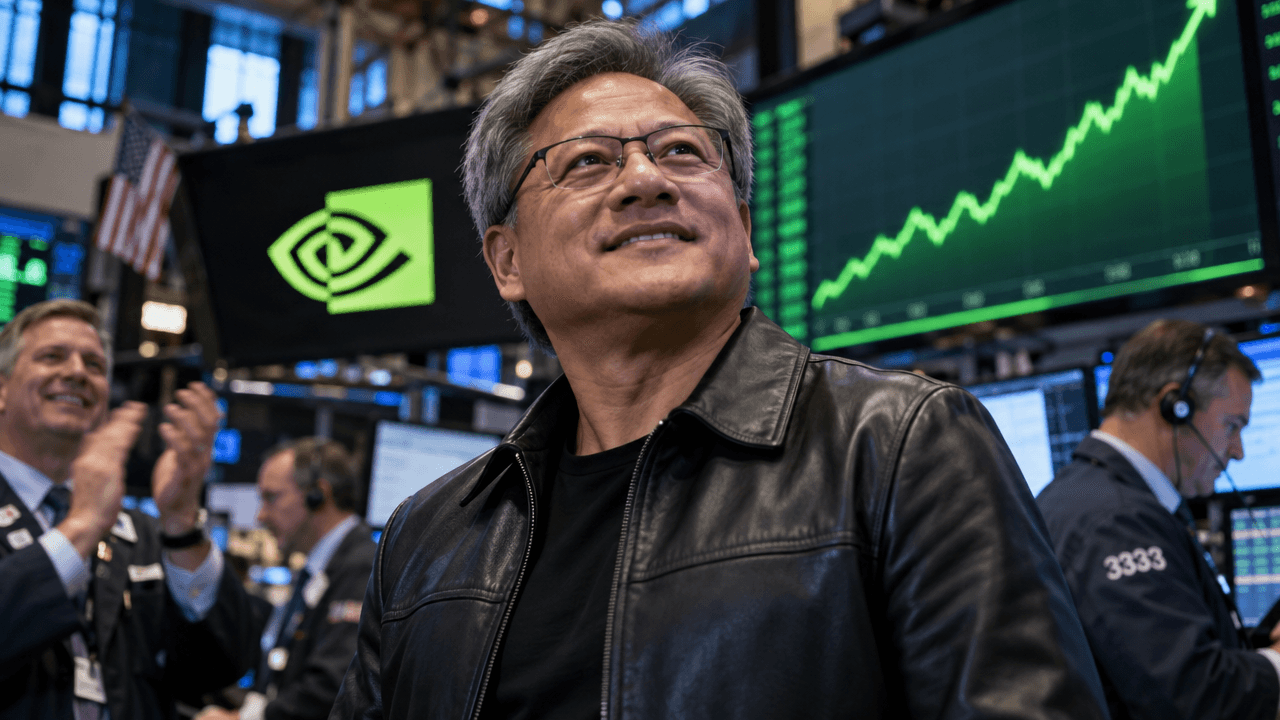
A powerful rebound in U.S. equities showed how quickly market sentiment can change when uncertainty surrounding a market leader is removed. Nvidia’s board reinstated Jensen Huang as president and chief executive officer, effective immediately, triggering a sharp recovery in technology stocks after a severe AI-led sell-off. Nvidia shares surged more than 30%, while the Nasdaq Composite climbed roughly 6.5% to 7%, the Nasdaq 100 gained around 6.9%, and the S&P 500 advanced approximately 4.7%. [1][2][14]
WHY NVIDIA’S LEADERSHIP NEWS MATTERED
Nvidia has become more than a semiconductor company. It is widely viewed as a central bellwether for artificial intelligence spending, data-center investment, and the broader technology sector. As a result, uncertainty surrounding the company’s leadership had the potential to affect much more than its own share price.
Huang’s reinstatement reassured investors that Nvidia’s strategic direction could return to familiar ground. His leadership has been closely associated with the company’s expansion from a graphics-chip manufacturer into a dominant supplier of AI computing infrastructure. The announcement therefore reduced one layer of uncertainty at a time when traders were already nervous about stretched technology valuations and the sustainability of AI-related demand.
The market reaction was immediate. Nvidia gained as much as 36% intraday before ending about 31% higher, while other AI-linked and technology stocks also rallied. [10] The response demonstrated the importance of leadership confidence in industries where long-term growth expectations are built around innovation, execution, and capital spending.
A Broader Risk-appetite Recovery
The rebound extended beyond Nvidia. Nasdaq 100 futures reportedly rose about 6% before the U.S. session, signaling that traders were positioning for a significant recovery in technology shares. [13] Gains across major indexes suggested that investors were not simply buying one company; they were rebuilding exposure to a broader group of assets that had been damaged during the previous sell-off.
This type of move is often described as a risk-on rotation. In a risk-on environment, traders generally become more willing to hold equities, growth stocks, high-beta assets, and other investments that can deliver stronger returns but also carry greater volatility. Technology companies, semiconductor manufacturers, and companies associated with AI infrastructure often benefit first because they are highly sensitive to changes in expectations.
The rebound also helped restore confidence after the S&P 500 and Dow had been pushed into correction territory during the earlier decline. [11] However, one strong session does not automatically establish a new upward trend. Sharp rallies can also reflect short covering, in which traders who had bet on falling prices quickly buy shares to limit losses. That activity can amplify gains without proving that underlying risks have disappeared.
What Traders Should Watch Next
The first question is whether Nvidia’s recovery can hold after the initial excitement fades. Traders should monitor trading volume, follow-through buying, and the performance of related companies. If semiconductor and software shares continue to advance together, the rally may indicate broader conviction. If Nvidia rises while other technology stocks weaken, the move may be more concentrated and fragile.
Investors must also continue evaluating AI fundamentals. Key considerations include data-center spending, chip demand, pricing power, competition, export restrictions, and the ability of customers to generate returns from their AI investments. A leadership announcement can improve confidence, but it does not eliminate valuation risk or guarantee uninterrupted earnings growth.
Federal Reserve policy remains another major influence. Interest-rate expectations affect the present value of future corporate earnings, which makes growth stocks especially sensitive to changes in bond yields and monetary policy. A rally in equities could lose momentum if inflation data remains persistent or if Federal Reserve officials signal that rates may stay restrictive for longer than expected.
Upcoming economic releases will therefore matter. Employment figures, inflation readings, consumer-spending data, and manufacturing indicators can all shift expectations for interest rates. Traders should avoid assuming that a technology-led rally will continue independently of the broader economic backdrop.
Implications For Simfi Traders
For SimFi traders, the session provides a useful case study in event-driven volatility. Simulated markets allow traders to practice responding to major news without placing live capital at risk, but the same principles of risk management still apply.
The first practical lesson is to avoid chasing the first price spike. When a major announcement produces a move of 30% or more in a single stock, spreads can widen, momentum can accelerate, and reversals can become severe. Waiting for a pullback, confirmation, or clearly defined entry level can produce a more disciplined decision than entering after the largest move has already occurred.
Position sizing is equally important. A trader who risks too much on a volatile technology name may suffer disproportionate losses even if the broader market view is correct. Predefined stop levels, maximum daily-loss limits, and smaller exposure can help protect a trading plan during fast-moving sessions.
SimFi traders can also compare instruments. Nvidia, semiconductor exchange-traded funds, Nasdaq futures, the S&P 500, and volatility products may respond differently to the same news. Tracking those relationships helps traders distinguish between a company-specific reaction and a genuine shift in market-wide risk appetite.
The Bigger Market Lesson
Nvidia’s leadership reversal produced one of the most dramatic equity rebounds of the year, but the event should be interpreted as a change in sentiment rather than a guarantee of lasting strength. The rally showed how important Nvidia has become to the AI trade and how quickly confidence can return when a major source of uncertainty is removed.
For traders, the most valuable response is preparation rather than prediction. Monitor the follow-through, respect volatility, evaluate the economic calendar, and keep risk consistent with the trade’s uncertainty. In both live and simulated markets, disciplined execution matters more than getting caught up in the excitement of a single headline.