
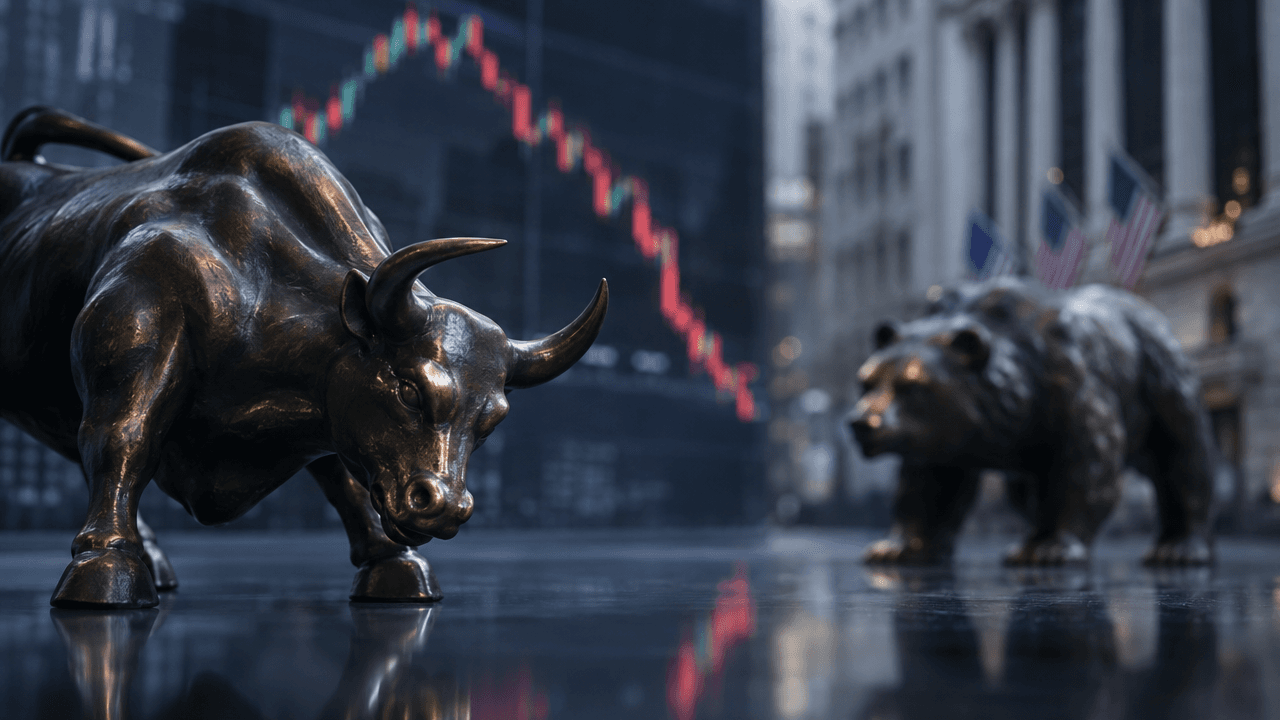
Monday’s explosive rebound in U.S. equities is already facing a reality check. On Tuesday, equity futures turned lower as traders questioned whether Nvidia’s leadership drama could genuinely restore confidence in the broader artificial intelligence trade or simply trigger another short-lived burst of speculation.
Nasdaq 100 futures fell approximately 1.7%, while S&P 500 futures declined about 1% and Dow futures dropped roughly 0.5% in premarket trading. The retreat followed Nvidia’s 31.5% surge on Monday after the company’s board reinstated Jensen Huang as chief executive. [7][8]
The Rebound That Changed The Mood
Monday’s rally was powerful by almost any measure. The S&P 500 climbed 4.7%, recovering slightly more than half of the previous week’s steep losses. The Nasdaq rose about 6%, marking its strongest session since April 2025, while Nvidia became the central force behind the market’s sudden change in direction. [7][11]
The announcement regarding Huang provided investors with a familiar figure at the center of the world’s most important AI-chip company. Huang has become closely associated with Nvidia’s growth, product strategy, and role in supplying the computing infrastructure needed for generative artificial intelligence.
For traders, the news appeared to remove one immediate source of uncertainty. Nvidia’s shares surged, and enthusiasm spread across semiconductor companies, cloud providers, and other technology stocks linked to AI spending.
However, a one-day rebound does not automatically repair the damage caused by a major sell-off. Before Monday’s rally, the S&P 500 and Dow had entered correction territory, while the market had suffered a seven-session losing streak. The indexes remained below their recent highs even after the sharp recovery. [1][5]
Why Futures Are Turning Lower
Tuesday’s weakness suggests that investors are separating relief from conviction. The reinstatement of a high-profile executive may improve sentiment around Nvidia, but it does not by itself answer the market’s larger questions.
Traders still need to evaluate whether AI-related companies can deliver enough earnings and cash flow to justify elevated valuations. They are also assessing whether corporate spending on data centers, chips, and cloud infrastructure can continue at its recent pace.
That distinction is particularly important for the Nasdaq 100. The index has significant exposure to large technology and semiconductor companies, making it sensitive to changes in AI expectations. When Nvidia rises sharply, related stocks often benefit. When Nvidia reverses, the same stocks can become a source of downward pressure.
Nvidia fell approximately 3.5% in premarket trading Tuesday after its extraordinary Monday gain. That pullback helped drag futures lower and demonstrated how quickly sentiment can shift when a rally depends heavily on one company and one headline. [2]
The Role Of Macroeconomic Data
Corporate news is not the only factor influencing markets. Investors are also awaiting inflation data expected later this week, which could provide an important signal ahead of the Federal Reserve’s December meeting. [8]
Inflation readings influence expectations for interest rates, and interest rates affect the valuation of growth stocks. When investors expect borrowing costs to remain high, future earnings become less valuable in today’s terms. That can place additional pressure on technology shares, particularly companies whose market prices assume rapid long-term growth.
This creates a difficult environment for traders. A strong Nvidia announcement may encourage buying, but an unexpectedly firm inflation report could quickly revive concerns about monetary policy. Conversely, softer economic data could support technology valuations, although weak growth might raise separate questions about corporate demand and earnings.
The result is a market balancing company-specific optimism against broader economic uncertainty.
What Traders Should Watch Next
The immediate focus should be on whether Tuesday’s decline remains orderly or develops into another broad liquidation. A modest pullback after a historic rally would be normal. A deeper decline spreading from Nvidia into other semiconductor, software, and cloud stocks would indicate that investors remain unwilling to rebuild AI exposure.
Market breadth is another useful signal. If only a handful of megacap technology shares fall while financials, industrials, consumer companies, and defensive sectors remain stable, the weakness may represent profit-taking within technology. If most sectors decline together, the market is likely responding to a wider reduction in risk appetite.
Traders should also monitor volume and volatility. Large price moves accompanied by heavy volume can indicate genuine repositioning rather than temporary noise. In a highly reactive market, however, chasing either the Monday rally or Tuesday’s decline can create unnecessary risk.
For SimFi participants, this is a practical example of why position sizing and predefined risk limits matter. A trader who bought technology futures after Monday’s surge faced immediate adverse movement Tuesday morning. A trader who sold after the initial weakness faced the opposite risk if markets stabilized. The objective is not to predict every turn, but to structure trades so that one unexpected headline does not overwhelm the account.
A disciplined approach could include reducing leverage, waiting for confirmation from multiple indexes, and defining exit levels before entering a position. Traders may also compare the Nasdaq 100 with the S&P 500 and Dow to determine whether weakness is concentrated in growth stocks or spreading across the market.
The Bigger Lesson
Tuesday’s reversal does not necessarily invalidate Monday’s rebound, but it does challenge the idea that one leadership announcement can restore a durable bull trend. Nvidia remains critically important to the AI investment cycle, yet market strength ultimately requires broader participation, credible earnings growth, and supportive economic conditions.
The sharp moves also highlight the difference between news-driven momentum and sustainable market direction. Monday rewarded traders who responded quickly to a surprising catalyst. Tuesday reminded them that enthusiasm can fade just as quickly.
For now, the most useful conclusion is caution rather than panic. U.S. equity futures turning lower after Monday’s rebound signals that investors are still testing the market’s foundation. Until the major indexes reclaim lost ground and AI-related shares demonstrate steadier performance, volatility is likely to remain a defining feature of the trading environment.