
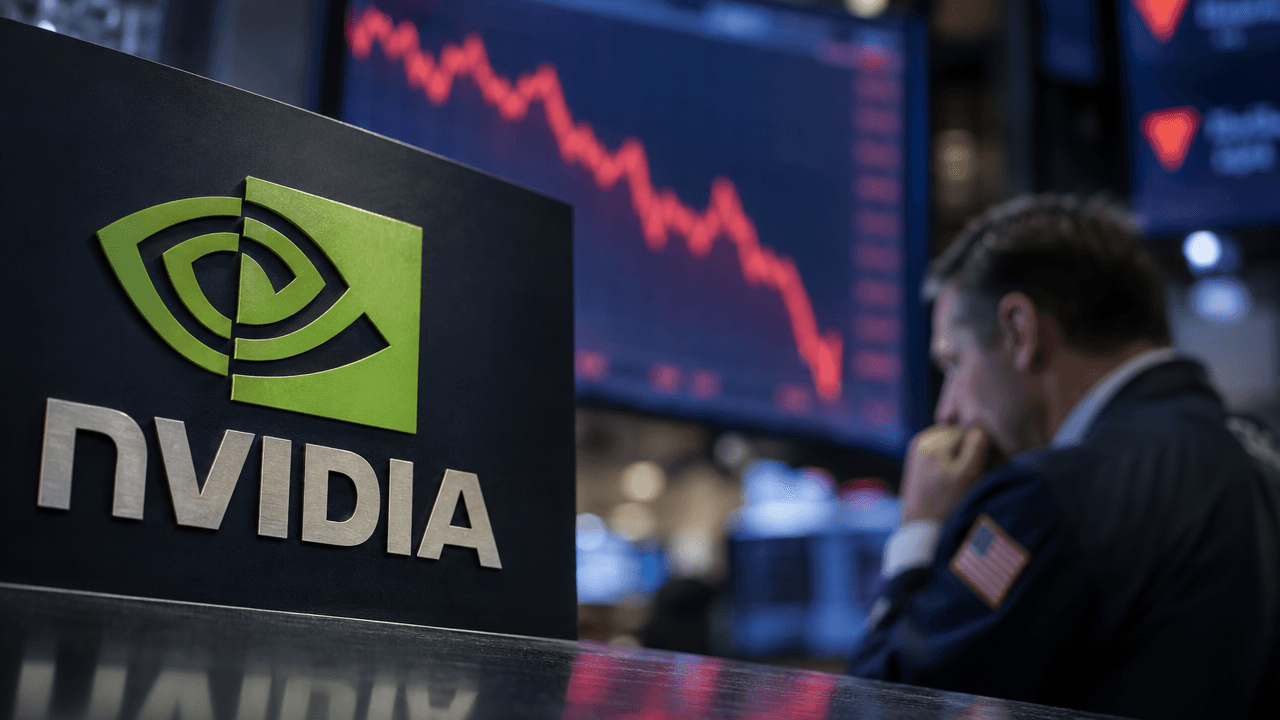
U.S. index futures moved lower Thursday as a sharp Nvidia selloff renewed concerns about the durability of the artificial intelligence rally and pulled technology stocks into the spotlight. Nasdaq 100 futures fell roughly 0.8% to 0.9%, while S&P 500 futures declined about 0.4%. Dow futures were little changed, highlighting how concentrated the pressure was in semiconductors and other growth-oriented shares. [2][3]
Nvidia shares dropped approximately 7% in premarket trading after reports raised questions about the company’s leadership and the potential consequences for the world’s most closely watched AI chipmaker. The decline added to a broader slide that had already reduced Nvidia’s value significantly from its recent peak. [1][4]
For investors, Thursday’s move is more than a single-stock story. Nvidia has become a key barometer for expectations surrounding AI spending, data-center construction and the earnings potential of the technology sector. When its shares fall sharply, traders often reassess the valuations and growth assumptions attached to companies across the entire AI supply chain.
Why Nvidia Matters To The Broader Market
Nvidia’s influence comes from both its size and its position at the center of the AI ecosystem. Its graphics-processing units are widely used to train and operate advanced AI models, making the company an important supplier to major cloud providers and technology firms.
That role has helped turn Nvidia into a market leader whose price movements can affect index performance even when other areas of the economy remain relatively stable. The Nasdaq 100, with its heavy concentration in technology and communications companies, is especially sensitive to Nvidia’s performance.
The premarket decline also spread to other semiconductor and AI infrastructure names. Intel, Marvell Technology and Micron were reported lower by between 2.6% and 3.4%, while CoreWeave and Nebius also fell sharply. [3]
This pattern is known as correlation risk. Companies may have different business models, customers and balance sheets, yet their shares can move together when investors treat them as part of the same investment theme. A selloff in a leading company can therefore become a sector-wide repricing event.
Leadership Risk And Investor Confidence
Leadership uncertainty can be especially disruptive when one executive is closely associated with a company’s strategy, culture and public identity. Nvidia Chief Executive Jensen Huang has become one of the most recognizable figures in the AI industry, and investors have linked his leadership directly to the company’s ability to execute its ambitious growth plans.
Reports that Nvidia’s board could consider removing Huang increased uncertainty around succession, strategic continuity and corporate governance. Even if the company’s underlying products and customer demand remain strong, markets can react quickly when questions arise about who will guide future decisions. [3][11]
The key lesson for traders is that operational strength does not eliminate event risk. A company can possess strong technology and robust demand while still experiencing substantial volatility because of leadership developments, regulatory pressure or changes in investor confidence.
What The Futures Move Signals
The uneven performance across index futures offers useful information. A decline of around 0.8% in Nasdaq futures compared with a mostly flat Dow suggests that investors were targeting high-growth technology exposure rather than abandoning equities indiscriminately. [2]
The S&P 500 sits between those two indexes because it combines technology with financial, industrial, health-care, consumer and energy companies. Its decline indicates that the Nvidia news had broader market consequences, but the relatively smaller move compared with Nasdaq futures points to concentrated technology weakness.
This distinction matters when interpreting market direction. A tech-led pullback may represent profit-taking or valuation concerns rather than a broad deterioration in economic expectations. Traders should monitor whether selling expands into banks, industrial companies and consumer shares once regular trading begins.
Investors should also watch market breadth, volume and the behavior of defensive assets. If a small group of technology stocks drives most of the decline, the market may be experiencing a rotation. If selling spreads across sectors and volatility rises sharply, the event could signal a deeper reduction in risk appetite.
Safe-haven Demand And The Ai Trade
The Nvidia selloff also supported demand for safer assets, with long-dated U.S. government bonds rising as investors reduced exposure to technology risk. [10] This type of move reflects a familiar market response: when uncertainty increases, some investors shift toward assets perceived as more stable or liquid.
However, a move into Treasuries does not automatically mean investors expect a recession. It may simply indicate that traders are reducing concentrated positions while waiting for more clarity. The strength and duration of the shift will be more informative than the initial reaction.
For the AI trade, the central question is whether the selloff changes long-term expectations or merely creates short-term turbulence. Investors will likely examine Nvidia’s financial performance, customer orders, product launches, export restrictions and management stability before deciding whether the decline represents an opportunity or a warning.
Practical Takeaways For Traders
First, avoid treating index futures as a guaranteed forecast for the regular session. Premarket trading can be less liquid, and prices may change as more participants enter the market.
Second, separate company-specific risk from sector-wide risk. Nvidia’s leadership concerns may be unique, but the resulting pressure on chipmakers and AI infrastructure firms shows how quickly thematic exposure can spread.
Third, review position sizing. Highly correlated technology holdings can create more risk than a portfolio review suggests. Owning several AI-related stocks does not necessarily provide meaningful diversification if they respond to the same catalyst.
Finally, define risk before entering a trade. Stop levels, reduced leverage and a willingness to wait for confirmation can help prevent an emotional reaction to a fast-moving headline.
Conclusion
Nvidia’s premarket decline has placed the AI trade and technology valuations under immediate pressure, sending Nasdaq and S&P 500 futures lower while encouraging demand for safer assets. The market’s next move will depend on whether investors view the episode as a temporary leadership shock or evidence that expectations surrounding AI growth have become too optimistic.
For traders, the most important takeaway is discipline. In a market where one company can influence an entire index, understanding concentration, correlation and event risk is just as important as analyzing a chart or economic indicator.