
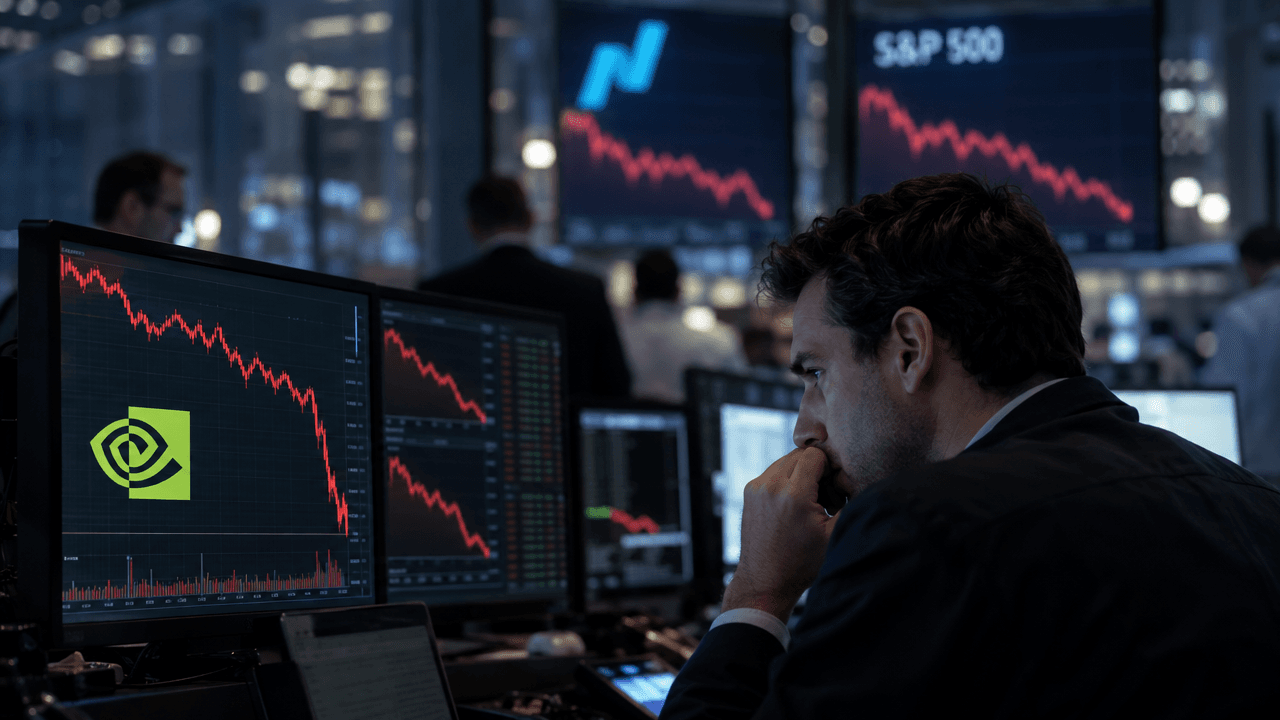
US equity futures retreated Thursday after a sharp late-session decline in Nvidia reignited concerns about leadership risk, elevated technology valuations, and the market’s heavy dependence on artificial intelligence stocks. Nasdaq 100 futures fell roughly 0.8% to more than 1%, while S&P 500 futures declined about 0.4% to 0.5%. Nvidia shares dropped approximately 8% to 10% in after-hours trading, weighing on semiconductor companies and other AI-linked names. [6][8]
The move illustrates how quickly sentiment can change when a company with enormous index weight becomes the center of uncertainty. Nvidia has been one of the primary engines of the technology rally, so a large move in its shares can influence index futures, exchange-traded funds, chipmakers, cloud providers, and the broader risk appetite of investors.
What Drove The Selloff
The immediate catalyst was a series of reports about possible leadership turmoil at Nvidia. Reports indicated that the company’s board was considering the future of Chief Executive Jensen Huang, prompting an abrupt decline in the stock after regular trading ended. Nvidia fell more than 8% at one point, while Nasdaq 100 futures dropped about 1%. [1]
Leadership uncertainty is particularly sensitive for a company viewed as central to the AI investment cycle. Huang is closely associated with Nvidia’s strategy, product roadmap, and relationships with major technology companies. Investors therefore appear to be treating the reports as more than a routine corporate headline.
It is important to distinguish between a reported possibility and a confirmed management change. After-hours trading is also generally less liquid than the regular session, which can amplify price movements. Nevertheless, the reaction shows how much confidence in Nvidia is tied to both its financial performance and the continuity of its current leadership.
Why Nvidia Matters To The Broader Market
Nvidia’s influence extends well beyond its own share price. The company is a major component of technology-focused indexes, and its valuation reflects expectations for years of growth in AI computing, data centers, and advanced semiconductors.
When Nvidia declines sharply, investors may reassess the entire AI trade. That can pressure chip designers, equipment manufacturers, data-center operators, software companies, and businesses that have benefited from enthusiasm surrounding generative AI. A decline in one dominant stock can therefore become a sector-wide risk reduction.
The broader market impact also depends on whether the selling remains isolated. If investors view the episode as a company-specific leadership issue, defensive buying may stabilize other technology names. If it raises deeper concerns about AI spending, chip demand, or stretched valuations, the pressure could spread into the wider Nasdaq and eventually affect the S&P 500.
Futures Are A Signal, Not A Verdict
Index futures provide an early indication of how markets may open, but they do not guarantee the direction of the regular session. Futures can recover before the opening bell as investors review new information, assess company statements, or buy shares after an exaggerated overnight move.
Traders should also remember that futures reflect expectations, not completed market transactions. A decline of 1% in Nasdaq 100 futures does not mean the index will necessarily open down 1% or finish the day at that level.
The next important signals will include Nvidia’s official response, premarket trading in major semiconductor stocks, Treasury yields, and the behavior of other large technology companies. If the selloff broadens while bond yields rise, the market may be facing both company-specific and valuation-related pressure. If other sectors remain firm, the decline may prove more contained.
What Traders Should Watch
First, monitor breadth. A technology selloff is more serious when falling stocks significantly outnumber advancing stocks across the entire market. If weakness is concentrated in Nvidia and closely related chip names, the event may remain relatively narrow.
Second, watch volatility and trading volume. Heavy volume combined with continued selling can indicate that institutional investors are reducing exposure rather than simply reacting to a temporary headline. By contrast, a quick recovery on strong volume may suggest that buyers still view the decline as an opportunity.
Third, evaluate correlation. During risk-off periods, stocks that normally move independently can begin falling together. This can increase portfolio risk and make position sizing more important than any individual trade idea.
For SimFi traders, the event offers a useful scenario-planning exercise. Rather than immediately chasing a short position, define several possible outcomes: Nvidia stabilizes and technology stocks rebound; the selloff spreads across AI shares; or the broader market absorbs the news with limited damage. Establish entry levels, invalidation points, and maximum risk before acting.
Practical Takeaways For Simfi Traders
Avoid treating overnight futures movement as a guaranteed opening trade. Wait for liquidity, price confirmation, and a clear risk level.
Separate the headline from the market structure. A dramatic move in Nvidia does not automatically mean every technology stock should be sold.
Track the Nasdaq 100, S&P 500, semiconductor ETFs, and market breadth together. Their relationship can reveal whether the pressure is isolated or systemic.
Reduce position size when volatility expands. Larger price swings can turn an otherwise reasonable trade into an outsized loss.
Finally, record the trade thesis and outcome. The goal is not merely to predict the next move, but to improve decision-making under uncertainty.
Conclusion
The retreat in US equity futures highlights the market’s sensitivity to Nvidia and the broader AI investment theme. The reported leadership uncertainty created an immediate shock, but the lasting significance will depend on whether investors interpret it as a temporary corporate disruption or a reason to question the durability of technology valuations.
For traders, the episode reinforces a fundamental lesson: major market leaders can influence sentiment far beyond their own share prices. Careful risk management, confirmation across multiple indicators, and patience during volatile premarket conditions are more valuable than reacting to the first headline.