
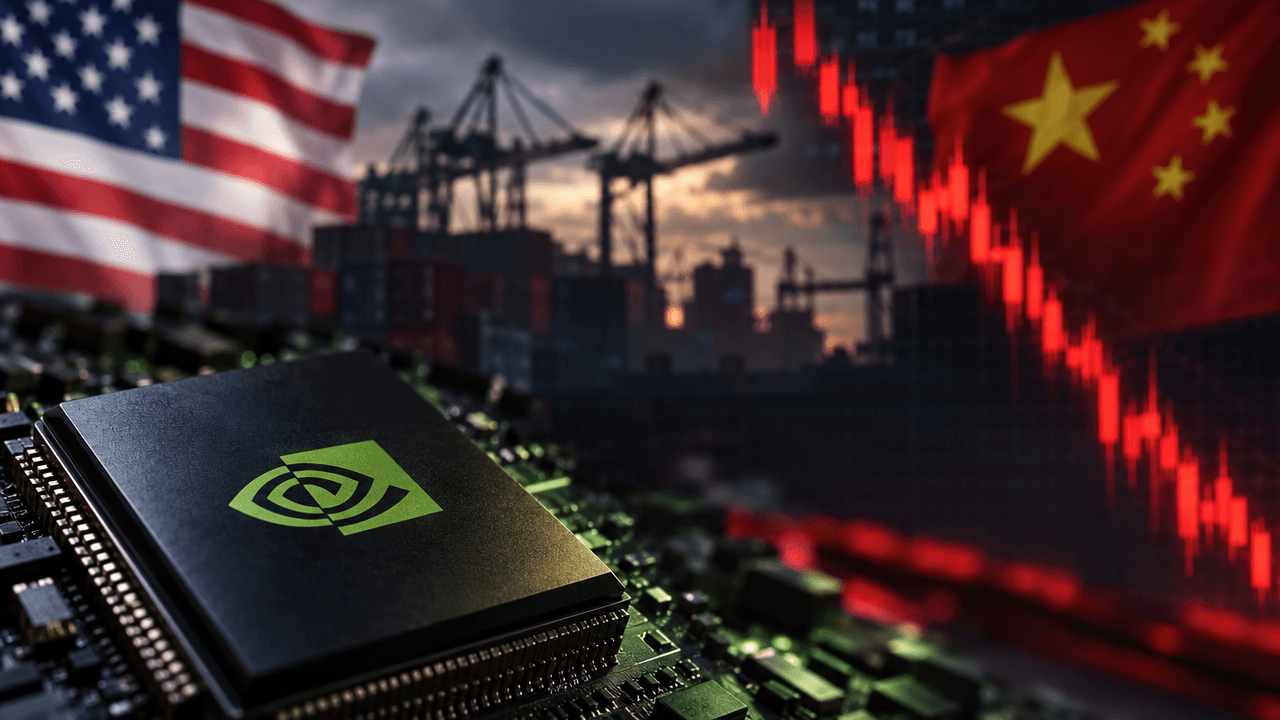
Nvidia’s latest weakness is doing more than damaging one company’s share price. It is intensifying concerns about the durability of the artificial-intelligence trade, increasing pressure on equity futures and reminding investors that technology stocks remain exposed to policy decisions as much as to earnings growth.
Nvidia shares fell 6.9% after the company warned about substantial charges connected to US restrictions on exports of its H20 artificial-intelligence chips to China. The charges are linked to inventory, purchase commitments and related reserves after Washington required an export license for the H20 chip. Nvidia has previously disclosed a $4.5 billion charge tied to the H20, while other China-related charges have also affected its results. [3][7]
The market reaction reflects the importance of Nvidia within the broader technology ecosystem. The company is a leading supplier of advanced graphics processors used in AI data centers, and its results influence expectations for chipmakers, cloud providers, server manufacturers and software companies. When Nvidia weakens sharply, investors often reassess the earnings outlook for the entire technology complex.
WHY NVIDIA’S DECLINE MATTERS
Nvidia has become a market bellwether because its growth is closely connected to the largest investment cycle in the technology sector. Major cloud companies and data-center operators are spending heavily on computing infrastructure, with Nvidia’s processors at the center of many of those projects.
That leadership creates both strength and vulnerability. Strong demand can produce exceptional revenue growth, but concentration also means that negative developments can spread quickly through multiple markets. Export controls threaten Nvidia’s access to an important customer base, while restrictions can complicate product planning, inventory management and long-term relationships with Chinese technology companies.
China and Hong Kong generated $19.7 billion of Nvidia revenue in the year ended January 2026, down from $25 billion the previous year. The decline demonstrates that export restrictions have already affected the company’s regional exposure, even while total revenue continued to grow strongly. [1]
Investors are therefore weighing two competing forces: continued global demand for AI infrastructure and a more uncertain regulatory environment. The question is no longer simply whether companies want advanced chips. It is whether those chips can be sold, shipped, installed and used under changing rules.
Pressure On Equity Futures
Nvidia’s decline can place immediate pressure on Nasdaq and S&P 500 futures because of the company’s large market value and its influence over investor sentiment. Futures markets are particularly sensitive to overnight developments, when traders adjust positions before the cash equity session opens.
A semiconductor selloff can also create a broader risk-off tone. Investors may reduce exposure to other high-growth technology companies, especially those trading at elevated valuations based on expectations of rapid AI-related expansion. Companies that have not reported a direct Nvidia problem can still decline if traders believe their future spending, margins or demand depend on the same investment cycle.
The effect can become more pronounced through index funds and algorithmic trading. A sharp move in a major technology stock can trigger portfolio rebalancing, volatility signals and sector-wide selling. If Treasury yields are also rising, the pressure on long-duration growth stocks may intensify because higher discount rates reduce the present value of projected future earnings.
This does not automatically mean that the AI investment cycle is ending. It does mean that the market is likely to demand stronger evidence that spending plans can generate sustainable returns.
Export Controls Turn Business Risk Into Policy Risk
The Nvidia episode highlights how geopolitical decisions can quickly become corporate financial risks. US export controls are intended to limit China’s access to advanced computing technology, but they also affect American companies that design products for global markets.
Restrictions can create several forms of exposure. A company may need to write down inventory that can no longer be sold to its intended customer. It may have to cancel production commitments, redesign products or seek licenses under uncertain conditions. Even when a license is available, the process can delay shipments and make revenue less predictable.
The policy risk may not be limited to direct exports. US officials have also considered rules aimed at preventing Chinese companies from remotely accessing advanced chips through overseas data centers. Such measures could affect cloud providers, data-center operators and international technology partners, not only chip manufacturers. [9][14]
Reports that Chinese computing projects worth more than $3 billion rely on restricted Nvidia processors show why regulators may continue examining indirect access routes. [2] For investors, this creates a difficult distinction between confirmed financial losses and potential future restrictions. Markets often price the possibility of tighter rules before the final policy is announced.
What Traders Should Watch
The next market moves will depend on whether Nvidia’s weakness remains company-specific or develops into a broader reassessment of technology risk.
Traders should monitor Nasdaq futures, semiconductor exchange-traded funds, and the relative performance of high-beta technology stocks. They should also watch Treasury yields, since rising yields can add pressure to richly valued growth companies. Currency markets provide another signal: high-beta currencies and other risk-sensitive assets may weaken if investors reduce exposure to global growth.
Nvidia’s management commentary will be especially important. Investors will want clarity on the size and timing of the charges, the company’s remaining China opportunity, the outlook for alternative products and the strength of demand from customers outside China.
Position sizing is equally important. A headline-driven move can extend beyond fundamental value, particularly when a heavily owned stock becomes the focus of macroeconomic and geopolitical concerns. Traders should define risk before entering a position rather than relying on the assumption that a major technology stock will quickly recover.
The Bigger Market Lesson
Nvidia’s decline is a reminder that technology leadership does not remove market risk; it can concentrate it. The AI trade remains supported by significant investment and demand, but its future is increasingly shaped by regulation, supply-chain controls, valuation and the ability of customers to convert spending into productive revenue.
For equity futures, the immediate risk is that Nvidia weakness encourages investors to reduce exposure across the technology sector. For currencies, the concern is that a wider risk-off move could weaken high-beta assets. For longer-term investors, the key issue is separating temporary sentiment pressure from a genuine deterioration in the AI growth outlook.
The most constructive approach is neither blind optimism nor panic. Investors should examine company-specific fundamentals, policy exposure and valuation together. Nvidia may remain a central beneficiary of AI investment, but its latest setback shows that even the strongest technology franchises operate within a changing geopolitical and financial framework.