
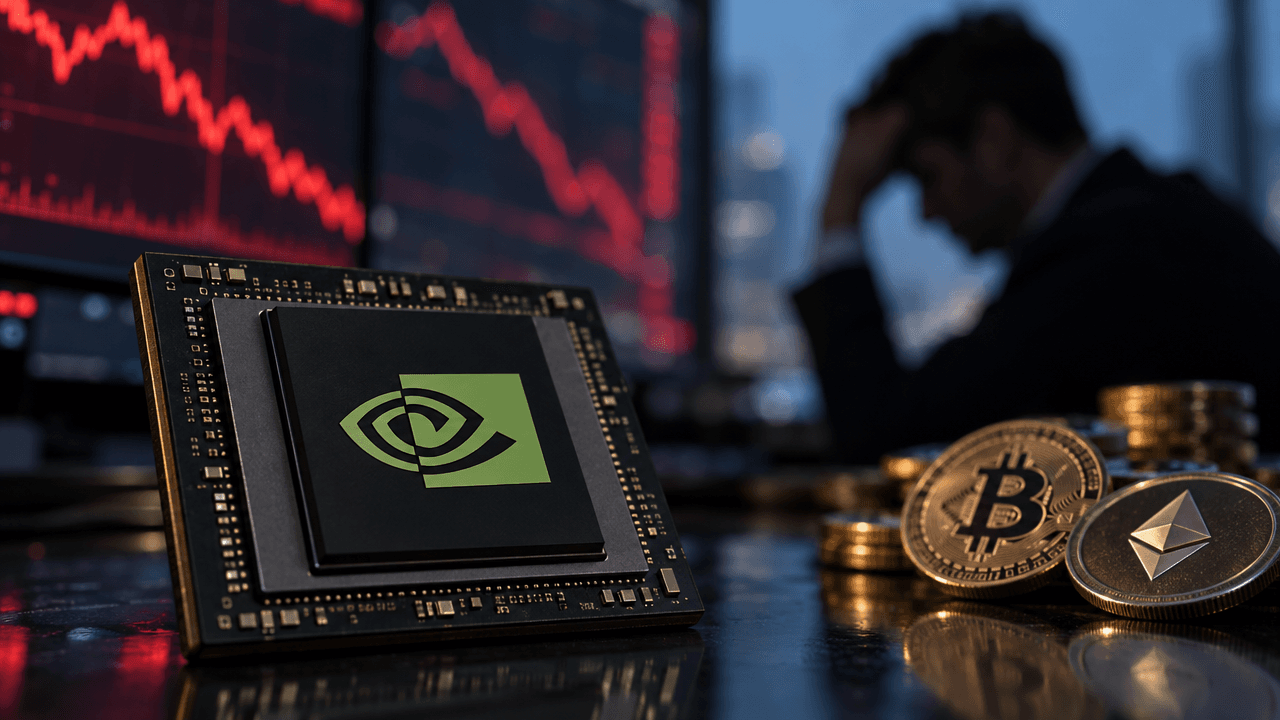
Technology weakness is once again testing the market’s enthusiasm for artificial intelligence. U.S. stock futures moved lower as concerns surrounding Nvidia’s leadership unsettled investors and raised fresh questions about whether the AI rally has become too dependent on a small group of high-growth companies. Nasdaq 100 futures were among the weakest, falling roughly 1% in recent trading, while Bitcoin and other cryptocurrencies declined alongside technology assets. [1][2]
The episode is important because it illustrates how quickly sentiment can travel across markets. A challenge facing one of the world’s most influential semiconductor companies can affect chipmakers, cloud-computing firms, software companies, equity indexes and digital assets within hours. For traders, the immediate lesson is clear: markets are not only reacting to earnings and economic data. They are also reassessing leadership risk, valuation, concentration and the durability of the artificial-intelligence investment cycle.
Why Nvidia Matters To The Ai Trade
Nvidia occupies a central position in the AI ecosystem. Its graphics-processing units power many of the data centers used to train and operate advanced artificial-intelligence systems. As a result, investors often treat Nvidia as more than an individual stock. Its performance is viewed as a signal for demand across the wider technology industry.
That influence helps explain why reports about uncertainty surrounding Chief Executive Jensen Huang created such a strong market response. Nvidia shares fell sharply in after-hours trading, and the decline pulled futures for major U.S. indexes lower. Nasdaq futures dropped about 0.9% in one market update, while S&P 500 futures fell about 0.4%. [1]
The reaction does not necessarily mean that demand for AI infrastructure has disappeared. Instead, it shows how much confidence is already reflected in technology valuations. When a market leader faces an unexpected leadership issue, investors may temporarily reduce exposure to the entire theme rather than wait for uncertainty to resolve.
Why Nasdaq Futures Are Especially Sensitive
The Nasdaq 100 has a high concentration of large technology and communications companies. Many of these businesses have strong growth expectations, but their valuations can also be sensitive to changes in interest rates, earnings forecasts and investor risk appetite.
When traders become less confident about long-term growth, high-multiple stocks often experience pressure first. A decline in one major semiconductor company can therefore trigger a broader reassessment of companies connected to data centers, cloud computing, cybersecurity and enterprise software.
Premarket futures can amplify that process. With fewer participants and less liquidity than the regular trading session, futures prices may react quickly to breaking headlines. A sharp move before the opening bell is not a guarantee that the cash market will follow the same path, but it is a useful indicator of how investors are positioning ahead of the session.
Traders should avoid treating a futures decline as a complete forecast. The market may stabilize if investors view the news as company-specific, or selling may broaden if additional evidence raises concerns about AI spending, chip demand or corporate governance.
CRYPTO’S CONNECTION TO TECHNOLOGY SENTIMENT
Bitcoin is not a technology stock, but it often trades like a high-risk asset when investors are seeking growth. During periods of strong liquidity and optimism, capital can flow into both speculative technology shares and digital assets. When confidence weakens, those positions may be reduced together.
Bitcoin fell toward $73,500 as technology stocks and U.S. futures weakened, while other cryptocurrencies also moved lower. [6] Another market report said Bitcoin traded below $72,000 during the selloff, reaching its lowest level since mid-August. [3]
This correlation is not constant. Bitcoin can respond to regulation, exchange-traded-fund flows, monetary policy and cryptocurrency-specific developments. However, the latest move highlights its sensitivity to broad risk sentiment. Persistent withdrawals from U.S. spot Bitcoin exchange-traded funds added another source of pressure during the decline. [6]
For crypto traders, the key point is that a bullish digital-asset thesis may still face short-term headwinds if equities are undergoing a risk reduction. A trader who watches only crypto charts could miss the broader portfolio flows driving the move.
What Traders Should Watch Next
The next stage of the market reaction will depend on whether investors separate Nvidia’s leadership uncertainty from the underlying AI growth story. Several developments deserve close attention.
First, traders should monitor Nvidia’s official communications, succession planning and forward guidance. Clarity about management and demand could help reduce the uncertainty premium surrounding the stock.
Second, watch the behavior of other AI-linked companies. If chipmakers, cloud providers and data-center operators stabilize while Nvidia remains weak, the market may be treating the issue as company-specific. If the entire group sells off, investors may be questioning valuations and the pace of AI capital spending.
Third, track Nasdaq breadth rather than focusing only on index futures. A decline led by a handful of mega-cap stocks is different from a broad selloff involving most technology companies. Breadth, volume and sector rotation can provide a clearer picture of market conviction.
Finally, crypto traders should monitor Bitcoin’s relationship with equities, ETF flows and the dollar. A recovery in technology stocks without improvement in crypto may signal digital-asset-specific weakness. Conversely, a simultaneous rebound could suggest that broader risk appetite is returning.
A Practical Risk-management Checklist
This environment rewards preparation rather than prediction. Traders should reduce excessive leverage, define exit levels before entering positions and avoid assuming that a familiar market trend will continue unchanged.
It is also useful to distinguish between headline risk and fundamental risk. A leadership story can produce sudden volatility, but its long-term significance depends on whether it changes earnings, capital investment or competitive advantages. Position sizing should reflect that uncertainty.
The decline in Nasdaq futures and cryptocurrencies is a reminder that modern markets are tightly connected. Nvidia’s importance to the AI economy, the Nasdaq’s concentration in growth stocks and crypto’s sensitivity to risk appetite can turn one corporate development into a cross-asset event. The most disciplined response is to assess the evidence, manage exposure and wait for price action to confirm whether the weakness is temporary sentiment or the beginning of a broader repricing.