
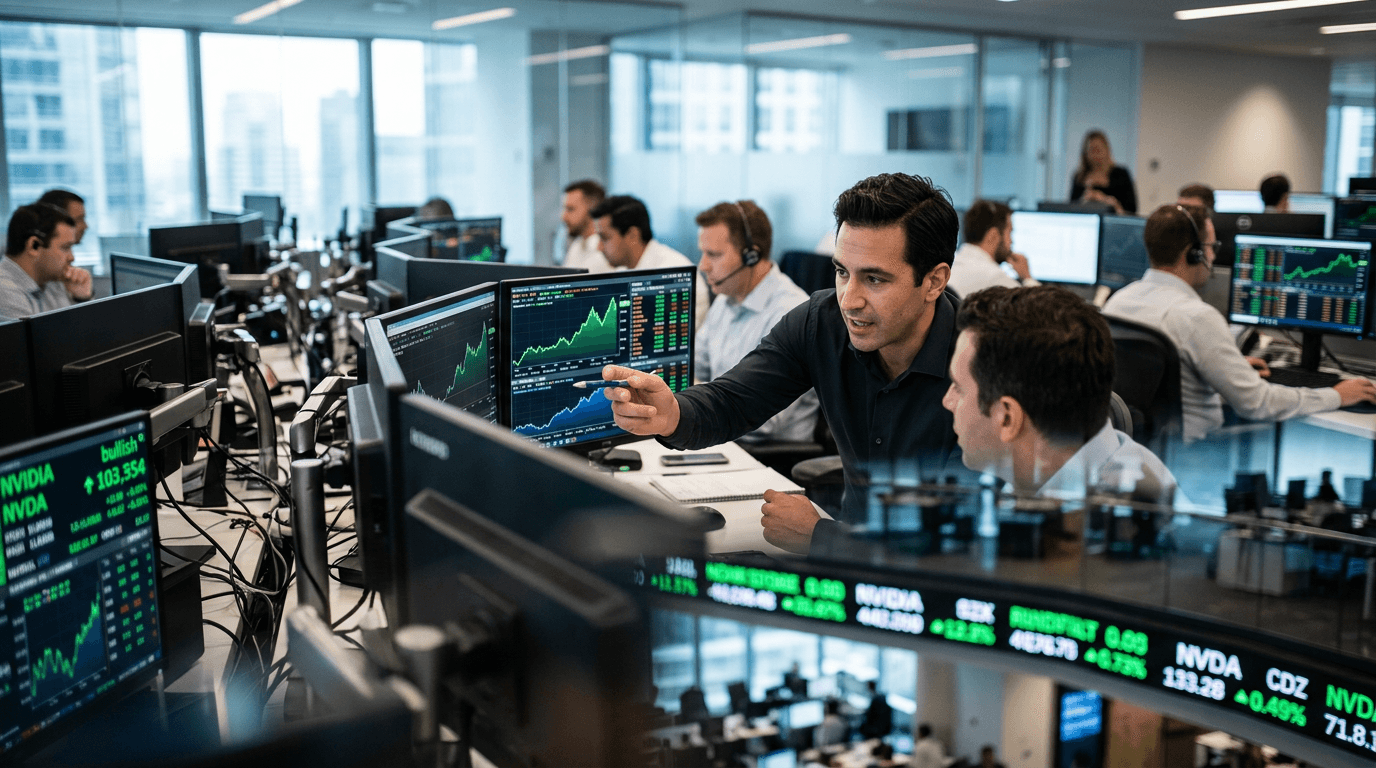
US index futures extended their advance after Nvidia’s latest guidance reinforced the idea that the AI boom is far from over, reviving risk appetite across equities and spilling over into the broader macro landscape.[2][8] For traders, this is more than a single-stock story: it is a live example of how one company’s outlook can ripple through index futures, currencies, bond yields, and global sentiment.[8][9]
Nvidia's Outlook And The Index Futures Reaction
Nvidia’s bullish sales outlook signaled that demand for AI chips and infrastructure remains robust, supporting the narrative that this year’s rally in AI-linked names still has room to run.[2][8] In response, contracts on the tech-heavy Nasdaq 100 climbed around 1%, while S&P 500 futures added roughly 0.6%, indicating broad investor willingness to add risk exposure rather than fade the move.[2][8] This reaction fits a pattern seen in previous earnings seasons, where strong Nvidia results and upbeat guidance have helped push US index futures higher and ease concerns about an “AI bubble.”[10][12]
At the heart of the move is positioning: many institutional portfolios are structurally overweight large-cap tech and AI beneficiaries, so confirmation of strong growth directly improves the earnings outlook for the major indices.[2][10] When a key AI bellwether beats expectations and paints a confident picture of future demand, traders often respond by increasing leverage in index futures rather than cherry‑picking single names, amplifying index-level moves.[2][12] However, recent episodes also show that futures do not always rally after strong Nvidia numbers, particularly when expectations are extreme and the bar for “bullish enough” is very high.[1][6][11] Understanding where expectations sit before the print is therefore just as important as the headline results themselves.
AI DEMAND AS A MACRO FORCE, NOT JUST A TECH STORY
The reaction to Nvidia’s guidance highlights a broader trend: AI investment has become a major macro driver, not merely a sector theme.[4][14] Recent research indicates that AI-linked capital spending in the US is now contributing to investment growth on a scale comparable to consumer spending, lifting profits and supporting the overall earnings trajectory of the market.[4][14] Net income for AI-related constituents of the S&P 500 is estimated to grow by roughly 46% year-on-year in 2026, compared with about 13% for the rest of the index, underscoring how concentrated profit growth has become.[4][14]
This profit leadership is one reason why AI heavyweights have outsized influence on index futures pricing: when traders buy exposure to the S&P 500 or Nasdaq 100, they are implicitly expressing a view on the durability of AI-driven earnings.[2][10][14] At the same time, the surge in demand for compute, power, and infrastructure is boosting pricing power for suppliers, contributing to upward pressure on inflation alongside other forces such as energy costs.[4][14] The combination of strong profits and potential inflationary impulses forces markets to reassess the path of monetary policy, which in turn feeds back into how index futures, the dollar, and Treasury yields trade.[8][9][14]
Beyond Equities: Dollar, Yields, And Global Risk Sentiment
When US index futures rally on the back of a bullish AI narrative, the impact extends beyond equity screens.[8][9] Stronger futures often signal improved growth expectations and a “risk-on” tone, which can lend support to the US dollar as global investors rotate back into US assets and hedge exposure via currency markets.[8][9] At the same time, higher expected growth and earnings can nudge Treasury yields higher as traders price a reduced likelihood of aggressive rate cuts, or even a longer period of restrictive policy if inflation risks are seen as persistent.[8][9][14]
Global risk sentiment tends to follow the lead of US tech and indices: a convincing move higher in US futures can stabilize or lift European and Asian markets, while also narrowing credit spreads as investors grow more comfortable taking corporate risk.[2][8][15] Conversely, any reversal in Nvidia or AI-related leaders can quickly pressure futures, weaken the dollar’s growth premium, and drive a bid into safe-haven assets such as Treasuries and defensive equities.[1][6][11] For traders, the key is to recognize that single-stock AI news has become a cross‑asset event, not an isolated tech-sector story.
What Active Traders Should Watch Next
Several practical focal points stand out for both discretionary and systematic traders:
1) Monitor the relationship between Nvidia’s price action and index futures, especially around key levels and option expiry dates, to detect when single-stock moves are translating into index-wide shifts or when they are being absorbed.[2][10]
2) Track language on AI capital expenditure and demand across broader earnings calls, not just Nvidia’s, to gauge whether the bullish narrative is broadening or narrowing to a few winners.[4][14][15]
3) Pay attention to how the move in futures interacts with the dollar and Treasury yields; sustained futures strength alongside rising yields can indicate a regime where growth optimism is outweighing rate concerns, while the opposite may suggest a more fragile rally.[8][9][14]
4) Use volatility around AI-related earnings as a proxy for market confidence in the theme; rising implied volatility without corresponding upside in futures can be a warning sign that investors are hedging rather than embracing the narrative.[1][6][11]
For intraday traders, this environment favors strategies that combine index futures with macro overlays—such as pairing long Nasdaq futures with short duration Treasury positions when AI optimism is reinforcing higher yield expectations.
Simulated Finance: Turning News Into Practice
For traders and learners using simulated finance platforms, moves like the current Nvidia-driven rally in US index futures offer a rich real‑time training ground.[2][8] In a SimFi environment, participants can construct and test multi‑asset strategies that express views on AI demand without the capital risk of live markets, focusing on how index futures, FX, and rates interact around key news events.[8][9]
Practical exercises might include designing scenarios where Nvidia’s outlook is either reinforced or challenged by subsequent data, then stress‑testing portfolios under different combinations of futures performance, dollar strength, and yield shifts.[4][14] Journaling simulated trades around such events helps build pattern recognition: how often does bullish guidance translate into sustained index gains, and under what macro conditions does the market fade the move?[1][3][6] Over time, this structured practice can sharpen the ability to separate noise from signal in AI-related headlines and to respond with disciplined, cross‑asset positioning rather than reactive trading.
Conclusion
Nvidia’s bullish outlook and the resulting extension of gains in US index futures underscore how central AI has become to the market’s growth narrative and risk appetite.[2][8][14] The impact now spans earnings, inflation, currencies, rates, and global sentiment, making AI bellwethers de facto macro indicators rather than isolated tech stocks.[4][14][15] For traders, the opportunity lies in treating these events as recurring, analyzable regimes: understanding how futures, the dollar, and yields co‑move, and using both live and simulated environments to refine strategies that can thrive in an AI-driven market cycle.[8][9][14]