
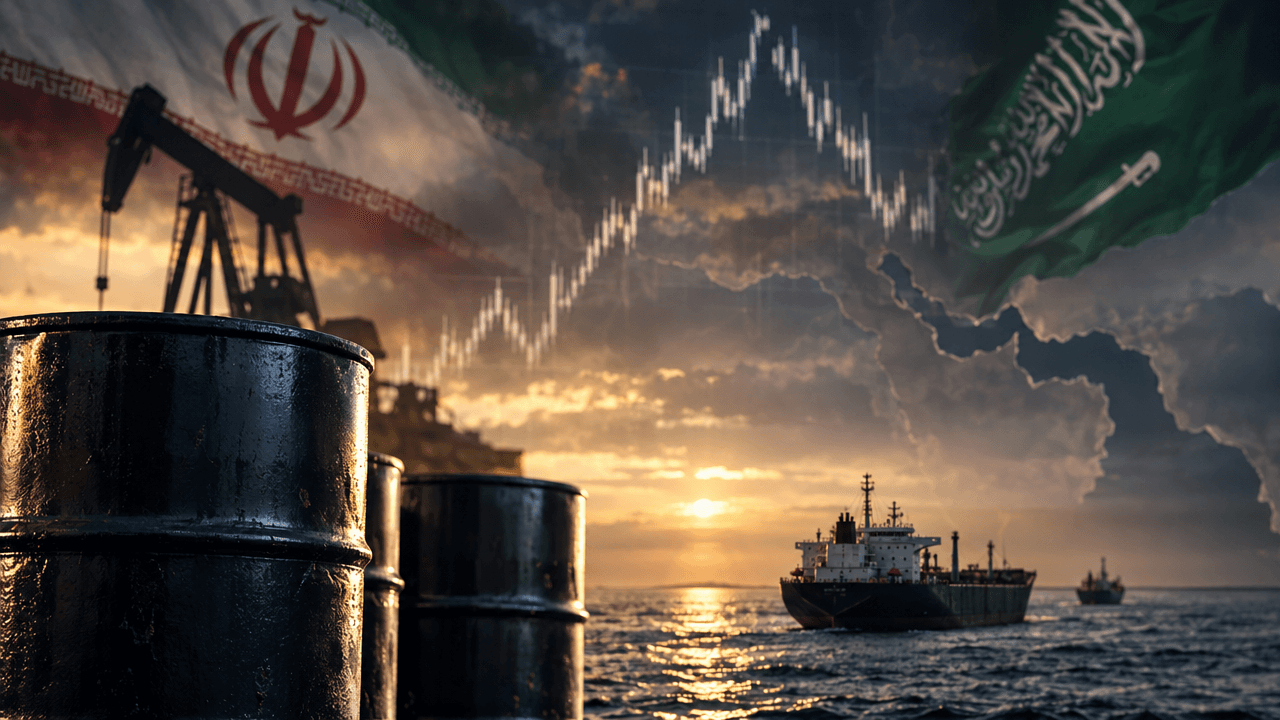
Oil futures have snapped back above $100 per barrel, but the rally is anything but smooth, with sharp intraday swings reflecting a market on constant geopolitical alert[4][7]. Brent crude is fluctuating around the $102–103 range after a drop of roughly 2–3% in the previous session, while West Texas Intermediate (WTI) has recently sold off by about 3.5–4.5% from recent highs[1][5]. Tensions involving Iran, shifting Saudi export patterns and conflicting signals from Washington are all feeding a risk premium that is keeping prices elevated and volatility high[4][8][12].
MARKET SNAPSHOT: VOLATILITY ABOVE THE $100 THRESHOLD
Crossing and holding above $100 is more than just a round number; for many institutional and retail participants, it marks a psychological boundary that can trigger hedging activity, option flows and systematic strategy adjustments[4]. Recent trading has seen Brent and WTI move several dollars in a single session, with prices briefly dipping toward the high-$90s before snapping back above $100 as headlines shift[6][7][9]. This environment is characterized by thinner liquidity during stress, wider bid–ask spreads and frequent repricing of risk, especially in short-dated futures and options[4][7].
The backdrop to these moves is a tug-of-war between improving physical flows and renewed geopolitical risk. On the one hand, Saudi Arabia’s crude exports have continued to recover from earlier disruptions, helping to reassure markets that Gulf producers can reroute some shipments when traditional chokepoints are threatened[1][14]. On the other, traders are watching tanker incidents and pipeline vulnerabilities in the region, which can quickly erase any sense of comfort and send futures sharply higher within hours[7][8][12]. For active traders and SimFi participants, this translates into rapid swings in margin requirements, mark-to-market P&L and strategy performance.
Key takeaway: Treat $100+ oil not as a stable new regime but as a volatility zone where positioning needs to be nimble and risk management rules clearly defined.
Geopolitical Drivers: Iran, Saudi Arabia And Shipping Routes
The main catalyst behind the latest spike is the intensifying confrontation between the United States and Iran, including reciprocal attacks and proxy activity that threaten key energy infrastructure and shipping lanes[8][12][15]. Crude transportation through the Strait of Hormuz, which handles a significant share of global seaborne oil, has faced intermittent disruption, with markets pricing in the risk of further interference with tanker traffic[8][11][14]. Each sign of escalation raises concerns about supply bottlenecks, while any hint of diplomacy or improved flows can quickly knock prices lower[5][10][15].
Saudi infrastructure has also been drawn into the conflict narrative. Reports of attacks and vulnerabilities around the kingdom’s East–West pipeline and export terminals have contributed to the risk premium embedded in futures spreads, even when physical damage is limited or quickly repaired[6][12]. Traders are watching Saudi loading schedules, alternative routes and onshore storage data for clues on how much flexibility producers have to maintain shipments during periods of heightened security risk[1][14]. These micro-level supply signals often drive intraday moves that can be just as powerful as macroeconomic data releases.
Complicating matters further are shifting diplomatic signals from Washington. Market participants have noted President Trump’s rejection of Iranian ceasefire proposals, reinforcing expectations that tensions may be prolonged rather than quickly resolved[12][15]. At various points, comments suggesting openness to negotiation have knocked prices sharply lower, while subsequent hard-line rhetoric has reversed those moves and pulled futures back above $100[6][9]. This headline sensitivity makes short-term trading highly news-driven and increases the value of scenario analysis and robust stop-loss design.
Key takeaway: Geopolitics is the primary engine of current volatility; monitoring military, diplomatic and shipping developments is as important as tracking traditional supply–demand data.
MACRO AND INFLATION IMPLICATIONS OF $100+ OIL
A sustained period of oil trading above $100 carries broader macroeconomic consequences beyond the futures curve[4][14]. Elevated crude prices feed directly into transport and manufacturing costs, raising operating expenses for logistics, aviation, petrochemicals and heavy industry[4]. These cost pressures can translate into higher consumer prices over time, particularly in fuel-intensive economies, reinforcing concerns that inflation could remain stubbornly high or reaccelerate after recent progress[4][14]. Central banks, already cautious about cutting interest rates too quickly, may interpret persistent $100+ oil as a reason to stay restrictive longer.
Market strategists have highlighted scenarios in which prolonged disruption to Gulf supply could push Brent toward $120 or even higher if key shipping routes or infrastructure were severely impaired[13][14]. While this is not a base case, the mere possibility forces investors to think about tail risks in their portfolios, from airline equities to emerging markets reliant on imported energy. Equity volatility, credit spreads and inflation expectations can all respond to sharp moves in crude, making oil a cross-asset driver rather than a siloed commodity[4][14].
For traders, this macro backdrop influences positioning in rates, currencies and equity indices alongside energy. Rising oil can support commodity-linked currencies and pressure net importers, while contributing to steeper yield curves if inflation premia increase. In simulated environments, building multi-asset strategies that incorporate oil shocks—such as testing how a sudden $10 move in Brent affects FX, indices and bond futures—can reveal hidden correlations and vulnerabilities.
Key takeaway: $100+ oil is not just a commodity story; it is a macro risk factor that can affect inflation, monetary policy expectations and cross-asset performance.
Trading And Simfi Strategies In A High-volatility Oil Regime
In a regime where oil futures can swing several percent in a single session, strategy design and risk management become more important than directional calls. Short-term traders are increasingly relying on volatility-aware approaches, such as narrowing holding periods, using options to express views and scaling position sizes dynamically in response to realized volatility. For many, the focus shifts from predicting the next headline to managing slippage, gap risk and intraday drawdowns.
Simulated Finance platforms like E8 Markets offer a structured environment to test these adaptations before capital is put at real risk. Participants can build scenario libraries around key geopolitical triggers—such as a temporary closure of the Strait of Hormuz, a surprise diplomatic breakthrough, or targeted attacks on major pipelines—and observe how their strategies perform under each path[8][11][13]. Stress-testing portfolios against rapid $5–$10 changes in futures prices, and layering in changes to correlations with equities and FX, helps traders refine stop placement, diversification and hedging rules.
Practical actions in this environment include defining maximum daily loss limits, planning how to adjust exposure after large overnight moves and clarifying whether strategies are designed to trade breakouts or fade spikes. Using simulated accounts to rehearse execution around major news events—such as scheduled diplomatic talks or military briefings—can improve discipline when real markets become disorderly. Over time, the goal is not just to survive high-volatility regimes, but to develop repeatable processes that can be deployed whenever geopolitical risk flares.
Key takeaway: Use simulation to turn a volatile, headline-driven market into a training ground for robust strategy design and disciplined execution.
Conclusion
Oil’s renewed life above $100, driven by US–Iran tensions, Saudi infrastructure risks and fragile shipping routes, has created a market where direction and volatility both matter. Futures are reacting quickly to every shift in diplomacy and conflict, with price action that can test even experienced traders. For market participants and SimFi users alike, the opportunity lies in treating this environment as a live case study in geopolitical risk, macro linkages and real-time risk management. By combining careful monitoring of supply developments with structured scenario planning and disciplined trading rules, it is possible to navigate—and even learn from—the turbulence rather than be swept away by it.