
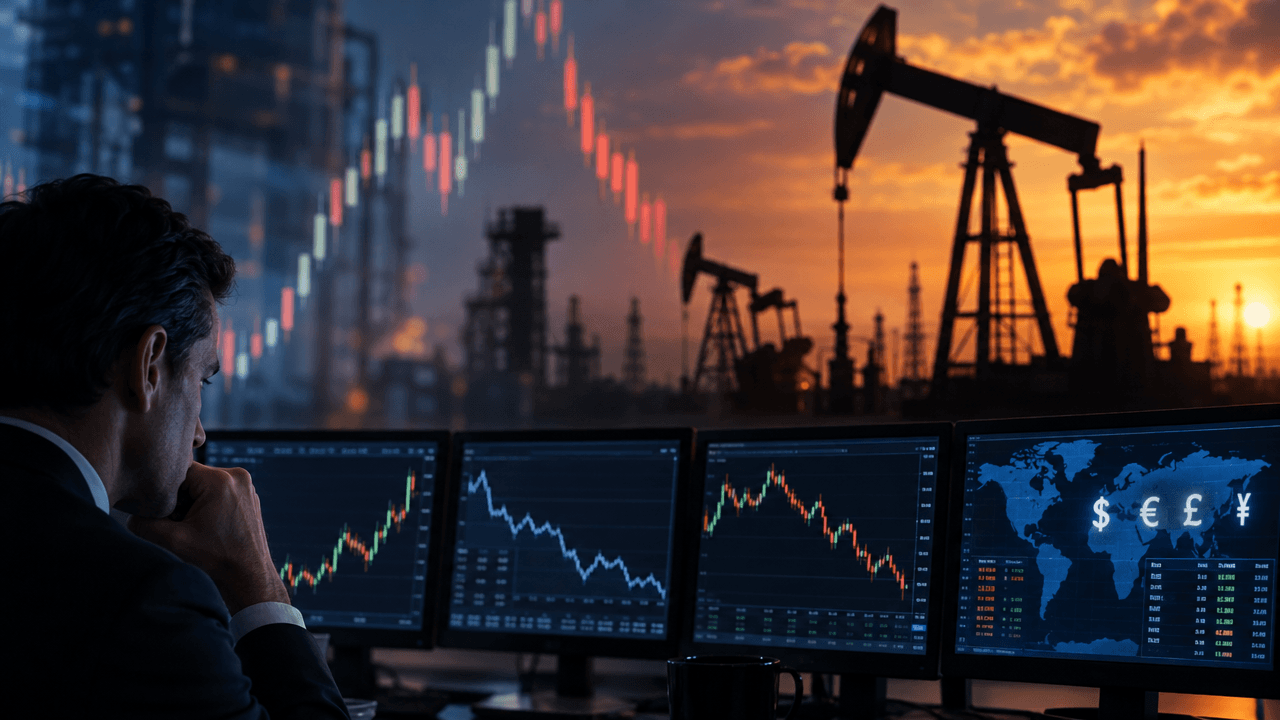
Oil pushing back above $100 a barrel has quickly become the focal point for global markets, reviving fears of a renewed energy-driven inflation shock and triggering a broad risk-off mood.[2][7][11] West Texas Intermediate (WTI) crude is trading in the low $100s, while Brent is in the mid-$100s, levels that are pressuring bond markets, equity futures, and volatility across FX, commodity, and index futures as investors reprice inflation and interest-rate expectations.[2][7][15]
WHY $100 OIL MATTERS
The $100 threshold is more than just a round number; it is a psychological line in the sand for traders, policymakers, and consumers alike.[2][7] Once crossed, it signals that energy is not just expensive, but potentially disruptive for growth, inflation, and financial stability.[9] The current surge is closely tied to Middle East tensions, including escalating conflict involving Iran and attacks on shipping routes that heighten fears of prolonged supply disruptions.[6][7][12][13]
Higher crude prices feed through quickly into refined products such as gasoline and diesel, raising transportation and production costs across the economy.[2][6][12] These increases act like a tax on households and businesses, reducing disposable income and compressing profit margins, especially in fuel-intensive industries such as airlines, logistics, and manufacturing.[9] For economies that were already grappling with elevated price pressures, $100 oil risks extending the inflation episode instead of allowing a clean normalization.[3][4]
Analysts estimate that every 20% gain in crude prices can lift headline inflation by roughly 0.3 percentage point, underscoring how quickly energy shocks can spill into consumer price indices.[9] When those shocks come on top of already tight labor markets and lingering supply-chain issues, they can shift inflation trajectories enough to force a rethink in central bank strategy.[2][4][5]
Inflation, Central Banks And Policy Expectations
The timing of this oil spike is particularly sensitive because major central banks are heading into key policy meetings with inflation still above target and growth slowing.[2][4][10] In Europe, updated projections suggest price pressures could remain above the 2% target well into 2028, even before fully factoring in the latest energy surge.[4] In the UK and US, policymakers have indicated that higher energy prices are adding to the case for keeping rates elevated for longer, and potentially tightening further if inflation data re-accelerates.[5][10]
Bond markets are already reacting. Global yields have jumped to multi-year highs as investors demand greater compensation for inflation risk and the prospect of “higher-for-longer” policy rates.[7][15] Rising yields tighten financial conditions, putting pressure on credit, housing, and risk assets, and increasing the cost of capital for corporates and governments whose fiscal positions were stretched by previous crises.[3][4]
For traders, this environment means that each inflation print and central bank communication carries outsized market impact. Energy-sensitive components of CPI and PPI are likely to show renewed momentum, complicating the narrative that inflation is smoothly returning to target.[2][10][12] Positioning around these releases becomes more binary: markets may swing sharply between relief rallies if data comes in softer than feared and risk-off episodes when inflation surprises on the upside.
Risk-off Sentiment Across Asset Classes
Equities have already shown the strain of $100 oil, with major indices in the US and Europe closing lower as energy-driven inflation worries and rising yields weigh on valuations.[1][2][13] Higher input costs threaten earnings margins, while tighter monetary policy compresses price-to-earnings multiples, creating a double headwind for stocks in cyclical sectors.[1][2] Growth and tech names, which are more sensitive to discount-rate assumptions, can be particularly vulnerable when real yields move higher.[7][13]
In FX markets, energy-linked currencies such as those of major oil exporters may benefit from improved terms of trade, while import-dependent economies risk deteriorating current accounts and weaker currencies.[3][9] At the same time, heightened uncertainty often drives flows into perceived safe havens such as the US dollar and the Japanese yen, a pattern already visible as Asia stocks waver and the yen strengthens.[14] This can amplify pressure on emerging markets facing both higher energy bills and tighter external financing conditions.[3][7]
Volatility is rising across commodity and index futures as traders rapidly adjust to the new regime, repricing inflation expectations and central bank paths.[2][7][15] Crude, refined products, and related assets are seeing bigger intraday ranges, while equity and bond futures are more sensitive to incoming headlines from the Middle East and energy markets.[6][7][12] For active traders, this translates into larger potential opportunities—but also a greater risk of whipsaw moves and slippage if position sizing and risk controls are not carefully calibrated.
HOW TRADERS CAN NAVIGATE A $100-OIL ENVIRONMENT
In a high-oil regime, the first step for traders is to recognize that correlations can shift quickly. Energy shocks often strengthen links between oil, inflation expectations, bond yields, and equity performance, but the direction and magnitude can vary by region and sector.[3][9] Building a clear macro map—how crude prices interact with currencies, rates, and indices—is essential before committing capital.
Several practical actions can help traders adapt
1) Re-anchor risk assumptions: Update volatility, correlation, and drawdown estimates to reflect current conditions rather than pre-shock averages.[2][7]
2) Focus on the data calendar: Prioritize energy-sensitive releases such as CPI, PPI, inventory reports, and central bank meetings where oil’s impact is likely to be front and center.[2][10][15]
3) Use scenario analysis: Model alternative paths—prolonged $100+ oil, a quick reversal, or further escalation—to stress-test portfolios and identify vulnerabilities.[3][9]
4) Consider hedging tools: Options and spread trades in energy, indices, or rates can help cushion portfolios against tail risks, provided position sizes and leverage remain within disciplined limits.[7][8]
5) Differentiate sectors and regions: Energy producers and some value sectors may benefit from higher prices, while energy-intensive industries and import-reliant economies may face headwinds.[1][3][9]
Simulated Finance: Practicing Without Capital At Risk
Simulated Finance (SimFi) offers a powerful way for traders to build and test playbooks for a high-oil world without putting real capital in harm’s way. In a SimFi environment, traders can design scenarios where crude spikes above $100, bond yields jump, and equities sell off, then observe how different strategies perform across FX, commodities, and indices.[2][7][15]
This approach allows a structured exploration of questions such as: How do momentum strategies behave when volatility suddenly rises? How robust are mean-reversion setups during headline-driven markets? What happens to portfolio risk when correlations between oil and equities strengthen or weaken?[3][9] By experimenting with scaling methods, hedging tactics, and diversification schemes in simulation, traders can refine their frameworks before deploying them in live markets.
SimFi also supports iterative learning. Traders can replay specific days when oil headlines triggered large moves—such as sessions where Brent broke above $100 and risk assets sold off—and practice decision-making around entries, exits, and risk cuts.[2][7][11][13] Over time, this builds pattern recognition and confidence, which are critical when markets turn fast and the cost of hesitation can be high.
Conclusion
Oil’s surge back above $100 a barrel is reshaping the macro landscape, reviving inflation worries, lifting yields, and putting pressure on risk assets across the board.[2][7][15] It functions both as an inflation shock—pushing prices through the economy—and as a drag on growth, acting like a tax on consumers that can ultimately cool demand.[3][9] For traders, the challenge is to navigate this complex backdrop with discipline: understanding the new correlations, respecting elevated volatility, and integrating both macro awareness and robust risk management into every decision.
A simulated trading environment provides a valuable laboratory to practice these skills and build resilient strategies before committing capital. In a world where $100 oil can quickly change the narrative in markets, the ability to learn, adapt, and rehearse responses to energy shocks is an edge in itself.[2][7][9]