
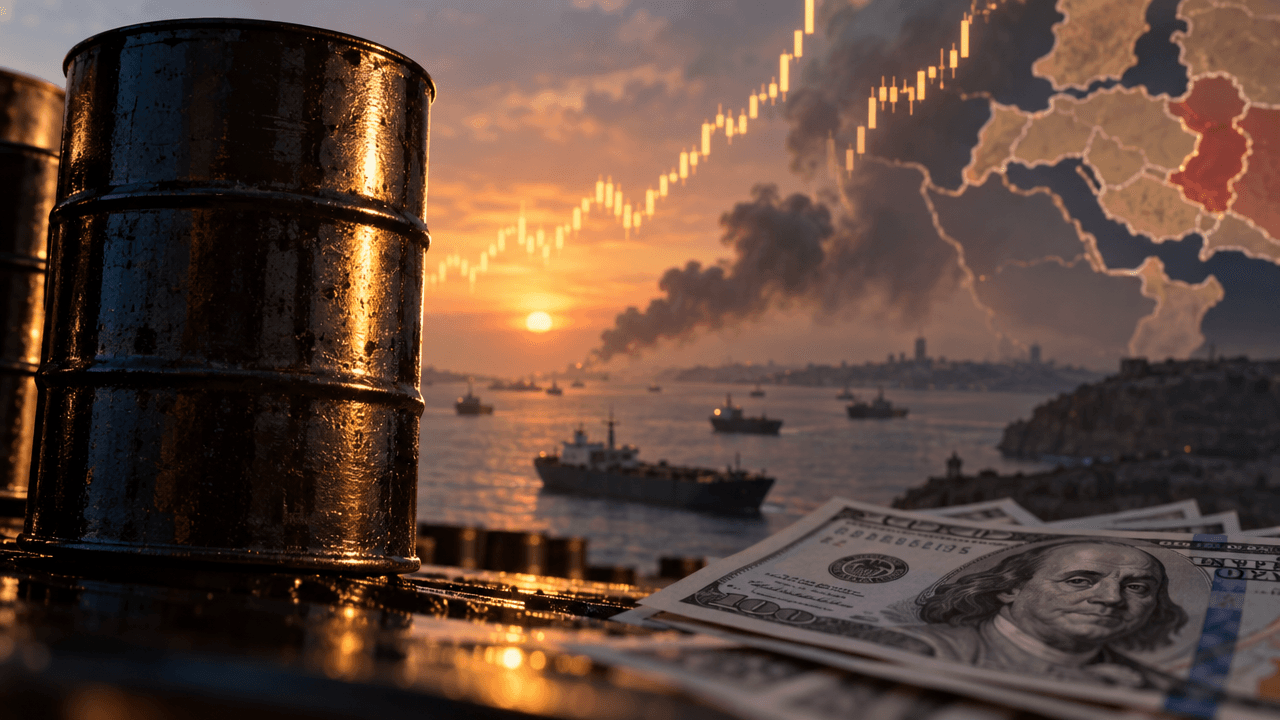
Oil surging above $114 a barrel is more than a headline about commodities. It is a warning that geopolitical risk is once again being priced directly into the global economy. Brent crude futures recently traded near $114, while U.S. West Texas Intermediate moved above $100, pushing both benchmarks to their highest levels since May. [1][2]
The immediate catalyst is the widening conflict involving Iran and attacks linked to the region’s energy infrastructure and shipping routes. Markets are especially focused on the Strait of Hormuz, the narrow waterway connecting the Persian Gulf with the wider global oil market. Although oil flows through the strait have remained close to pre-conflict levels, shipping costs and security concerns have increased sharply. [1]
For traders, the rally illustrates how quickly a supply-risk premium can develop. For consumers, businesses, and policymakers, it raises a more difficult question: how long can higher energy prices persist before they begin reshaping inflation, interest rates, and economic growth?
The Strait Of Hormuz Risk Premium
The Strait of Hormuz is central to the oil market because a significant share of global crude and liquefied natural gas shipments passes through it. Any military escalation, tanker attack, insurance disruption, or temporary blockade could delay exports and remove barrels from the international market.
Oil prices do not need a complete shutdown to rise sharply. Traders often price the possibility of disruption before a physical shortage occurs. Tankers may avoid the area, operate more slowly, pay higher insurance premiums, or temporarily switch off tracking systems. Those actions increase the cost and uncertainty of moving energy, even if some crude continues to reach buyers.
Recent reports have also highlighted attacks on Saudi energy facilities and tankers, adding to concerns that the conflict could spread beyond military targets. Saudi Arabia has increased flows through its East-West pipeline, which bypasses the Strait of Hormuz, but alternative routes cannot necessarily replace every barrel normally shipped through the waterway. [9]
This is why the market reaction can appear disproportionate to the immediate change in production. Traders are pricing the potential loss of supply, not merely the supply already lost.
WHY OIL ABOVE $100 MATTERS
Higher oil prices affect the economy through several channels. The most visible is fuel. When crude rises, gasoline, diesel, jet fuel, and heating costs can increase. Transportation companies then face higher operating expenses, while manufacturers and retailers may pay more to move goods.
Energy is also an input into chemicals, plastics, fertilizers, packaging, and industrial production. As these costs spread through supply chains, inflation can rise beyond the energy category itself. Oil-importing economies are particularly exposed because they must spend more of their income and foreign currency on energy purchases.
The shock can also reduce household spending. Consumers who pay more at the pump have less available for restaurants, travel, clothing, and other discretionary purchases. That creates a difficult combination: faster inflation and slower economic activity.
Central banks may describe this as a supply shock, but that does not make it irrelevant to monetary policy. If higher energy prices lift inflation expectations or lead workers and businesses to demand compensation for rising costs, policymakers may worry about second-round effects.
Central Banks Face A Tougher Decision
The oil rally complicates expectations for future interest-rate decisions. Before the latest escalation, investors may have been anticipating lower rates as inflation eased or economic growth weakened. A prolonged energy shock could delay those cuts, encourage a more cautious approach, or even force some central banks to consider tightening policy again.
The challenge is that raising rates cannot produce more oil or reopen a shipping route. Higher borrowing costs may reduce demand, but they do not directly repair damaged infrastructure or resolve a military conflict. Policymakers must therefore balance the risk of allowing inflation to become embedded against the risk of worsening an economic slowdown.
Central-bank officials have already warned that energy disruptions can push inflation higher while reducing growth. The Bank of Japan, for example, has described the combination as a difficult environment in which crude shortages can raise prices and weaken economic activity at the same time. [13] European policymakers have also identified continued Strait of Hormuz disruption as a source of upward pressure on energy prices. [8]
The key variable is duration. A brief spike may fade as traders unwind risk premiums. A sustained disruption could affect inflation data, corporate earnings, consumer confidence, and interest-rate expectations for months.
What Traders Should Watch
The most important indicator is not simply the daily oil price. Traders should monitor whether physical shipments are being delayed, whether tanker insurance costs continue rising, and whether major producers can increase exports through alternative routes.
Inventory data also matters. Large commercial or strategic stockpiles can cushion a temporary disruption. However, inventories cannot indefinitely compensate for a prolonged reduction in supply.
The shape of the futures curve offers another clue. If near-term contracts trade at a significant premium to later contracts, the market may be signaling immediate scarcity. If prices remain elevated across the curve, traders may be assigning a greater probability to a longer-lasting disruption.
In a SimFi environment, this event provides a useful risk-management exercise. Traders can build scenarios for a short-lived spike, a gradual normalization, and a severe supply interruption. Each scenario should include defined entry levels, invalidation points, maximum loss, and assumptions about volatility. The objective is not to predict the next headline, but to manage exposure when headlines can move markets faster than technical signals.
Conclusion
Oil above $114 reflects a collision between geopolitical uncertainty and a market that depends on reliable transportation routes. The rally may continue if attacks intensify or shipping through the Strait of Hormuz deteriorates. It may also reverse quickly if negotiations improve, flows normalize, or the supply threat proves smaller than feared.
The practical lesson is that energy markets reward preparation more than certainty. Traders should track physical supply, freight conditions, inventories, currency movements, and central-bank communication together. For investors and businesses, the oil surge is a reminder that geopolitical events can become inflation events—and that inflation events can quickly become monetary-policy events.