
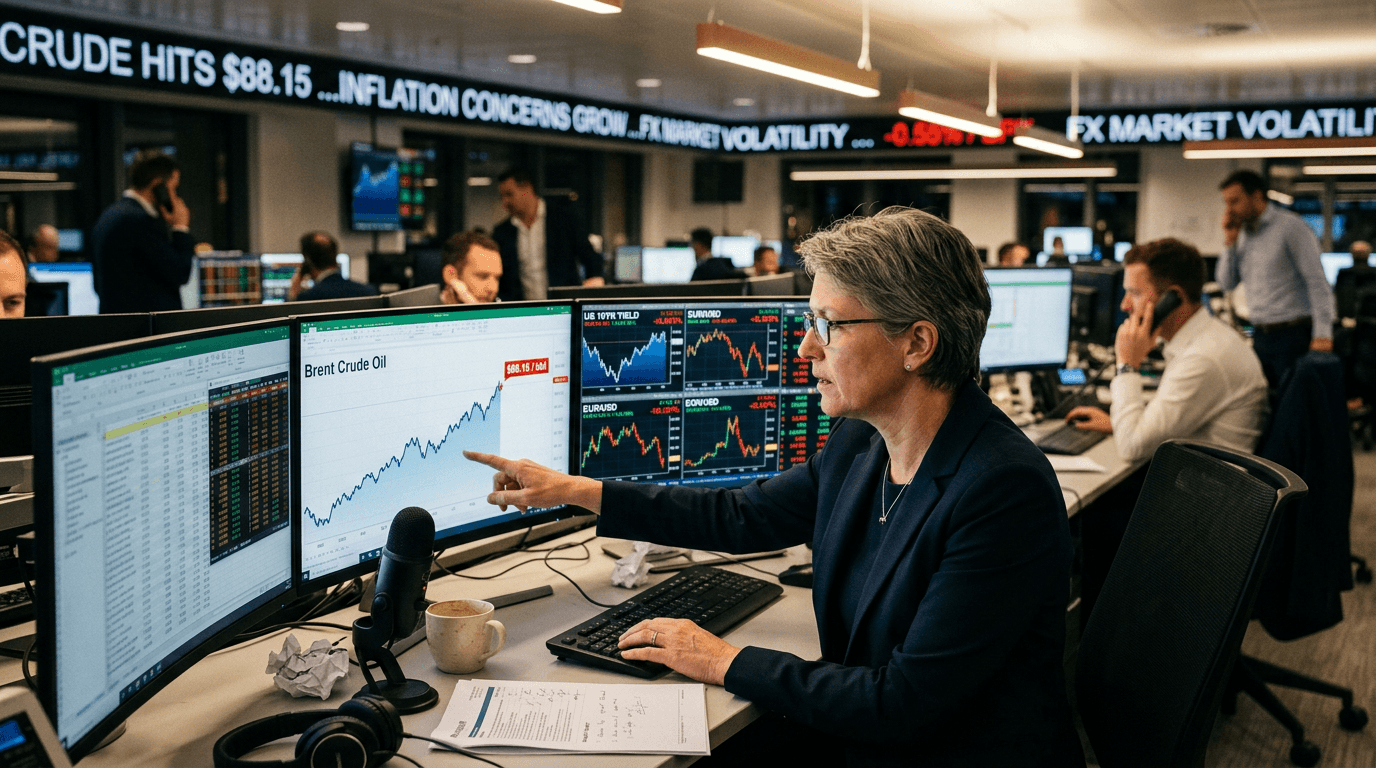
Oil’s latest surge above $88 a barrel has turned a routine market session into a macro story, with energy costs once again at the center of inflation worries and risk sentiment.[6][9][10] After a roughly 4–5% jump in recent sessions, Brent crude has pushed to its highest levels since late July, reinforcing expectations that elevated energy prices may stick rather than fade quickly.[6][9][10] For traders across forex, rates, and futures, this move is not just about crude; it is about what higher fuel and transportation costs mean for headline inflation, central-bank reaction functions, and the pricing of risk across asset classes.[1][5][12]
WHY THE MOVE ABOVE $88 MATTERS
Oil is a foundational input for the global economy, and moves of this magnitude tend to ripple well beyond the energy sector.[2][3][15] Recent price action has been driven in part by geopolitical tensions and disruptions around key shipping routes, which have tightened supply expectations and increased the risk premium embedded in crude benchmarks.[4][9][10] When traders see oil breaking above levels like $88 and flirting with the $90 zone, they begin to reassess whether the inflation downtrend can continue smoothly or whether another energy-driven bump in prices is coming.[5][7][12] History shows that the duration of an oil shock, not just the size, is what ultimately matters for growth and markets, making sustained high prices far more concerning than short-lived spikes.[13]
Key takeaway: The move above $88 is a signal that energy costs may reassert themselves as a macro driver rather than just a sector story, requiring traders to revisit their inflation and policy scenarios.[1][5][12]
How Higher Energy Costs Feed Inflation
Oil feeds inflation through multiple channels: transportation, manufacturing, utilities, and consumer fuel spending.[2][3][15] Higher crude prices raise operating costs for businesses that rely on shipping and logistics, encouraging them to pass costs on to end customers and compressing disposable income in the process.[2][3][5] As gasoline, diesel, and other refined products become more expensive, households have less room for discretionary consumption, which can slow demand even as headline inflation is pushed higher by energy components.[2][3][11] Central banks watch these dynamics closely, because persistent energy-driven inflation can force them to consider a tighter policy stance or delay planned rate cuts, particularly when inflation expectations start to drift up.[1][5][7]
In recent weeks, traders have already seen higher oil prices coinciding with rising government bond yields, as markets price in the possibility that inflation may be more stubborn and that policy rates could stay restrictive for longer.[1][12][15] Elevated oil prices around $90 are also being linked to downside scenarios for equities, with some analysis suggesting that a sustained period at these levels could catalyze a double‑digit decline in major stock indices.[11][14][13]
Key takeaway: Oil-driven inflation pressures can alter both the timing and direction of central-bank moves, which in turn reshapes valuations across equities, bonds, and currencies.[1][5][7]
Market Ripple Effects: Forex, Rates, And Futures
In forex markets, higher oil prices tend to support producer currencies while pressuring large importers, particularly those with existing current-account deficits.[3][7][15] At the same time, geopolitical shocks that push crude higher often trigger safe‑haven flows into the dollar, amplifying currency volatility and complicating the picture for emerging markets.[8][12][13] For rates traders, the combination of higher inflation expectations and safe‑haven demand has recently translated into rising long-term yields, with benchmark 10‑year government bonds climbing as oil spikes.[1][12][15] This environment narrows the room for aggressive easing and increases sensitivity to incoming data, as every inflation print is reinterpreted through the lens of energy costs.[1][5][7]
Futures markets feel the impact through repriced curves and changing risk appetite.[3][5][12] Equity index futures have shown vulnerability to sustained energy shocks, as investors reprice earnings expectations for energy‑intensive sectors like transport, manufacturing, and consumer goods.[3][5][11] Volatility indicators and credit spreads also tend to widen in the wake of significant oil spikes, reflecting rising uncertainty about growth and policy.[8][12][13]
Key takeaway: Rising oil prices above $88 create cross‑asset knock‑on effects, influencing currency trends, yield curves, equity index levels, and volatility regimes that traders need to incorporate into their positioning.[1][3][12]
Implications For Simulated Finance Traders
For participants on SimFi platforms like E8 Markets, an oil shock is an ideal live case study in macro‑driven market behavior.[3][15] Simulated trading allows you to explore how higher energy prices might affect different asset classes without the pressure of real capital at risk, making it easier to test hypotheses about inflation, policy, and risk sentiment.[3][15] Traders can build scenarios where Brent sustains levels around $90, then map out potential paths for equity indices, bond yields, and major currency pairs under different central-bank responses.[11][14][13] Because historical episodes show that the length and persistence of an oil shock matter most, SimFi environments are well suited to stress‑testing portfolios over extended time horizons rather than just reacting to intraday volatility.[13][15]
Through simulated portfolios, traders can practice hedging strategies—such as using energy futures, options, or sector rotation—to offset the impact of higher fuel costs on broader holdings.[3][5][11] They can also experiment with safe‑haven allocations, evaluating how shifts into currencies, high‑grade bonds, or defensive sectors perform when oil‑driven inflation fears rise.[8][12][15]
Key takeaway: Simulated trading provides a controlled environment to observe and learn from oil‑driven market swings, helping traders refine their macro playbook before committing real capital.[3][13][15]
Practical Playbook: How To Navigate An Oil Surge
First, monitor the relationship between oil and inflation expectations by watching energy‑sensitive data releases and market‑based measures of future price levels.[1][5][12] If energy components start driving upside surprises in inflation prints, be prepared for the possibility that central banks may pause or slow easing plans, which will affect both rates and currency trends.[1][5][7] Second, map sector sensitivities: energy and certain commodity producers may benefit from higher prices, while transportation, airlines, and consumer discretionary names often come under pressure as costs and fuel bills rise.[2][3][11] Third, pay attention to volatility indicators and credit spreads, as oil‑driven uncertainty can quickly spill into broader risk sentiment, influencing leverage and liquidity in the system.[8][12][13]
Within a SimFi framework, codify these observations into rules and scenarios.[3][15] Define how your simulated portfolio should adjust when oil breaks key levels like $88 or $90, whether through hedge activation, sector rotation, or currency reallocations.[11][14][15] Review how different strategies perform across multiple simulated paths, including cases where oil spikes briefly and cases where it stays elevated for months.[13][15]
Key takeaway: A structured playbook—built and tested in a simulated environment—helps traders respond rationally to oil shocks rather than react emotionally to headline risk.[3][13][15]
Conclusion
Oil’s move above $88 per barrel is more than a headline; it is a reminder that energy prices remain a powerful driver of inflation, policy expectations, and cross‑asset pricing.[1][5][12] Whether this surge proves short‑lived or evolves into a sustained shock, traders who understand the transmission channels—from fuel costs to inflation, from inflation to rates, and from rates to risk appetite—will be better positioned to navigate the volatility.[2][3][15] By using simulated finance platforms to model scenarios and test strategies, market participants can turn a challenging macro backdrop into a learning opportunity, sharpening their ability to respond when energy once again takes center stage.[3][11][13]