
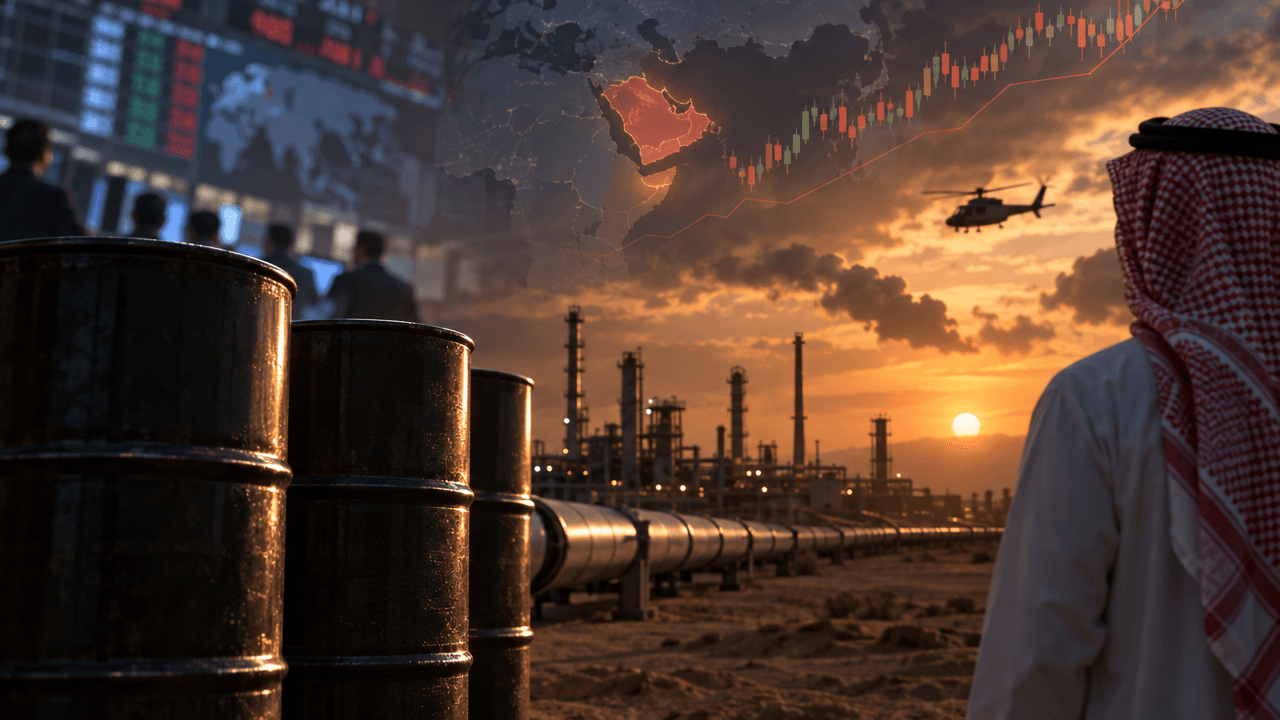
Oil futures are holding near multi‑month highs as traders reprice geopolitical risk in the Middle East, with Saudi Arabia’s brief danger alerts for key cities including the oil hub of Yanbu putting supply security back in the spotlight.[1][2][13] For both directional and macro‑focused traders, this environment is a live case study in how risk premiums build, spill over into currencies and equities, and complicate the inflation outlook just as central banks weigh their next moves.
Global Oil Market Snapshot
West Texas Intermediate (WTI) October futures trading around the $102–103 per barrel area and Brent November near $107 signal that markets are embedding a meaningful geopolitical premium on top of fundamental demand and supply dynamics. That price zone is consistent with levels seen when traders anticipate potential disruptions, even if physical flows have not yet been materially impaired.
Saudi Arabia’s oil infrastructure is central to this premium narrative. Yanbu, its main Red Sea oil port, routinely handles millions of barrels of crude exports each day, making it a critical node between Middle Eastern production and global consumers.[1] The fact that this region has recently seen a series of “potential danger” alerts and all‑clear messages underscores how quickly sentiment can swing when security headlines hit core energy assets.[1][2][13]
The pipeline network that feeds Yanbu adds another layer of complexity. Reporting that drone damage has shut the kingdom’s East–West pipeline, which normally carries about 4 million barrels per day and could put up to 4% of global crude supply at risk if flows are not restored within days, reinforces the idea that even short disruptions can tighten seaborne supply and support prices.[15] For traders, the combination of high spot prices, elevated volatility, and widening calendar spreads is a textbook example of how supply‑side risk drives futures curves.
Geopolitical Risk Premium: Saudi Alerts In Focus
The latest price action cannot be understood without the pattern of Saudi civil defence alerts. In recent months, authorities have issued early warnings via the National Early Warning Platform for Yanbu and other cities, then sent all‑clear updates within minutes once the perceived danger had passed.[1][2][10][13] These rapid‑fire alerts, even when no casualties or damage are ultimately reported, remind markets that critical infrastructure sits within a live conflict zone.
Saudi Civil Defense has at times issued three consecutive “potential danger” alerts for Yanbu in a single day before confirming that conditions returned to normal, highlighting the sense of uncertainty faced by residents and, by extension, energy traders watching from afar.[3][11] This pattern keeps risk desks on edge, because each alert raises the question of whether the next one will coincide with a confirmed hit on export capacity.
Multiple sources have linked some of these alerts to Houthi missile and drone activity targeting Saudi Aramco facilities, oil refineries, and the Petroline pipeline terminating at Yanbu, as well as assets in the Jazan region.[3][4][5][6] Even when air defences intercept incoming threats, the mere attempt to strike energy infrastructure can trigger temporary shutdowns, add inspection and maintenance delays, and amplify the perceived probability of a larger disruption. This is precisely the environment in which a geopolitical risk premium in oil tends to persist rather than fade quickly.
Cross-asset Reactions: Fx, Commodities, And Equities
Higher oil prices and elevated supply risk do not stay contained within the energy complex. In foreign exchange markets, energy‑linked currencies such as the Canadian dollar (CAD) and Norwegian krone (NOK) typically find support as higher crude prices improve terms of trade and boost export revenues. At the same time, importer currencies in Asia, notably the Japanese yen (JPY) and Indian rupee (INR), often come under pressure as rising energy bills widen trade deficits and worsen the growth‑inflation trade‑off.
Equity and broader commodity futures markets generally respond with a more defensive tone. Rising input costs can squeeze margins in energy‑intensive sectors such as airlines, chemicals, and manufacturing, prompting investors to rotate toward more resilient industries or reduce overall risk exposure. Commodity baskets may see rotation out of growth‑sensitive industrial metals and into defensive assets, or into energy itself, as traders seek to hedge inflation risk.
For volatility traders, this environment tends to lift implied volatility in both crude and key indices, even if spot moves remain orderly. Options pricing reflects not only current price levels but also the probability of tail events, and repeated alerts around strategic infrastructure encourage the market to assign a higher probability to adverse scenarios. This is where SimFi environments can be particularly useful: traders can model cross‑asset correlations and stress‑test portfolios under various shock magnitudes without immediate real‑world capital at risk.
Inflation And Central Bank Implications
Sustained oil prices above $100 add another complication for central banks already wrestling with sticky core inflation and uneven growth. Higher energy costs filter into transportation, manufacturing, and eventually consumer prices, potentially lifting headline inflation and influencing expectations in ways policymakers cannot ignore.
If central banks are heading into key meetings while oil trades at multi‑month highs, they must decide whether to lean more hawkish to prevent second‑round inflation effects or to emphasize growth risks if higher energy costs threaten demand. This ambiguity can itself fuel market volatility, as traders recalibrate rate expectations and term premia in bond markets.
For macro‑oriented traders, the interplay between oil prices, inflation data, and rate expectations is a critical source of opportunity and risk. Scenario analysis—such as mapping how a sustained $110–120 oil range might affect inflation prints and policy paths—can inform positioning in rates, FX, and equities. In a SimFi setting, running these scenarios repeatedly with different assumptions about supply disruptions, demand growth, and policy reaction functions helps refine trading playbooks before deploying them in live markets.
Practical Takeaways For Traders And Simfi Users
First, recognize that geopolitical risk premiums can persist beyond the immediate headline. Repeated alerts around key infrastructure, even when followed by all‑clear messages, signal a regime where tail risks are structurally higher, and crude futures can stay elevated longer than fundamentals alone would suggest.[1][2][3][13] Position sizing and stop‑loss discipline should reflect that reality.
Second, track cross‑asset feedback loops. Energy‑linked FX, importer currencies, and sector‑level equity performance often move in tandem with oil, providing both confirmation signals and alternative avenues for expressing views. Using a simulated environment, traders can test whether hedging via FX or equity indices offers better risk‑adjusted outcomes than direct crude exposure in different volatility regimes.
Third, integrate macro and micro perspectives. Central bank communication, inflation data releases, and security developments around assets like Yanbu and the East–West pipeline are all part of the same narrative.[1][3][15] Building structured scenario trees—ranging from “alerts with no damage” to “prolonged pipeline outage”—helps traders avoid ad‑hoc decisions driven solely by the latest headline.
Finally, use SimFi platforms to rehearse execution under stress. Fast‑moving situations, such as sudden danger alerts or unexpected pipeline shutdowns, test order placement, slippage assumptions, and psychological resilience. Practicing entries, exits, and risk management rules in a simulated environment when oil is already at elevated levels can improve performance when similar conditions arise in live markets.
In sum, oil futures hovering near multi‑month highs amid Middle East tensions and Saudi alert scares reflect not just current supply‑demand balances but a broader repricing of geopolitical risk. Whether trading crude directly or navigating its ripple effects across FX, equities, and inflation expectations, a disciplined, scenario‑driven approach—refined in simulation and applied with clear risk controls—offers the best path through a complex and still‑evolving landscape.