
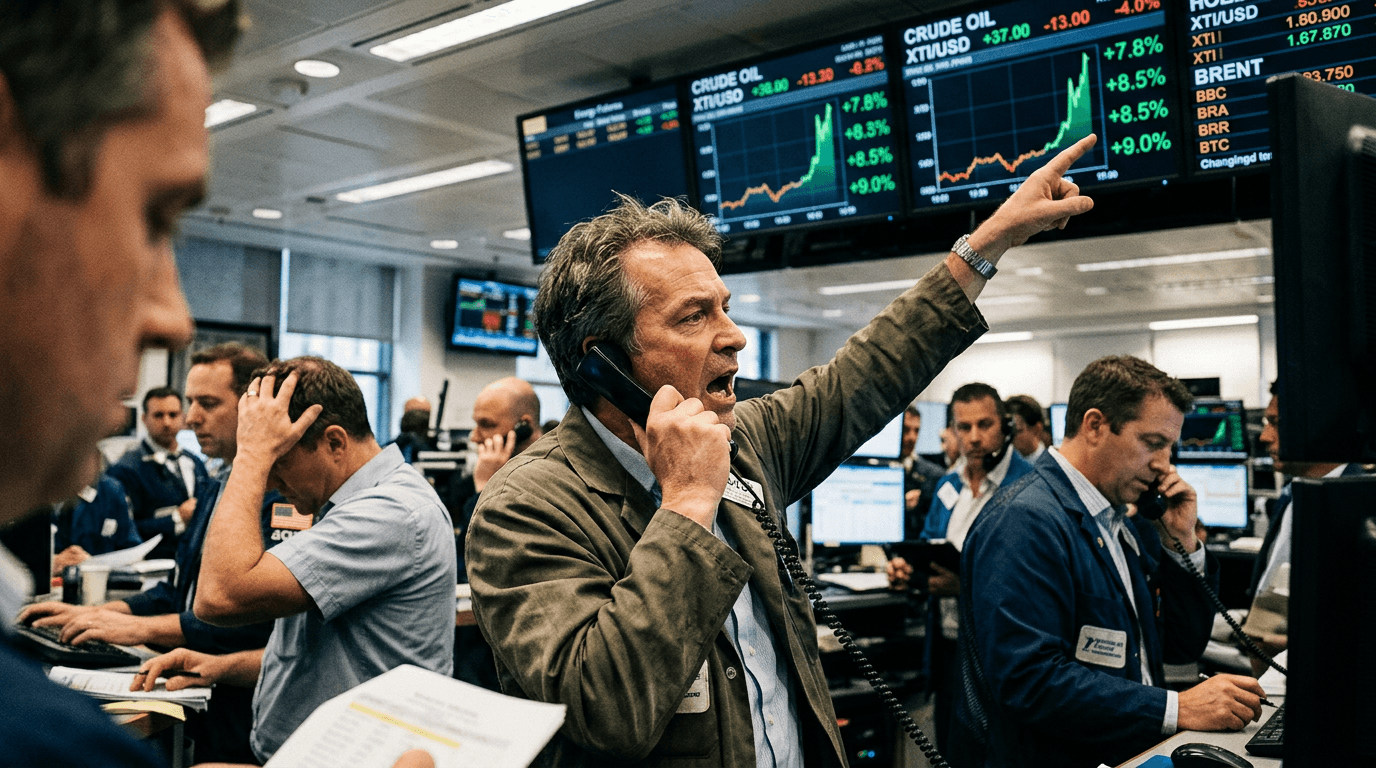
Oil futures ripped higher, jumping as much as 9%, after headlines of intensified US–Iran conflict and fresh claims from Tehran that the Strait of Hormuz is closed, even as US officials insist that oil flows remain intact.[2][4] For traders, this is not just another Middle East headline—it is a stress test for energy markets, inflation expectations, and risk sentiment across global assets.[4][5]
Why Oil Futures Just Surged
The immediate catalyst for the spike was a renewed escalation between the United States and Iran, including reports of fresh strikes and rising fears of a broader regional war that could directly target energy infrastructure.[2][6] As traders repriced the risk that supply from one of the world’s most sensitive energy corridors could be disrupted, crude futures reacted in textbook fashion: sharp, fast, and liquidity-thin.
Brent crude briefly surged back above the psychologically important $100 per barrel mark, with intraday gains of around 10% to roughly $101.59, while West Texas Intermediate (WTI) climbed toward $96 before paring some of the move.[4] That scale of intraday rally—up to 9–10% in major benchmarks—is characteristic of a supply shock narrative rather than a demand or macro story.
Adding fuel to the move were reports that two tankers had been struck in regional waters and that Oman temporarily cleared ships from a key export terminal near the Strait of Hormuz, highlighting operational risks for shipping and insurance costs.[4] Even with US officials signaling that flows remain largely intact for now, markets are forward-looking: futures prices embed probabilities of what might happen, not just what is happening today.
Strait Of Hormuz: Why This Chokepoint Matters
The Strait of Hormuz is one of the most critical maritime chokepoints in the global economy, carrying around a quarter of global seaborne oil trade, as well as significant volumes of liquefied natural gas and fertilizers.[5] When a chokepoint of this magnitude comes under question—even rhetorically—risk premia on every barrel that transits the region can reprice within minutes.
Disruptions or perceived disruptions in Hormuz transmit through multiple channels: physical supply risk, higher freight and insurance costs, and a surge in precautionary stockpiling by refiners and importers.[4][5] UN trade analysis notes that such disruptions quickly ripple beyond energy into maritime transport and global supply chains, raising broader concerns for trade and development.[5]
Historically, similar shocks—whether from regional wars, blockades, or tanker attacks—have driven sharp spikes not only in oil but also in related markets such as bunker fuel, shipping rates, and even agricultural commodities, as higher fuel and fertilizer costs pressure food prices.[5] That pattern is now back on traders’ radar.
The Macro Ripple: Stocks, Bonds, Currencies, Inflation
The oil move is not happening in isolation. Rising energy prices are feeding directly into inflation expectations and complicating the outlook for central banks that had been preparing, or at least signaling, gradual easing after a period of tightening.[4] Higher oil acts like a tax on consumers and businesses, but in the near term it risks reigniting headline inflation just as policymakers thought they had it under control.
Global bond markets are already reacting. Elevated oil prices have stoked fears that inflation will reaccelerate, triggering a sell-off across fixed income markets and erasing year-to-date gains in major global bond indices.[4] Higher yields tighten financial conditions, potentially offsetting some of the growth support that lower rates would have provided.
Equity markets are also feeling the strain. Index futures tied to major US benchmarks such as the S&P 500, Nasdaq, and Dow have come under pressure as investors reassess margins for energy-intensive sectors and the probability of a “higher-for-longer” rate environment.[4] Energy producers and some commodity-linked names may benefit, but broader risk sentiment typically weakens when oil spikes for geopolitical reasons.
Currency markets are likely to reflect the classic pattern: net oil importers face pressure on their exchange rates and trade balances, while exporters may see support from improved terms of trade. This can create relative-value opportunities, but it also raises volatility for carry trades and cross-asset strategies that had been built on calmer macro assumptions. (This pattern is based on long-standing market behavior, not a single data point.)
Why This Matters For Traders And Investors
Beyond the immediate price action, this episode underscores how quickly narrative and risk premia can shift when geopolitical stress meets a critical supply chokepoint. For discretionary traders, systematic strategies, and risk managers alike, there are several key lessons:
First, tail risk is real, and it often arrives via geopolitics rather than economics. Oil markets had already been tight due to earlier disruptions and policy decisions; a military escalation layered on top can push prices into ranges that were not part of base-case scenarios.[4][5]
Second, correlations can change under stress. Energy price spikes linked to conflict often lead to “risk-off” behavior in stocks and high-yield credit, while safe-haven assets and volatility instruments catch a bid. Bond markets can react in non-linear ways as traders weigh stagflationary risks: slower growth but higher inflation.[4]
Third, liquidity can evaporate when everyone rushes to hedge at once. Wide bid–ask spreads and slippage in futures and options markets are common during such shocks, especially in shorter-dated contracts where hedging activity concentrates.
Using Simulated Trading To Navigate Oil Shocks
For many traders, jumping directly into highly volatile crude futures during a geopolitical crisis can be risky—both financially and emotionally. This is where simulated finance environments become valuable.
In a SimFi setting, traders can:
- Practice trading oil and equity index futures around headline risk without real capital at stake.
- Test different playbooks: momentum breakout strategies on crude, mean-reversion setups after overextended spikes, or cross-asset hedges using equity indices, bonds, or volatility products.
- Build and refine rules for trading “event risk” days—such as maximum intraday loss limits, position-sizing caps in high-volatility regimes, and clear criteria for when to stand aside instead of forcing trades.
- Analyze how hypothetical portfolios would have performed during past Middle East shocks, stress-testing exposures to energy prices, inflation-sensitive assets, and commodity currencies.
Because simulated environments mirror real-time pricing and volatility, they allow traders to experience the psychological pressure of fast markets—gap moves, headline bombs, intraday reversals—while refining their discipline and process.
Practical Takeaways For Your Playbook
Several actionable ideas emerge from this oil futures surge:
- Map the chain: When oil spikes for geopolitical reasons, immediately think in terms of linkages—energy, inflation expectations, bonds, central-bank policy paths, equities, and FX. This helps identify both risks and opportunities beyond the crude contract itself.[4][5]
- Watch the chokepoints: Track developments around key maritime corridors like the Strait of Hormuz, as they can abruptly change the risk profile for global supply chains and commodity prices.[5]
- Respect volatility: Widen expected ranges, tighten risk limits, and avoid overleveraging into gaps. Intraday swings can be violent when markets are pricing low-probability, high-impact scenarios.
- Think in scenarios, not predictions: Instead of trying to “call” the conflict outcome, define base, bullish, and bearish scenarios for oil and related assets, and map how your positions behave in each.
- Train before it counts: Use simulated trading to rehearse decision-making under stress—setting orders, adjusting stops, and managing emotions when markets move 5–10% in a day.
Geopolitical shocks are, by definition, hard to time. But they are not impossible to prepare for. The latest surge in oil futures is a reminder that disciplined process, robust risk management, and practice under realistic market conditions are as important as any headline or chart pattern.