
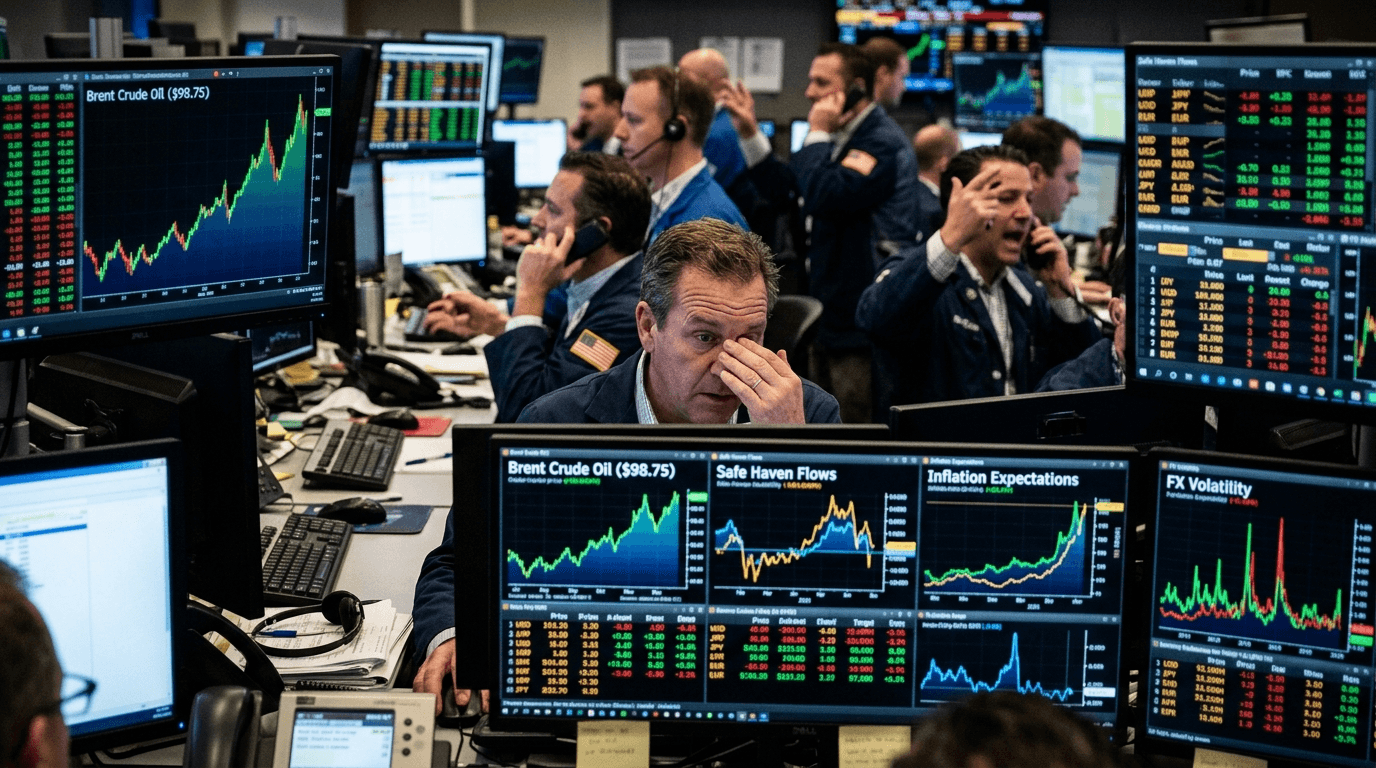
Escalating tensions between the United States, Iran and broader Middle East actors have pushed energy markets back into the spotlight, with Brent crude edging closer to the psychologically important $100 per barrel mark and West Texas Intermediate (WTI) trading back above $79.[1][4][14] At the same time, renewed demand for traditional safe havens is lifting gold and silver prices and supporting a stronger U.S. dollar as investors reposition away from risk assets.[3][8] For traders, this is not just a headline; it is a live test of how geopolitics, commodities, inflation and FX interact in real time.
Markets React To Middle East Escalation
The latest leg higher in oil prices is rooted in fears over supply disruption rather than a sudden surge in demand.[1][6] The Middle East still controls key chokepoints for global energy flows, notably the Strait of Hormuz, through which a substantial share of seaborne crude passes.[5][6] When markets perceive meaningful risk to that corridor—via blockades, attacks on infrastructure, or sanctions that restrict exports—traders quickly price in a higher “risk premium” on each barrel of oil.
Recent conflict has already been described by global energy authorities as one of the largest supply disruptions in the history of oil markets, with estimates that regional output could fall by around 10 million barrels per day in severe scenarios.[6] Even with emergency releases from strategic reserves and higher production from other countries, this could translate into an 8 million barrel per day drop in global output.[6] That scale of potential shortfall explains why Brent has surged from the low-$70s earlier in the year to peaks well above $100 at times, marking moves of more than 50% in a matter of months.[5]
For short-term traders, such moves are amplified in futures markets, where leveraged positions and options activity can accelerate price swings. Volatility in front-month contracts tends to spike, while longer-dated futures reprice the probability that elevated geopolitically driven prices will persist.
Why Oil Supply Risks Matter For Inflation And Rates
Higher oil prices feed directly into inflation expectations, and that is where the current move becomes macro‑critical rather than just a commodity story.[2][11] Oil is embedded in everything from transport and logistics to manufacturing and agriculture. A sustained period with Brent near $90–$100 per barrel can add up to 0.8 percentage points to inflation in developed economies relative to prior forecasts.[2] That might sound modest, but in a world where central banks are fighting to get inflation back to target, it is enough to shift policy.
If policymakers conclude that an oil‑driven inflation shock will be persistent rather than temporary, they may be forced to keep interest rates higher for longer or even resume rate hikes.[2][11] That, in turn, impacts growth expectations, equity valuations and credit markets. Rate‑sensitive sectors, such as housing and highly leveraged companies, can feel the strain quickly as borrowing costs remain elevated.
For traders in rates and equity index products on a simulated finance platform, this environment is a chance to explore how an energy shock can alter yield curves and sector performance. Historically, prolonged oil spikes have tended to weigh on consumer discretionary stocks while supporting energy producers and, in some cases, inflation‑linked assets.
SAFE‑HAVEN FLOWS: GOLD, SILVER AND THE U.S. DOLLAR
Geopolitical shocks rarely affect just one asset class. As the Middle East conflict has escalated, flows into safe‑haven assets have picked up, supporting higher prices for gold and silver and a stronger U.S. dollar.[3][8] Gold often responds to periods of heightened uncertainty and inflation anxiety, acting as a store of value when real yields and risk appetite are in flux. Silver tends to move alongside gold but with additional sensitivity to industrial demand.
The U.S. dollar benefits from a combination of higher relative interest rates and its status as the world’s dominant reserve currency. When risk aversion rises, global investors frequently rotate into dollar‑denominated assets, including Treasuries, even if the original shock is centered in another region. In the current episode, the prospect of tighter U.S. monetary policy in response to higher energy‑driven inflation adds another tailwind for the dollar.
From a multi‑asset perspective, this means correlations can temporarily shift. Equities may sell off while oil and gold rally, and FX markets adjust to a stronger dollar backdrop. Simulated trading across asset classes offers a way to study these cross‑market relationships: for example, testing how gold responds to changes in real yields or how USD performance compares against currencies of commodity exporters versus importers.
FX PRESSURE ON OIL‑IMPORTING ECONOMIES
Not all currencies react the same way to an oil shock. Oil‑importing economies, particularly those running current account deficits, tend to come under pressure when crude prices spike.[3][8] Rising energy bills widen trade deficits and can erode investor confidence in the currency’s outlook. In the recent move, currencies such as the Indian rupee (INR) and Japanese yen (JPY) have faced headwinds as higher oil prices threaten growth and raise import costs.[3][8]
Japan, with limited domestic energy resources and long‑standing ultra‑easy monetary policy, is especially exposed when both oil rises and the U.S. dollar strengthens. Higher import prices squeeze real incomes, while yield differentials between Japanese government bonds and U.S. Treasuries can encourage capital outflows, weakening the yen further. India faces similar challenges, as elevated oil prices feed into domestic inflation and fiscal pressures, complicating the central bank’s policy calculus.
For FX traders, this environment underscores the importance of understanding a country’s energy balance and external financing needs. Back‑testing strategies that differentiate between net‑exporters (such as certain Middle Eastern producers or commodity‑rich economies) and net‑importers can highlight how the same shock can have opposite currency effects.
How Traders Can Navigate Geopolitical Shocks
Geopolitical‑driven moves often unfold in fast, information‑dense phases: initial surprise, reassessment of fundamentals, and then the grind of policy responses and evolving headlines. The current Middle East conflict and its impact on oil and safe‑haven flows encapsulate each of these stages. For traders, whether discretionary or systematic, several practical lessons stand out.
First, scenario analysis is essential. Before a shock hits, mapping out “mild disruption,” “major blockade,” and “rapid de‑escalation” scenarios for oil can help frame potential price ranges and cross‑asset impacts. The market has seen everything from relatively contained 10–15% swings in past conflicts to far more dramatic spikes when supply disruption is both deep and prolonged.[10][12][13] Having pre‑defined playbooks reduces the temptation to react emotionally to headlines.
Second, risk management must adapt to volatility. Position sizing, use of options rather than outright futures, and diversification across assets can help manage the sharper intraday moves that accompany geopolitical news. Safe‑haven assets may offer partial hedges, but their performance is not guaranteed; understanding when gold and the dollar move together, and when they diverge, is a key analytical edge.
Finally, simulated finance environments are particularly valuable during such episodes. They allow traders to experiment with strategies—such as long‑oil/short‑oil‑importer FX baskets, or long‑gold vs. equity hedges—without real capital at risk. By replaying historical stress periods and overlaying current data, traders can refine their understanding of how energy shocks propagate through inflation expectations, rate pricing, and currency markets.
As the Middle East conflict continues to reshape expectations around oil supply and global risk, the market narrative is once again reminding participants that geopolitics and macroeconomics are tightly intertwined. Those who can connect the dots between barrels, basis points and FX crosses will be better positioned to interpret—rather than simply react to—the next wave of headlines.