
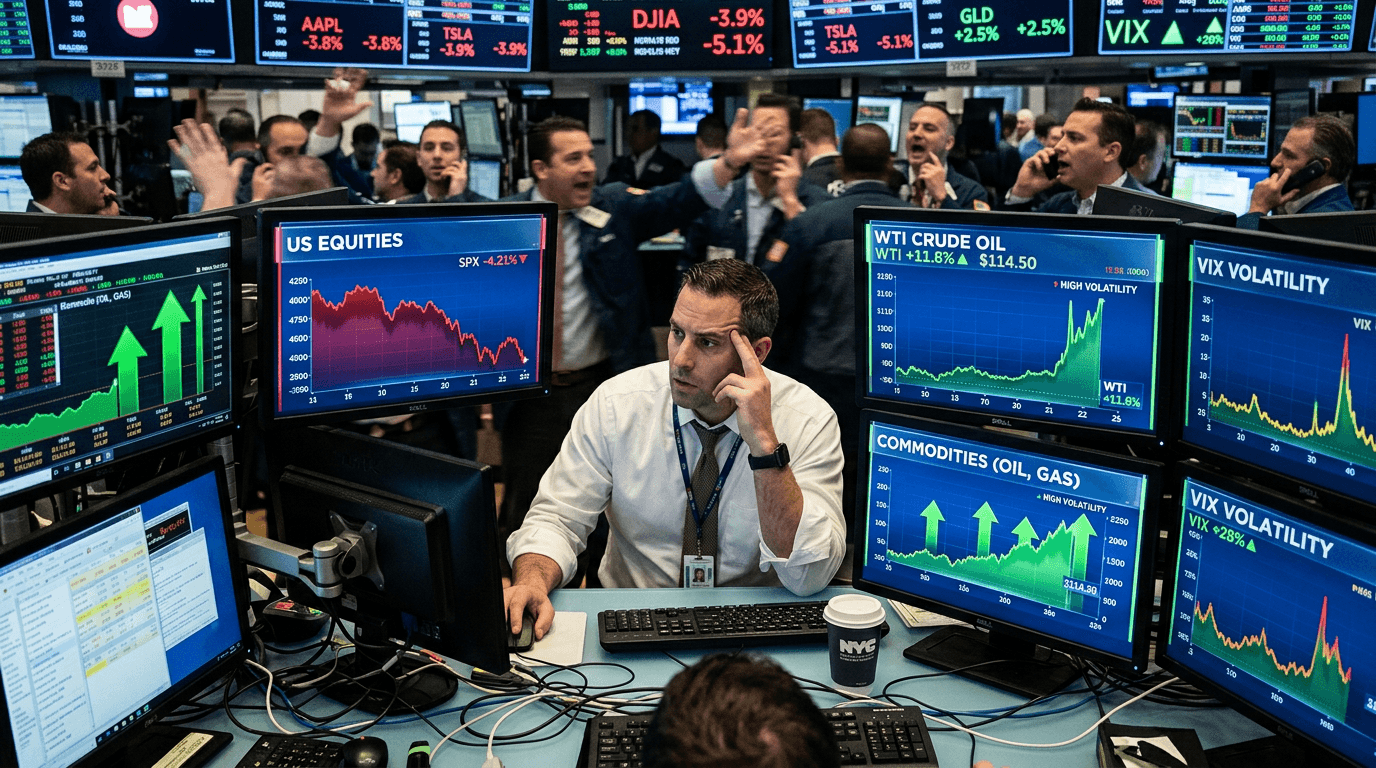
Oil markets just delivered a stark reminder of how tightly geopolitics and asset prices are intertwined. A sudden 9% jump in crude, driven by escalating tensions between the US and Iran and broader Middle East instability, rippled through global markets. US equities sold off hard, commodity futures rallied, and volatility futures spiked as traders scrambled to hedge risk and reposition portfolios.
The episode underscores a key theme for traders: in a world still sensitive to inflation and policy uncertainty, large moves in energy can quickly morph from a sector story into a cross‑asset event.
WHAT HAPPENED: A 9% OIL SPIKE AND A RISK‑OFF SWING
Crude oil surging 9% in a single session is a meaningful shock, even in a historically volatile asset. The move was fueled by fears that intensifying conflict could disrupt supply routes or key production and export facilities in the Middle East, particularly around the Strait of Hormuz, through which a large share of global seaborne oil flows.
As oil ripped higher, US equity indices turned sharply lower. Cash markets closed near the lows of the day, and index futures extended the decline in after‑hours trading, signaling ongoing stress. Energy stocks initially rose with crude, but the broader market reaction was firmly risk‑off: cyclicals and growth names led declines, with high‑multiple tech, small caps, and transport stocks under particular pressure.
At the same time, commodity futures beyond crude—especially refined products and key industrial commodities—caught a strong bid. Volatility futures, commonly used as a hedge against equity downside, climbed as traders bought protection against a deeper drawdown.
Why Higher Oil Can Slam Equities
A spike in oil affects equities via several channels, and understanding them helps explain why a 9% move can trigger a broad sell‑off rather than just a rotation into energy names.
1. Inflation shock and rate expectations Oil is a major input into transportation, manufacturing, and logistics. A sharp spike raises forward-looking inflation expectations. With inflation still above many central banks’ targets, traders worry that higher energy costs will slow or delay any shift toward easier monetary policy. That repricing shows up in higher yields at the front of the curve and softer equity valuations, especially in rate‑sensitive sectors like tech and real estate.
2. Margin pressure for corporates For many non‑energy companies, oil is a cost, not a profit center. When crude jumps quickly, firms have limited ability to pass higher costs through to consumers immediately. That compresses margins and weighs on earnings expectations, which equity markets discount rapidly.
3. Risk sentiment and tail risk Geopolitical tensions in a critical region add a layer of tail risk: traders must consider scenarios involving supply disruptions, shipping bottlenecks, or even direct strikes on energy infrastructure. Even if those scenarios don’t materialize, the perceived probability rise is enough to drive risk‑off behavior and demand for hedges.
The result is a paradox that often surprises newer traders: oil up, energy names up, but broad indices down as the macro and risk‑premium channels dominate.
Ripple Effects In Futures And Fx Markets
The 9% move in crude did not occur in isolation. It reshaped pricing across futures curves and foreign exchange pairs, offering a live case study in cross‑asset linkages.
1. Energy futures across the curve Crude and refined product futures rallied not just at the front month but along the curve, though with varying intensity. When front‑month contracts rise faster than later maturities, the curve can flip into or deepen backwardation, reflecting immediate supply concerns and a “war premium” in nearby contracts. That structure rewards holders of long futures via positive roll yield but also increases volatility as liquidity concentrates in the front.
2. Volatility futures and hedging demand Equity volatility futures, such as those linked to implied volatility indices, spiked as traders sought protection. When volatility futures rise, it typically reflects a surge in demand for puts and structured hedges. For active traders, that presents both risk and opportunity: volatility strategies can perform well, but poorly timed short‑vol trades can be punished quickly.
3. FX: petrocurrencies and safe havens Currencies of major oil exporters—often dubbed “petrocurrencies”—tended to strengthen as higher crude prices improve their terms of trade and fiscal outlooks. Meanwhile, safe‑haven currencies drew inflows as investors reduced risk exposure in higher‑beta FX. Traders also monitored emerging‑market importers vulnerable to higher energy costs, where currency weakness may compound inflation pressures.
Inflation, Central Banks, And The Policy Narrative
Beyond immediate price action, a move like this can shift the macro narrative around inflation and central‑bank policy.
For much of the recent cycle, markets have oscillated between expecting more hikes to tame inflation and anticipating cuts to support growth. Energy is a crucial input into that debate. A sustained oil rally can:
- Lift headline inflation and, with a lag, filter into core components via transport and production costs
- Pressure central banks to sound more hawkish, even if growth data soften
- Narrow the perceived window for near‑term rate cuts and keep real yields elevated
If traders start to believe that higher oil will stick, they may revise their expectations for the path of rates. That repricing can hit long-duration assets, compress equity multiples, and shift flows into shorter‑duration or inflation‑linked instruments.
At the same time, policymakers know that reacting too aggressively to a purely geopolitical, potentially temporary oil spike can over-tighten financial conditions. The tug‑of‑war between inflation risks and growth concerns often translates into choppy markets and higher risk premia.
How Traders Can Navigate Shocks Like This
For both live and simulated finance traders, events like this are less about predicting geopolitical outcomes and more about managing risk and adapting to shifting correlations.
Key takeaways and action points
1. Respect cross‑asset linkages A large move in one asset—like crude—rarely stays contained. Monitor related markets: equity indices, sector ETFs, volatility futures, bonds, and FX. Use these relationships to contextualize moves rather than trading any market in isolation.
2. Watch the futures curve, not just the spot price Changes in curve shape (backwardation vs contango) carry information about perceived short‑term risk and inventory dynamics. For trend traders, the curve also affects roll costs and potential carry.
3. Reassess correlation and regime In quieter periods, equities and commodities may behave independently or even positively correlated. In stress regimes, those correlations can flip quickly. Backtests and strategies should account for regime shifts rather than assuming static relationships.
4. Use volatility intelligently Higher volatility is both a risk and a resource. For directional traders, it demands tighter risk management and position sizing. For options traders, it can open opportunities in spreads, hedges, and volatility arbitrage—if you understand how implied volatility is priced relative to realized.
5. Separate scenario planning from prediction You don’t need to know how the geopolitical situation will resolve to trade it prudently. Build scenarios: prolonged tension with elevated oil, a rapid de‑escalation and oil reversal, or a more severe disruption with further spikes. Consider how each would impact your positions and risk profile, and plan responses in advance.
Conclusion
The 9% surge in crude on Middle East tensions is more than a headline; it is a textbook example of how geopolitical risk can reprice assets across the spectrum. Oil’s jump tightened financial conditions, rattled equities, lifted commodity and volatility futures, and reignited inflation concerns that feed directly into the central‑bank and macro narrative.
For traders, the lesson is clear: stay alert to geopolitical catalysts, understand how energy shocks propagate through equities, futures, and FX, and treat volatility not just as something to fear but as a signal and a set of opportunities. In today’s interconnected markets, mastering those dynamics is as important as any single trade.