
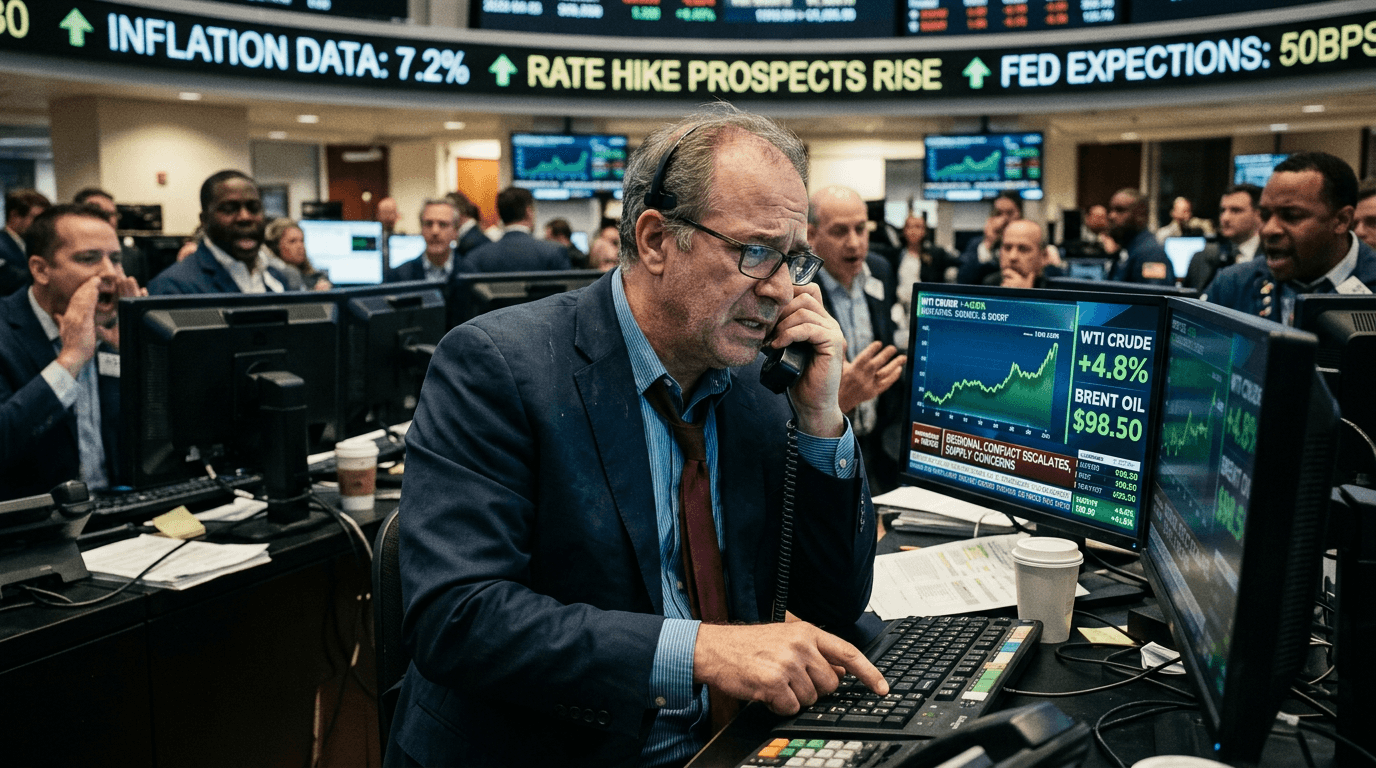
Oil markets have been jolted back into the spotlight as futures jump on rising US–Iran war risks and the threat of a wider Middle East conflict. West Texas Intermediate (WTI) has pushed above the $75 mark, while Brent has rebounded above $79, reflecting a sharp repricing of geopolitical risk as traders digest reports of military strikes, disrupted energy flows, and heightened tensions around key shipping lanes such as the Strait of Hormuz.[1][5][10][15] The move is not just an oil story—it is reviving fears of higher inflation and a more hawkish stance from major central banks.
OIL FUTURES SPIKE ON US–IRAN WAR RISKS
The latest rally in crude is driven less by traditional supply–demand fundamentals and more by an abrupt reassessment of geopolitical risk premia. Recent sessions have seen US crude jump by around 7–8% intraday, with futures briefly trading near the high-$70s after strikes on Iranian targets and retaliatory action across the region.[5][10][15] Brent, the global benchmark, has repeatedly spiked into the low-$80s before settling back toward the high-$70s as traders weigh the probability of sustained disruption.[1][2][5]
The Strait of Hormuz—through which roughly a fifth of the world’s oil and gas supply passes—has been at the center of market anxiety, with confrontations and intermittent shutdowns of operations and shipping intensifying the risk of further supply outages.[1][4] Even before this latest jump, earlier phases of the conflict had driven Brent above $100 and, at one point, to a four-year high above $120 per barrel on war-escalation fears.[4][13] That history makes traders particularly sensitive to renewed fighting: any sign that shipping lanes or production facilities could be targeted tends to be priced quickly and aggressively into futures.
Key takeaway: When geopolitical risk centers on a critical energy chokepoint like Hormuz, the market reaction can be swift and large—even if actual barrels lost are still uncertain.
Why Geopolitical Shocks Hit Energy Markets So Hard
Oil futures respond to two distinct forces during conflicts: actual supply disruption and perceived future risk. In the US–Iran confrontation, both are in play. Reports of shutdowns in Middle Eastern oil and gas operations, interruptions to shipping routes, and the potential for sanctions or counter-sanctions all feed into a higher risk premium embedded in futures prices.[1][12]
At the same time, analysts continue to note that underlying fundamentals—such as the prospect of a surplus in light, sweet crude in early 2026—have not completely disappeared.[3] That means part of the current move is explicitly a “geopolitical price,” layered on top of an otherwise more balanced or even slightly oversupplied market. When tensions ease, prices have tended to retrace, as seen in earlier episodes when ceasefire talks or temporary truces allowed crude to slip back toward pre-war levels.[8][14]
For traders, this mix of fundamentals and event risk makes oil a classic “headline-driven” market. Price action can swing several dollars in a single session on news of strikes, negotiations, or naval incidents—offering opportunity, but also elevated tail risk.
Key takeaway: In conflict-driven rallies, traders must separate durable supply changes from short-lived headline risk; both matter, but they behave differently over time.
From Oil To Inflation: The Pass-through Channel
The latest spike in oil prices matters far beyond the energy complex because crude is a key input into headline inflation. Higher oil prices filter through into gasoline, diesel, jet fuel, and broader transportation costs. That, in turn, affects the prices of goods and services across the economy—from logistics and food distribution to air travel and manufacturing.
Historically, a sharp, sustained rise in oil (for example, a move above $90–100 for Brent) has added meaningful upward pressure to consumer price indices, even when core inflation is otherwise moderating. In the current episode, the conflict has already pushed benchmarks into the $80–90 range at various points, including some of the largest weekly increases ever recorded for US crude futures.[6][9][12][16] If geopolitical risk keeps prices elevated, inflation expectations could re-accelerate, especially in regions heavily dependent on imported energy.
For policymakers, the problem is that this type of shock is both external and sudden. Unlike demand-driven inflation, energy shocks are harder to “fine tune” without inflicting additional pain on growth. Yet central banks cannot ignore them if consumers and businesses begin to assume that higher fuel costs are here to stay.
Key takeaway: A sustained oil rally raises the odds that headline inflation will stay sticky, complicating any narrative of a smooth disinflation.
Central Banks Face A Tougher Policy Balancing Act
The jump in oil futures is already influencing rate expectations. When markets see higher energy prices and renewed inflation risk, they tend to price in a more hawkish reaction from central banks—either delaying planned rate cuts or, in a more extreme scenario, reopening the door to additional hikes.
After the post-pandemic tightening cycle, many central banks were cautiously pivoting toward a pause or gradual easing. An oil-driven inflation shock can interrupt that trajectory. Bond markets may start to reflect higher term premiums as investors demand compensation for inflation uncertainty, and interest-rate futures may reprice the expected path of policy rates. Equity markets often respond by rotating away from rate-sensitive sectors and toward energy and defense names, while overall risk appetite can deteriorate when war risk is front and center.[5][15]
For traders and investors, the implication is that oil cannot be analyzed in isolation. Crude futures now sit at the intersection of geopolitics, inflation expectations, and monetary policy. A headline out of the Strait of Hormuz can ripple into bond yields, FX, and stock indices within minutes.
Key takeaway: Rising oil on war risk doesn’t just move energy—it can shift the entire macro narrative around rates, growth, and risk assets.
What Traders Should Watch Next
For market participants, especially those using simulated finance platforms to hone their strategies, the current environment is a live case study in event-driven trading. Several indicators merit close attention:
- Geopolitical developments: Military moves, ceasefire talks, and sanctions discussions between the US, Iran, and regional players can rapidly change the risk calculus.[1][4][12]
- Shipping and infrastructure: Any confirmed disruption to Hormuz traffic, pipeline capacity, or production facilities is likely to have outsized impact on futures volatility.[1][4]
- Price levels and volatility: Key technical zones around $80, $90, and $100 in Brent, and the mid-$70s to $90 range in WTI, have recently featured as pivot points during the conflict.[5][6][9][12]
- Central bank communication: Statements from the Fed, ECB, and other major central banks that explicitly reference energy prices or geopolitical risk can reprice rate expectations quickly.
On simulated markets, traders can stress-test strategies against different scenarios: a brief conflict with rapid normalization of flows, a prolonged standoff with persistent risk premia, or a severe supply shock driving prices toward prior highs. Practicing position sizing, hedging with options, and cross-asset correlation analysis in such environments can build discipline before deploying capital in live markets.
Key takeaway: In a war-driven oil market, scenario planning and risk management matter as much as directional views.
Ultimately, the jump in oil futures on US–Iran war risks is a reminder that geopolitics can reassert itself as a dominant market driver with little warning. As crude prices rise, inflation nerves and rate-hike fears are likely to move in tandem, keeping macro volatility elevated. For traders, the challenge—and opportunity—is to navigate this complex intersection of energy, politics, and monetary policy with a structured framework, rather than reacting to each headline in isolation.