
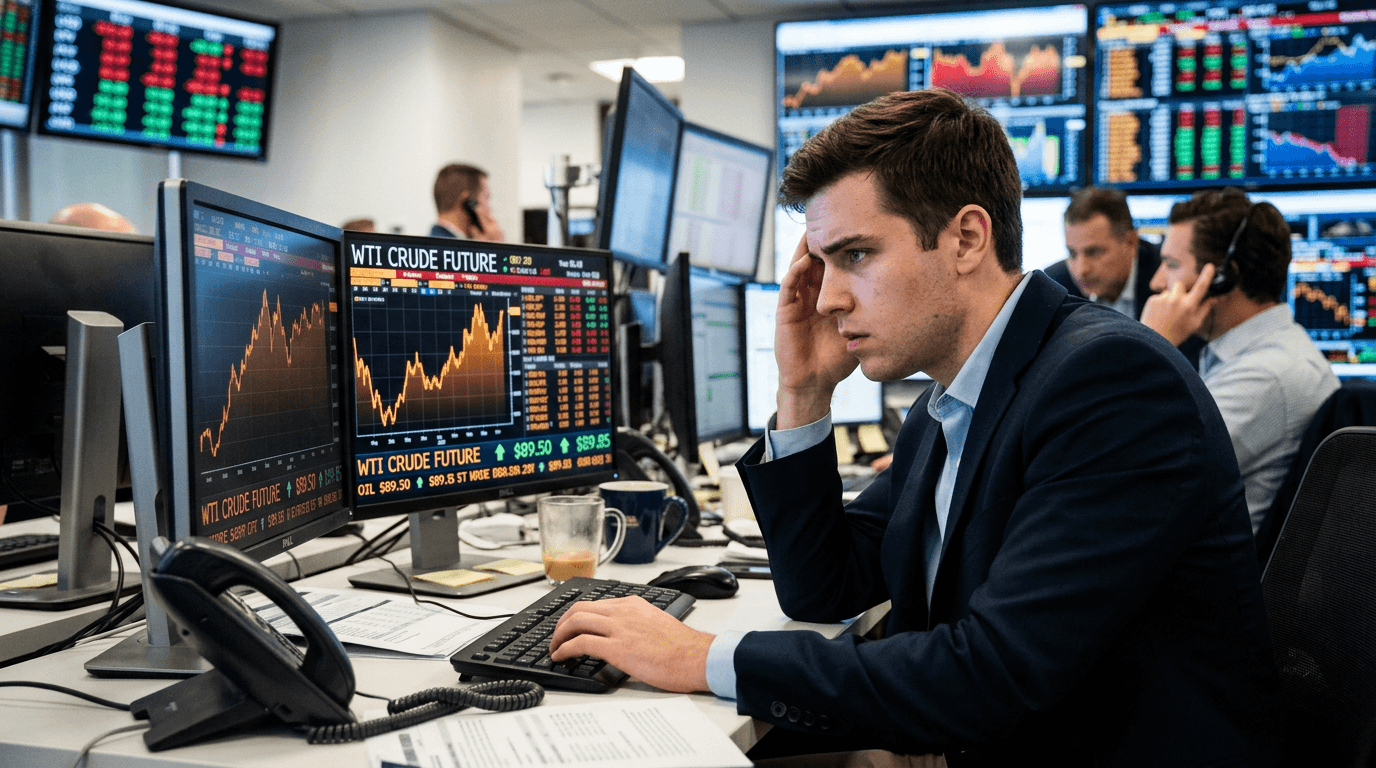
Oil markets are back in the spotlight as crude futures hover near the $90 per barrel area, a level that reflects not just supply and demand fundamentals but an elevated geopolitical risk premium. Prices have been buoyed by renewed tensions between the United States and Iran around the Strait of Hormuz, a vital shipping lane for global energy flows, keeping volatility high across oil, inflation expectations, and commodity-linked currencies.
Market Backdrop: Crude Near Recent Highs
Crude futures trading near $90 signal that the market is pricing in more than just a steady recovery in demand. This zone sits above many estimates of marginal production costs for key producers, suggesting a layer of “fear pricing” tied to geopolitical uncertainty and supply security. The move higher has followed a series of military incidents and shipping disruptions, turning what had been a relatively balanced market into one dominated by headline risk.
At these levels, oil is once again an important driver of broader financial conditions. Higher energy prices feed directly into transport, manufacturing, and consumer costs, which in turn influence inflation expectations and central bank reaction functions. For traders, the key is to distinguish between moves driven by durable shifts in supply-demand fundamentals and those driven by short bursts of geopolitical stress that may mean-revert once tensions ease.
Middle East Risk And The Strait Of Hormuz
The current risk premium is closely tied to the Strait of Hormuz, a narrow passage connecting the Persian Gulf to global markets and historically responsible for the transit of a large share of the world’s seaborne crude and gas exports. Periodic closures, blockades, or attacks on tankers have an outsized impact because alternative routes are limited and more expensive, amplifying perceived supply vulnerability.
Recent U.S.–Iran clashes in and around the strait, including reported attacks on shipping and competing claims of control over transit, have raised the specter of sustained disruption. Markets react quickly when tanker traffic slows or when either side hints at tightening its grip on the corridor. Even when the physical flow of oil remains largely intact, traders often price in the risk that a sudden escalation could interrupt supply, pushing futures higher and widening time spreads.
For energy traders, this underscores the importance of tracking not just headline prices but also physical market indicators: tanker traffic volumes, freight rates, and insurance premia. These metrics can reveal whether the market is dealing with actual flow constraints or simply repricing geopolitical risk.
Inflation, Energy Costs And Macro Markets
Oil near $90 matters far beyond the energy complex because it feeds into inflation expectations and real economic activity. Higher fuel costs raise input prices for logistics, agriculture, and industrial production, which can compress corporate margins or be passed through to consumers. In economies already grappling with elevated inflation, renewed energy pressure can complicate central banks’ efforts to bring price growth back toward target.
Bond markets tend to respond by adjusting breakeven inflation rates and term premia, particularly in economies with high energy import dependence. Equity markets, meanwhile, can see a divergence: energy producers benefit from higher prices and improved cash flows, while energy-intensive sectors—from airlines to chemicals—face margin headwinds. For traders, this creates relative value opportunities between sectors and regions, especially when oil shocks hit some economies harder than others.
SimFi traders can use these dynamics to practice cross-asset thinking. For example, a simulated scenario where sustained $90–$100 oil coincides with sticky inflation and cautious central banks forces a trader to consider not just crude contracts, but also index futures, sector rotation, and fixed-income positioning.
Commodity-linked Fx: Cad, Nok And Beyond
Crude’s strength reverberates through foreign exchange markets, particularly in commodity-linked currencies such as the Canadian dollar (CAD) and Norwegian krone (NOK). These economies derive meaningful export revenue from oil and gas, so higher prices can improve terms of trade, support fiscal balances, and in some cases strengthen their currencies relative to peers.
However, the relationship is not purely mechanical. While higher oil prices can support CAD and NOK over the medium term, risk-off episodes tied to Middle East tensions may boost demand for traditional safe havens like the U.S. dollar or Swiss franc, offsetting the positive commodity impulse. That is why periods of geopolitical stress can simultaneously see elevated oil prices and a stronger dollar, complicating straightforward “oil up, petro-FX up” narratives.
For FX traders, this environment emphasizes the importance of context. Monitoring correlations between oil and CAD/NOK, differentiating between trend moves and short-lived spikes, and considering the broader risk sentiment can help avoid oversimplified trades. Simulated trading can be particularly useful for stress-testing strategies under different combinations of oil price paths and risk appetite regimes.
How Traders Can Navigate Volatile Oil Markets
When crude trades near recent highs on geopolitical risk, disciplined process matters more than ever. Traders—whether in live markets or on a SimFi platform like E8 Markets—should focus on a few core practices:
1) Define clear scenarios: Map out base, bull, and bear cases for U.S.–Iran tensions and Strait of Hormuz disruptions. Link each scenario to expected ranges for crude, key FX pairs, and equity sectors.
2) Watch volatility, not just price: Implied volatility in oil options, risk reversals, and skew can reveal whether the market is more worried about upside supply shocks or downside demand risks.
3) Manage position sizing and leverage: Headline-driven moves can be abrupt and gap-prone. Using moderate leverage, wider but well-defined stops, and diversification across assets helps mitigate the impact of sudden swings.
4) Separate structural and tactical views: A trader may hold a structural view that global energy demand and constrained supply support higher prices over time, while tactically expecting short-term pullbacks as diplomatic efforts ebb and flow. Simulated trading is a powerful way to practice holding both views without emotional overreaction.
For newer traders, focusing first on understanding macro linkages—energy, inflation, FX, and risk sentiment—can be more valuable than trying to predict the next headline. More experienced participants can use SimFi environments to refine timing, options strategies, and cross-asset hedging.
Conclusion: Turning Volatility Into A Learning Edge
Crude oil futures hovering near $90 amid shifting Middle East risk and U.S.–Iran tensions highlight how quickly geopolitics can reprice global markets and reignite inflation concerns. Energy prices, petro-currencies, and risk assets are all part of the same macro tapestry, and traders who understand those connections are better equipped to navigate periods of stress.
For participants on simulated finance platforms, this environment is an opportunity rather than just a source of noise. Practicing scenario analysis, cross-asset thinking, and disciplined risk management in response to oil-driven shocks can build skills that transfer directly into real-world trading. The headlines may be volatile, but a structured approach to markets can turn that volatility into a valuable learning edge.