
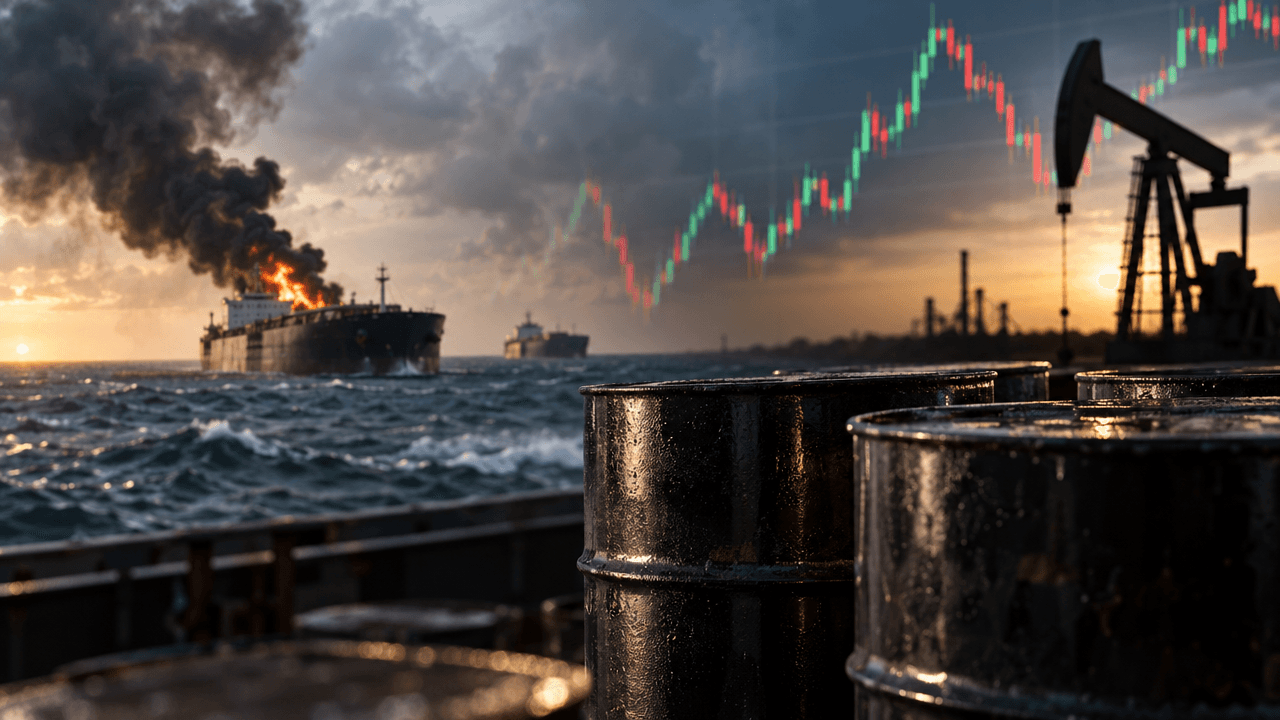
Oil prices remain caught between two powerful forces: immediate geopolitical danger and the slower-moving fundamentals of global supply and demand. Brent crude has been trading around $92–$93 per barrel, while West Texas Intermediate has hovered near $85–$86, reflecting a market that is highly sensitive to every development in the Middle East. [1][3]
The latest tension centers on tanker attacks near the Strait of Hormuz, one of the world’s most important energy corridors. Any threat to shipping through the waterway can trigger a rapid risk premium because disruptions could delay or restrict exports from major Gulf producers. Yet that premium is being limited by expectations that global production will exceed consumption during the fourth quarter.
The International Energy Agency expects fourth-quarter oil supply to average approximately 105 million barrels per day, about 1.7 million barrels per day above projected demand. [4][6] That potential surplus is giving traders a reason to sell rallies, even as geopolitical headlines create sharp short-term price spikes.
The Two Forces Driving The Market
Geopolitical risk typically affects oil prices through expectations rather than immediate physical shortages. When tankers are attacked or shipping routes become less secure, traders anticipate higher transportation costs, longer delivery times and the possibility that exporters may struggle to move crude. Futures prices can rise before a single barrel of production is lost.
The Strait of Hormuz is particularly important because it connects the Persian Gulf with the wider global market. A prolonged disruption could affect crude exports, refined products and tanker availability. Recent incidents have already increased uncertainty around shipping and pushed tanker rates sharply higher, according to the U.S. Energy Information Administration. [5]
However, the market has also seen evidence that oil flows through the region are recovering. That has reduced some of the immediate supply fears and encouraged traders to focus on the broader surplus outlook. The result is a tug-of-war: geopolitical news supports prices, while improving export flows and ample production pressure them lower.
Why The Surplus Matters
A surplus of 1.7 million barrels per day is significant because even a relatively modest imbalance can influence inventories, storage economics and producer behavior. If supply consistently exceeds demand, excess crude tends to move into storage. Rising inventories can weaken the futures curve, reduce buying urgency and make buyers more selective.
The surplus projection also changes how traders interpret disruptions. A tanker attack may still cause a sudden rally, but participants may view that move as temporary if they believe spare barrels are available elsewhere or that exports will recover quickly. This helps explain why oil prices have remained volatile rather than moving steadily higher.
Supply expectations are not fixed. They can change if Middle Eastern exports are interrupted, if producers voluntarily reduce output or if demand accelerates. Conversely, the surplus could become larger if economic growth slows, refinery activity weakens or non-OPEC production expands faster than expected.
For traders, the key question is not simply whether supply exceeds demand. It is whether the surplus will be large enough, persistent enough and geographically accessible enough to offset a regional disruption.
What Traders Should Watch
The first indicator is the actual flow of crude and petroleum products through the Strait of Hormuz. Headlines about attacks matter, but shipping data, tanker movements and export volumes provide a clearer picture of whether a temporary security incident is becoming a sustained supply problem.
The second is inventory data. U.S. crude inventories, refinery utilization and product stocks can influence WTI, while global inventory estimates are especially important for Brent. A surprise drawdown may support prices by suggesting that demand is stronger than expected. A build can reinforce the bearish impact of the projected surplus.
The third factor is the futures curve. When near-term contracts trade above later-dated contracts, the market may be pricing immediate scarcity. When later contracts are more expensive, traders may be responding to current oversupply and the cost of storing crude. Changes in the curve can reveal whether the market views geopolitical risk as temporary or lasting.
Finally, traders should monitor demand forecasts and economic indicators. Oil consumption is closely connected to transportation, manufacturing and industrial activity. Slower global growth could make the projected surplus more persistent, while stronger demand would absorb some of the additional supply.
Practical Takeaways For Simfi Traders
Volatility creates opportunity, but it also increases the risk of entering trades based on headlines alone. A disciplined approach begins with defining the market’s primary driver. If prices rise on a tanker attack but fail to hold gains, that may indicate that the supply surplus remains the dominant force.
Position sizing is especially important in a market capable of moving sharply within minutes. Traders can consider reducing exposure around major geopolitical announcements, using predefined stop-loss levels and avoiding excessive leverage. A correct market view can still produce a loss if the position is too large or the timing is poor.
It is also useful to separate directional and event-driven strategies. A longer-term bearish view based on surplus expectations does not necessarily invalidate a short-term bullish trade after a confirmed supply disruption. These are different time horizons and should be managed with different risk parameters.
For SimFi participants, the current environment is an effective test of process. Track the fundamental thesis, identify the events that would invalidate it and record whether price action confirms or contradicts the analysis. The goal is not to predict every headline, but to respond consistently when new information changes the balance of risk.
The Bigger Market Picture
Oil’s current volatility reflects a market trying to price two opposing realities at once. Gulf shipping remains vulnerable to geopolitical shocks, but production and recovering exports may be sufficient to keep the global market in surplus. Brent near the low-$90s and WTI in the mid-$80s show that traders are assigning value to both risks rather than fully committing to either outcome.
The most important development will be whether supply disruptions become prolonged enough to overwhelm the expected surplus. Until then, rallies may continue to attract sellers, while fresh attacks or evidence of falling exports may generate sudden upward moves.
For traders, the central lesson is clear: oil prices are being driven not by one headline, but by the interaction between physical flows, inventories, demand expectations and geopolitical risk. Understanding that interaction can help market participants manage volatility with greater discipline and avoid confusing a temporary price shock with a lasting change in fundamentals.